|
|
Sunday, May 11th, 2008
I was looking through my bookshelf today for something to read, and thinking, I really need something different, a change of pace. Well what caught my eye was the Inferno, which I have been meaning to read for a while -- since 2005, when I bought this translation. I read the book a long time ago, in high school, in a different translation, and maybe again in college; but I think my ear has developed enough since then that I will get a lot out of rereading it now. So here I go!
posted evening of May 11th, 2008: Respond
➳ More posts about Inferno
|  |
Friday, May 9th, 2008
Tonight we watched Crash. It's funny -- it reminded me in certain key ways of Lush Life, which I just finished reading; and my reaction to it was similar to my reaction to that book: it's a pretty gripping, entertaining story as long as you avoid thinking about the deficiencies in the plot and characterizations. If you just watch, don't think: a good movie. (In the end, not nearly as well-done a story as Lush Life, which despite having some similar defects is much more coherent.)
 A.O. Scott's review is absolutely spot-on. Here is a nice line: "Metaphor hangs in the California air like smog."
posted evening of May 9th, 2008: Respond
➳ More posts about The Movies
|  |
Wednesday, May 7th, 2008
I have been following the discussion at The Edge of the American West about using fiction in history curricula with great interest. So it was on my mind this evening as I read Pamuk's essay "Mario Vargas Llosa and Third World Literature" (from Other Colors).
Is there such a thing as Third World literature? Is it possible to establish -- without falling prey to vulgarity or parochialism -- the fundamental virtues of the literatures of the countries that make up what we call the Third World? In its most nuanced articulation -- in Edward Said, for example -- the notion of a Third World literature serves to highlight the richness and the range of the literatures on the margins and their relation to non-Western identity and nationalism. But when someone like Fredric Jameson asserts that "Third World literatures serve as national allegories" he is simply expressing a polite indifference to the wealth and complexity of literatures from the marginalized world. Borges wrote his short stories and essays in the 1930s in Argentina -- a Third World country in the classic sense of the term -- but his place at the very center of literature is undisputed.
The essay follows a pattern I have noticed in Pamuk's literary essays: he lays out a great deal of history in a very small space, leaving it to the reader to fill in the elisions. The history here is that of 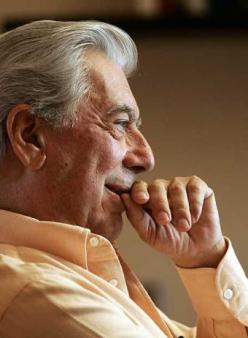 Llosa's relationship with the Existentialists (specifically Sartre, de Beauvoir, and Camus) and his break with Marxism. Of all this I know nothing besides a very general notion of Llosa as the Peruvian writer who was a radical youth but became quite conservative in his adulthood. (All I have read by the man is The Real Life of Alejandro Mayta, and that when I was very young.) Llosa's relationship with the Existentialists (specifically Sartre, de Beauvoir, and Camus) and his break with Marxism. Of all this I know nothing besides a very general notion of Llosa as the Peruvian writer who was a radical youth but became quite conservative in his adulthood. (All I have read by the man is The Real Life of Alejandro Mayta, and that when I was very young.) But Pamuk sketches the story so well, he gives me a feeling of familiarity with the actors. He makes me wish very strongly to read Death in the Andes:
This novel takes place in the abandoned and disintegrating small towns of the remote Andes -- in empty valleys, mineral beds, mountain roads, and one field that is anything but deserted -- and follows an investigation into a series of disappearances that may be murders.... Though Death in the Andes skirts tired modernist hypotheses about the Third World, it is still not a postmodern novel in the manner of, say, Pynchon's Gravity's Rainbow. ...[I]t would be wrong to dismiss it as a coarse statement about inscrutable cultures, for it is a playful and mostly witty realist text about everyday life in Peru: in short, a trustworthy history.
Which last bit I guess is what made me think about Dr. Rauchway's post linked above and the comments thereto.
posted evening of May 7th, 2008: Respond
➳ More posts about Other Colors
|  |
Tuesday, April 29th, 2008
I wrote in comments to Dr. Waterman's post at The Great Whatsit, that the first two stanzas of "To Brooklyn Bridge" had me anticipating a story -- maybe I should try and explain what I mean.  How many dawns, chill from his rippling rest
The seagull's wings shall dip and pivot him,
Shedding white rings of tumult, building high
Over the chained bay waters Liberty --
Then, with inviolate cure, forsake our eyes
As apparitional as sails that cross
Some page of figures to be filed away;
-- Till elevators drop us from our day... So: You see the seagull flying across the bay in the dawn in the first stanza -- and I think this stanza is really the most beautiful bit of the poem -- and the second gives a feeling of dropping, as if we are taking our eyes from the gull to look at the events below it. Great! We're going to have a poem describing some events on the lower Manhattan waterfront! But no; the lens never focuses after it leaves the gull. That's my complaint. "Till elevators drop us from our day" totally makes me think, "Till human voices wake us, and we drown."
 Update: Waterman suggests that at least some of the images in subsequent stanzas could be interpreted as transformations of (or references to) the seagull. This is an interesting idea.
posted evening of April 29th, 2008: Respond
|  |
|
The University of Utah press will be publishing Autobiographies of Orhan Pamuk: the Writer in his Novels, by Michael McGaha, in July. It purports to be "the first book-length study of the life and writings of Pamuk", a claim which is born out by the searching I've been doing online. So, exciting! Can't wait! It is an excellent, promising title for a book about Pamuk's novels.
posted morning of April 29th, 2008: Respond
➳ More posts about Orhan Pamuk
| |
Monday, April 28th, 2008
Well, Lush Life is seeming (⅓ of the way in) like it's not as good as I remember Freedomland being. It's a fun book, and exciting, but it doesn't really bear thinking about -- like I'm enjoying the read as long as I'm not thinking about what I'm reading. It's reminding me a lot of NYPD Blue, in that way. So, no posts about this book, I'm just going to read it without the reflection.
posted evening of April 28th, 2008: Respond
➳ More posts about Lush Life
| |
Sunday, April 27th, 2008
I'm taking a little break from the heavy European lit to read Richard Price's Lush Life. Ellen's been really enjoying it and she just finished, I'm going to dive in tonight. We've read Clockers and Freedomland previously and enjoyed them both -- if memory serves I thought Freedomland was by far the better of the two so I've got my fingers crossed that the upward trend will continue with his latest.
posted evening of April 27th, 2008: Respond
|  |
Thursday, April 24th, 2008
 Ellen and Sylvia are back home from their D.C. vacation -- they had a good trip and took plenty of pictures. Ellen and Sylvia are back home from their D.C. vacation -- they had a good trip and took plenty of pictures.
Sylvia was play-acting this afternoon and I found this snippet pretty amusing: I'm an eagle!... I'm soaring... across the ground... While she was away, Sylvia finished Further Adventures of the Great Brain, and got about halfway through Prince Caspian. (Odd combination, a little -- she has been really wrapped up in the Great Brain books lately, and she wanted to reread Caspian before the film comes out.) I'm so proud!
posted evening of April 24th, 2008: Respond
➳ More posts about The Chronicles of Narnia
| |
Wednesday, April 23rd, 2008
But Galip is insane.
--The Modesto Kid
(I'm stretching, stretching these last two chapters of the Black Book because I just don't want the story to end!)
I've become very attached to the following reading of the events portrayed in The Black Book. It seems like it might be susceptible to an Occam's Razor argument. - In Chapter 19 ("Signs of the City"), Galip goes insane.
- The second half of the book takes place in a different reality than the first; that is to say, Galip's insanity has the effect of moving him into a different world. What is happening in the old reality of the first half is not really germane to the discussion.
I'm not sure what this gets me -- I don't want to say, the events described in the second half of the book are the flow of our reality, because they seem so rooted in paranoia; and I also don't want to say, they are Galip's fevered hallucinations as he lies on a hospital bed in "the reality outside the story", because that seems banal to me.
Later, when he himself went over to Aunt Hâle's, he looked at the great purple flowers on her dress and saw that they were printed on a background that was the exact same shade of pistachio green. Was this a coincidence, or the strange leftover from thirty-five years ago, or a reminder that this world, like the gardens of memory, still shimmered with magic? Pamuk's interjection in the last chapter ("But I Who Write") is a stroke of genius. We the readers are allowed, encouraged, to privilege our own readings of the novel's events over what the author intended. This passage moves me to tears: That night, Galip saw Rüya among the baby dolls in Alâaddin's shop. She had not yet died. Like the dolls around her, she was blinking and she was breathing, but only just; she was waiting for Galip, but he was late; he just couldn't manage to get there; he just stood there at his window in the City-of-Hearts Apartments, staring at Alâaddin's shop in the distance, watching the light stream from its window onto the snow-covered pavement as tears rolled from his eyes.
posted evening of April 23rd, 2008: Respond
➳ More posts about The Black Book
| |
Monday, April 21st, 2008
I am finding this next-to-last chapter of The Black Book, "The Crown Prince", bountiful fodder for my thoughts. Thinking further tonight I reckon my initial reaction was a little hasty and missed: that Galip is insane, and so is the Crown Prince he is telling about; and that Pamuk is by no means writing a manual for healthy living -- I can make of his book what I want to, but his role as a novelist is to conjure and to describe. I was wrong about the prince only destroying western books: he also burns The Thousand and One Nights and has the Mathnawi removed from his residence -- it seems significant to me that he does not destroy this book, but that might just be me reading in.* I will remember this line when next I'm reading Rumi: "Every time he leafed through the stories in this utterly disorganized book, he found himself identifying with the dervish saint who believed disorganization to be the very essence of life." -- I have never heard that said about Rumi or about Sufi but it seems like a glorious doctrine. After battling with books and the voices inside them for ten long years, Prince Osman Celâlettin Efendi finally realized he would only become himself if he could speak in his own voice, and speak forcefully enough to drown out the voices in those books. The prince's realization here mirror's Celâl's column in Chapter 23, "A Story About People Who Can't Tell Stories" (Ooh! A-and! I had totally forgotten that his column in Chapter 16 is called "I Must Be Myself"!) -- his ultimate unspoken recognition that he is not an author, that he has no story to dictate, brings "the very silence that both men sought. Because it was only when a man had run out of stories to tell that he came close to being himself, the Prince would say." -- this Prince puts too much importance on generalizing from his own experience. Off to read some more...
 *And why no reference to the Koran?
posted evening of April 21st, 2008: Respond
| Previous posts about Readings
Archives  | |
|
Drop me a line! or, sign my Guestbook.
•
Check out Ellen's writing at Patch.com.
| |