|
|
Sunday, December 14th, 2008
In the ninth chapter of The Stone Raft I find the second explicit reference to a work of literature that I've come across in Saramago's work. (The first was in The Year of the Death of Ricardo Reis, to Borges' "Examination of the Works of Herbert Quain".) -- Pedro and Joachim are telling José about the stressful time they've had being examined by Portuguese authorities, and Joachim says (after Pedro has gone to bed), "...shall I tell you what this reminds me of, a story I read years ago entitled At the Mercy of the Quacks, Do you mean the story by Rodrigues Miguéis, That's the one." Miguéis, 1901 - 1980, was a Portuguese author and illustrator. The best source for information about him on the net in English appears to be this page at Brown University. I don't see this story in the abbreviated bibliography offered there, but there are plenty of links for further research.
posted morning of December 14th, 2008: Respond
➳ More posts about The Stone Raft
|  |
Saturday, December 13th, 2008
Over at the Fifth World they are talking about Hermann Hesse. I was reminded of how when I started reading Das Glasperlenspiel (about 13 years back or so; never finished or even got very far in), I took the narrator's attack (or what I perceived as an attack) on Crossword Puzzles very personally.  I was doing the NY Times crossword every day at the time and reading this felt like being lectured about what a waste of time and consciousness it was: I was doing the NY Times crossword every day at the time and reading this felt like being lectured about what a waste of time and consciousness it was: Übrigens gehörten, so scheint es, zum Feuilleton auch gewisse Spiele, zu welchen die Leserschaft selbst angeregt und durch welche ihre Überfütterung mit Wissenstoff aktiviert wurde, eine lange Anmerkung von Ziegenhalß über das wunderliche Thema »Kreuzworträtsel« berichtet davon. Es saßen damals Tausende und Tausende von Menschen, welche zum größern Teil schwere Arbeit taten und ein scweres Leben lebten, in ihre freistunden über Quadrate und Kreuze aus Buchstaben gebückt, deren Lücken sie nach gewissen Spielregeln ausfüllten. Wir wollen uns hüten, bloß den lächerlichen oder verrückten Aspekt davon zu sehen, und wollen uns des Spottes darüber enthalten. Jene Menschen mit ihren Kinder-Rätselspielen und ihren Bildungsaufsätzen waren nämlich keineswegs harmlose Kinder oder spielerische Phäaken, sie saßen vielmehr angstvoll inmitten politischer, wirtschaftlicher und moralischer Gärungen und Erdbeben, haben eine Anzahl von schauerliche Kriegen und Bürgerkriegen geführt, und ihre kleinen Bildungsspiele waren nicht bloß holde sinnlose Kinderei, sondern entsprachen einem tiefen Bedürfnis, die Augen zu schließen und sich vor ungelösten Problemen und angstvollen Untergangsahnungen in eine möglichst harmlose Scheinwelt zu flüchten.
(Approximately:)
In addition to the feuilleton it seems as if there were certain games, which the reading public loved and through which the information overload was started, a long communication from Ziegenhalß about the wonderful idea of crossword-puzzle deals with this. There sat at this time thousands and thousands of people, for the most part hard-working people with hard lives, bent over quadrants and crosses of characters in their free time, filling in their blanks according to certain rules. We should guard against just seeing the ridiculous or crazy aspects of this, hold ourselves back from making fun. These people with their baby-puzzles and their picture-constructions were indeed in no way harmless children or playful (?Phäaken)* Phæacians, they sat fearful in the middle of political, economic and moral agitation and earthquakes, conducted a number of horrible wars and conflicts, and their little picture-games were not simply little senseless childishness, but rather they bespoke a deep unfilled need, a need to close their eyes and flee from unsolved problems and anxious imaginings of death into a world of appearances, as harmless as ever it could be. This comes at the end of a couple of pages' discussion of the ridiculous idea of the feuilleton, which I believe means approximately "op-ed column" -- I hadn't thought of this before but it would be an interesting passage to keep in mind while reading The Black Book. Figuring out how to translate Phäaken, below the fold.
 *Phäaken is apparently the name of some kind of supernatural monster, maybe the best translation would be færies or something. Google results are mostly references to "Odysseus and the Phäaken", but all in German -- I'm not sure what part of the Odyssey this is from.... (looking at Google, looking at the Odyssey....) Aha! Never mind! It means Phæacians! I wonder what this connotes. ...I'm not totally sure of this, but I think the intended meaning is naïf: Nausicaa says,
We live too far apart, out in the surging sea,
off at the world's end --
no other mortals come to mingle with us.
(Book VI, l. 222 ff., Fagles' translation.) So if someone is a "Phæacian,"  he is callow and unfamiliar with the world -- is my best guess, anyhow. Now I've got an image in my head that's hard to shake, of a drunken Captain Haddock hurling epithets at the object of his annoyance, muttering "Flibbering Phæacians!"
↻...done
posted evening of December 13th, 2008: 2 responses
➳ More posts about The Glass Bead Game
|  |
|
In the eighth chapter of The Stone Raft, a fourth person joins the group of pilgrims -- the first female pilgrim, and the first person who was mentioned in the book -- back in the first sentence of the whole story, "When Joana Carda scratched the ground with the elm branch all the dogs of Cerbère began to bark..." This is key -- references to Ms. Carda and her elm branch have appeared throughout the story but no information about who she is, where she lives, what she was doing. Now here she is, still carrying the branch* -- she has come by train seeking the other three. The group is still one person short of the full complement -- I wonder if the final person to join them will be Maria Dolores. I'm still curious why she was given a name, when the only other characters with names are the members of this group of pilgrims. A point for research -- when José, Joachim and Pedro return to Portugal they cross the border at "the mouth of the Guadiana", which is Vila Real de Santo António; but the starlings, "swept away by the volley of gunfire from Rosal de la Frontera of bitter memory,... made a wide circle northward..." I wonder what battle is being referenced here. Something from the Spanish Civil War? Or earlier, maybe part of a border conflict between Spain and Portugal? In Lisboa, José, Joachim and Pedro stay at the Hotel Bragança, where Ricardo Reis stayed a long time ago -- the narrator references this point, saying, ...the book where that name was once registered, many, many, years ago, is stored away in the archives, covered with dust in the attic, written on a page that may never come to light, and if it should, most likely the name will be illegible, the line will be faded, or even the entire page, that's one of the effecs of time, to blot out everything. It is deemed unwise for Joana to stay in the same hotel -- the authorities have by now found out about the travelers and are giving them some grief -- so she moves in up the street, at the Hotel Borges. Ha!
 *"...which unfortunately is neither telescoping nor easily packed away, so that people stare in amazement as she passes, and the receptionist at the desk, jesting to disguise his genuine curiosity, makes a discreet reference to wands that are not walking sticks, Joana Carda responded with silence, after all, there is no law to prohibit guests from taking even a branch of Holm Oak into their room, much less a thin little stick, not even two meters long, which fits easily into the elevator and can be neatly stored away out of sight in a corner."
posted morning of December 13th, 2008: Respond
➳ More posts about José Saramago
|  |
Tuesday, December 9th, 2008
Bill of Orbis Tertius Quintus gives my thoughts on identification with authors a sympathetic link. Nice to see them framed by someone else -- gives me something to think about.
posted evening of December 9th, 2008: 3 responses
|  |
|
Returned to Pedro's house in Orce, the three travellers watch Gibraltar slipping past on TV, and get a glimpse of José's starlings -- he admits he had forgotten them on the drive. There they are now, as Unamuno described them, his swarthy face cupped in the palms of his hands, Fix your eyes where the lonely sun sets in the immense sea, all nations with the sea to the west do the same,... Interesting -- what poem of Unamuno's is this? It's a beautiful line. Google gives no hits for the phrase, "Fix your eyes where the lonely sun sets in the immense sea" -- perhaps it has not been translated precisely this way before. What is hellish about Orce? Repeatedly in the text, Saramago is describing this town as the abode of the Devil -- pictures of the region I can find on the internet seem pretty idyllic though. This is where Pedro asks to join the travellers in their journey.
posted evening of December 9th, 2008: Respond
➳ More posts about Miguel de Unamuno
| |
Sunday, December 7th, 2008

They are seated on the ground, under a Cordoban olive tree, the kind that, according to the popular quatrain, makes the oil yellow, as if olive oil weren't yellow, or only occasionally slightly greenish...
Any ideas what the popular verse referenced is? Google's not doing much for me. Is Cordoban/Cordovan a variety of olive in addition to being a place where olives are grown?
posted evening of December 7th, 2008: Respond
|  |
|
I sort-of knew that Spain does not have sovereignty over Gibraltar. I would have needed some kind of prompt to remember it though. Saramago gave me the prompt today, when he had Gibraltar break away from the Iberian peninsula, remaining with Europe as Iberia floats away. Strikes me as hilarious, to have the supernatural tectonic forces in the novel respect political boundaries rather than just physical ones. (Taking the Pyrenees as a natural physical boundary.) So: it was interesting to see the Spaniards celebrating the departure of Gibraltar. I got the sense this passage was intended in fun -- I am curious to know what the Spanish national attitude toward British sovereignty there is. (Another point of sovereignty I found out about in today's reading is the dispute over Olivenza in Badajoz, which Portugal does not officially recognize the Spanish claim to. Joachim Sassa's car is not interested in seeing Gibraltar, since as a Portuguese car, "his ancient grief is Olivença, and this road does not lead there.")
Work on the Stone Raft Map proceeds apace -- this is really fun and will make a useful companion to the book.
posted afternoon of December 7th, 2008: 2 responses
|  |
Saturday, December 6th, 2008
Near the end of the fifth chapter of The Stone Raft, José and Joachim are in a tourist office in Granada getting directions from the newly introduced* Maria Dolores, who describes herself as "an anthropologist by training and a militant feminist by inclination." She asks if they are doing research on Orce Man, the fossilized skull discovered "some years ago" which is the oldest human fossil found yet in Europe. There is an article about Orce Man at talkorigins.org which says it was discovered in 1982 and that in 1984 a symposium about it was cancelled when French scientists suggested the skull was probably not human. So perhaps this narrows down the setting of the novel to sometime around late 1983 or early 1984? It was published in 1986.
*(Anyway I don't think she was mentioned in the first chapter. Should go back and double-check.)
posted evening of December 6th, 2008: Respond
|  |
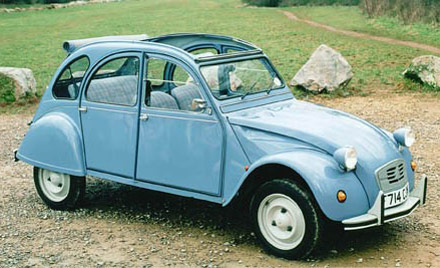 Citroën Deux Cheveaux -- Joachim's wheels. I'm trying to embed it here but haven't quite figured that out yet. Embedded map is below the fold.
posted evening of December 6th, 2008: Respond
| |
|
So I'm thinking The Stone Raft may benefit, as The Black Book did, from a Google Maps approach to reading. I find myself struggling to remember which character lives where, and wondering about the course of their journey and the landmarks they see along the way. I'm thinking it would make sense to create a Google Maps view of Spain and Portugal with markers for locations referenced in the novel. A sampling of locations and landmarks I did not recognize from the fifth chapter would include among other things, Orce (a village in Granada and apparently the spot where the oldest human remains in Europe were found), Aracena (the town where Joachim and José spend the night), the Giralda (a public work of art of some kind in Seville*)... Also I need to find out who the Spanish poet Antonio Machado is, whom I believe I have seen referenced in Saramago before.
*Update: the Giralda is actually a piece of architecture, a bell tower -- depending on how loose your definition of "public work of art" is, it might fit; I had been thinking it was a statue.
posted evening of December 6th, 2008: Respond
| Previous posts about Readings
Archives  | |
|
Drop me a line! or, sign my Guestbook.
•
Check out Ellen's writing at Patch.com.
| |