|
|
Thursday, January 29th, 2009
In truth, we can only read the maps of cities we know. In my case, for example, and first and foremost, Buenos Aires. The problem is, under normal circumstances, a map plays a kind of trick on us, because if we know a city well, any detail it shows us will be either redundant or limited. Come to think of it, that describes the relationship I have with Buenos Aires: redundancy and insufficiency.-- Sergio Chejfec, My Two Worlds
This line really captures my imagination. I've always liked looking at maps -- I'm very familiar with the distinction between looking at a map of familiar territory and looking at a map of somewhere I've never been (and the gradations of experience in between), but I would never have thought of expressing it this way. I love the idea that home is necessarily redundant and insufficient.
posted evening of January 29th, 2009: Respond
➳ More posts about My Two Worlds
|  |
|
Sergio Chejfec turned out not to be the highlight of the evening. His work -- the portion of it that is excerpted in BOMB -- is lovely and introspective; but because it is introspective it did not lend itself to being read aloud. You want room for your mind to wander while you're reading it. My favorite thing I heard this evening was the poetry of Nicanor Parra, read by his translator Liz Werner from the recent book Antipoems: How to Look Better & Feel Great. For instance, from the poem "Something Like That": THE TRUE PROBLEM of philosophy
is who does the dishes
nothing otherworldly
God
the truth
the passage of time
absolutely
but first, who does the dishes
whoever wants to do them, go ahead
see ya later, alligator
and we're right back to being enemies Also very nice to listen to was Lina Meruana's short story "Ay" -- she writes a flowing, engaging narrative that pulled me in. She only read the first half of the story but it was enough to make me want to read the rest of it on the train coming home. Raúl Zurita was also there, reading some oddly dream-like poems about the coup of 1973 and about Akira Kurosawa; he has one of the most pleasant reading voices I've ever heard -- it was almost hard to get past the immediate sensory delight of listening to him speak, to get at the content of the poems. Zurita also has a piece in this issue of BOMB about Nicanor Parra, sort of bringing me full circle.
posted evening of January 29th, 2009: Respond
➳ More posts about Sergio Chejfec
|  |
|
I'm looking forward to hearing Sergio Chejfec reading this evening, and hope to buy a copy of his book. And I just found out, he is blogging, and has been since 2006! His blog is Parábola Anterior -- mostly in Spanish, the top article AOTW is translated into English by Margaret Carson (who translated My Two Worlds and will be at the event tonight). At LanguageHat's site, I asked how his name is pronounced; Bill Walderman notes that the name is the Polish spelling of Heifetz.
posted afternoon of January 29th, 2009: Respond
|  |
Wednesday, January 28th, 2009
I commented at The Great Whatsit today that I was not finding the second and third books of the His Dark Materials series quite as  overwhelmingly great as I found the first. But as of the reading I did with Sylvia tonight -- chapter 2 of The Amber Spyglass -- I want to take that back, and just say the middle book is a lull between two masterpieces. The beauty of the narrative here is just enough to take my breath away. overwhelmingly great as I found the first. But as of the reading I did with Sylvia tonight -- chapter 2 of The Amber Spyglass -- I want to take that back, and just say the middle book is a lull between two masterpieces. The beauty of the narrative here is just enough to take my breath away. I am realizing that these books could be made into a truly fantastic series of movies if only the studios were not so attached to live action and CGI -- I think they are a perfect match for anime (or maybe I mean "for Studio Ghibli", which is about the sum total of my exposure to anime). Reading about Will talking to Balthamos and Baruch, especially the fight against Metatron, was bringing visions of Spirited Away flickering across my mind. Metatron is even a perfect name for an anime bad guy! I also noticed a couple of coincidences of imagery with Cien Años de Soledad, which I take as a very good sign -- I am absorbing enough of the book even without knowing the language well, for it to be on my mind when I'm not reading it. When the narrator noted that Will's knife could cut between worlds but could not "abolish distance within worlds," I immediately flashed on Melquíades' statement that "la ciencia ha eliminado las distancias"; and when Will's boots were sinking into the soft sand in the hot, humid new world, my mind jumped to "aquel paraíso de humedad y silencio,... donde las botas se hundían en pozos de aceite humeante..."
posted evening of January 28th, 2009: Respond
➳ More posts about His Dark Materials
|  |
Tuesday, January 27th, 2009
Finalists for 3%'s 2008 awards are announced today for fiction and poetry. The fiction list includes a couple of books that are on my reading list, nice; and I'm glad to see Death with Interruptions did not make the list -- it seemed out of place on the long list. Interesting stuff in poetry too.
posted morning of January 27th, 2009: Respond
|  |
Sunday, January 25th, 2009
Tonight Sylvia and I started in on the final book of the His Dark Materials trilogy, The Amber Spyglass. Just at the outset I noticed Mrs. Coulter's monkey dæmon doing two things that I hadn't seen other characters' dæmons doing before this. One is eating; when the monkey is introduced on the second page, he is picking apart pinecones to get the sweet nuts. Dæmons have never been shown yet eating; I was sort of assuming that as spiritual beings (or as expressions of their humans' spirits) they did not need to. The other is acting as a sort of babelfish -- when Ama tries to speak to Mrs. Coulter in her own (unspecified but not fully understood by Coulter) language, Mrs. Coulter instead has Ama's dæmon speak to the monkey, and there is no linguistic barrier to this kind of communication. Mrs. Coulter instead has Ama's dæmon speak to the monkey, and there is no linguistic barrier to this kind of communication. So, huh. These are two pretty big deals, especially the second, and I wonder why neither one has come up in the trilogy to date. The language thing would be one (incomplete) way of answering the question I asked earlier about communication in this world. But if dæmons can do that, why are there language barriers at all? Possibly (a) only the golden monkey can do this -- he has repeatedly been characterized as different from other dæmons -- or (b) only Mrs. Coulter knows that dæmons can do this.
posted evening of January 25th, 2009: Respond
➳ More posts about Sylvia
|  |
|
At emol.com there is a site dedicated to Cien Años de Soledad -- it is a Flash application so  I can't link to pages inside it; but if you click "Entrar" and watch the lovely video of mariposas amarillas, and then click "Fragmentos", several recorded readings of passages from the book are available, along with the text being read. Following each reading is some discussion of the passage; I am not understanding Spanish well enough yet to follow that. I can't link to pages inside it; but if you click "Entrar" and watch the lovely video of mariposas amarillas, and then click "Fragmentos", several recorded readings of passages from the book are available, along with the text being read. Following each reading is some discussion of the passage; I am not understanding Spanish well enough yet to follow that.
 Another useful page is Macondo at The Modern Word -- a huge trove of links and information about the author and his works.
posted morning of January 25th, 2009: Respond
➳ More posts about Cien años de soledad
| |
Saturday, January 24th, 2009
Edmond Caldwell responds with some very thoughtful commentary to my post on Baroque fiction. I was happy, and a little surprised, to see that what I have in mind and am venturing to express as "Baroque" is broadly similar to what he was thinking about when he used the term last month.
The only place where I might depart from you've written is in the idea that this entails a canceling out individual "free-will" (if I'm even correct that that is what you're saying; forgive me if I've got it wrong), because I think that's still looking at the situation through the old humanist lens (in which it's an either/or question, one either has self-originating "free will" or one is subject to iron determinism, like a puppet). I think the baroque sentence is more dialectical than this; that human agency is deeply or even thoroughly conditioned means perhaps not that it doesn't exist but that it is more collective than we thought. This is a good point and makes me realize that I wasn't thinking clearly this morning when I tried writing about the fatalism in Of Love and Other Demons. Of course there is not a binary distinction between "human actors possessed of free will" on the one hand and "pre-programmed robots" on the other -- there is a pretty broad spectrum of how self-directed a character's actions can seem. (And of course I am getting uncomfortable talking on and on about characters with or without free choice, without acknowldeging that there is an author behind them making the decisions...) I really liked Mr. Caldwell's idea (if I'm understanding him right) that the individual characters in this type of novel can be seen as being subsumed in a kind of collective consciousness which is directing their actions.
posted evening of January 24th, 2009: 2 responses
➳ More posts about Of Love and Other Demons
|  |
|
I checked out Cien Años de Soledad from the library today -- not sure how far I'm going to be able to get with it, but I'm having fun with it. So far I have gotten to where I can read the first two paragraphs (about 5 pages) pretty fluently; I've been going back over them to try and work the vocabulary into my brain before I move on. I was made very happy by the sentence, "El mundo era tan reciente, que muchas cosas carecían de nombre, y para mencionarlas había que señalarlas con el dedo." -- "The world was so new, many things did not yet have a name, and in order to mention them, you had to point them out with your finger." I loved this sentence when I read the book in English but had forgotten it. I am curious about what exactly accent marks do in written Spanish. Are they optional? In these first 5 pages there are several instances of aun and aún, which seem to be the same word and pronounced the same way. Maybe there's a subtle distinction I'm not picking up on. And I seem to recall seeing solo both with and without an accent over the first "o".
 ...Well this page solves at least one piece of the puzzle; accent marks are not optional, and "sólo" means something different from "solo" ("only" vs. "alone") -- it doesn't mention "aun," but I'm assuming there is a subtle difference in meaning between the two spellings. That distinction looks pretty synthetic to me; forcing different spellings for what is essentially a single word, according to how it is used in a sentence. Seems like it must be a pretty common mistake to leave the accent off of "sòlo" or put one onto "solo". ...Okay: this page says, "The word aún means todavÃa or still, while aun means incluso or even." So, problem solved, I guess.
posted evening of January 24th, 2009: 10 responses
➳ More posts about Gabriel García Márquez
| |
|
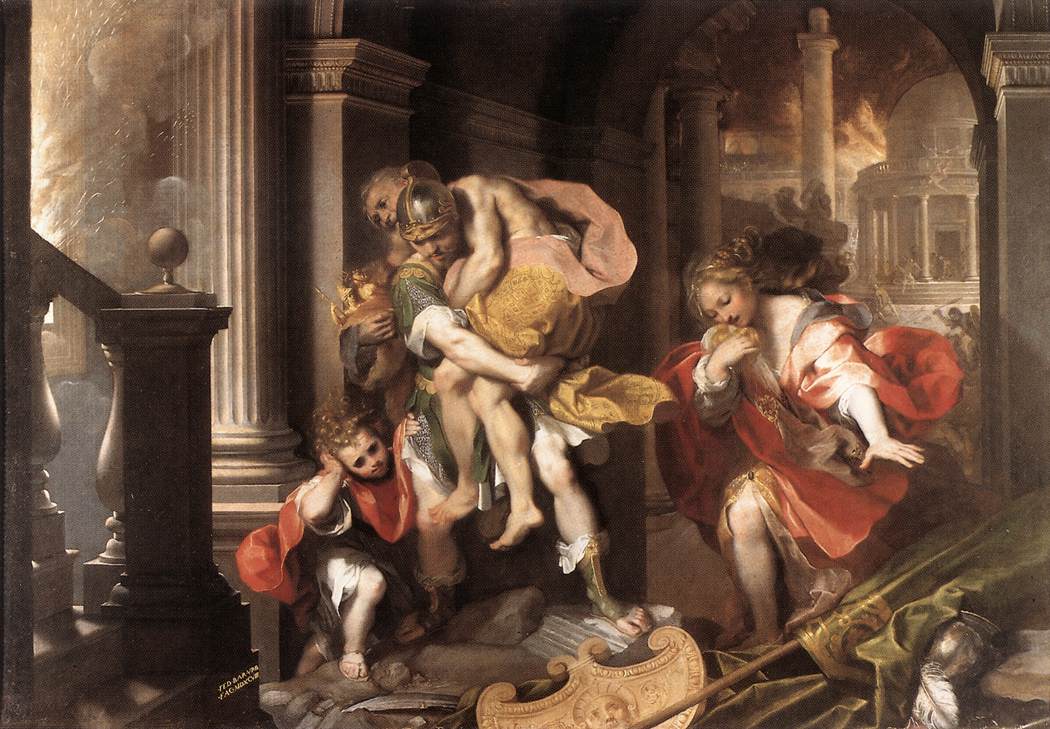 I've been using the adjective "sensual" to describe the style of writing in Of Love and Other Demons, and I find that I had earlier called a similar quality in Absalom, Absalom! "painterly." Hm: what if I called this quality "Baroque," would that work? I believe the term connotes a lot of what I am trying to communicate. Rich, lush, ornate detail; depiction of extravagant beauty. The shade of meaning I'm trying for is: gorgeous visual/sensory descriptions that point you* toward a feeling of fixed destiny, of an absence of free will. Is that too much work for such a little word to do? Feelin' like Humpty-Dumpty... I've been using the adjective "sensual" to describe the style of writing in Of Love and Other Demons, and I find that I had earlier called a similar quality in Absalom, Absalom! "painterly." Hm: what if I called this quality "Baroque," would that work? I believe the term connotes a lot of what I am trying to communicate. Rich, lush, ornate detail; depiction of extravagant beauty. The shade of meaning I'm trying for is: gorgeous visual/sensory descriptions that point you* toward a feeling of fixed destiny, of an absence of free will. Is that too much work for such a little word to do? Feelin' like Humpty-Dumpty...
Note: I have recently seen the term "Baroque" used in a literary context, if memory serves by Chad Post,** to describe the long, syntactically ornate sentences used by e.g. Saramago or Castellanos Moya. This may be why I'm thinking of the term right now; it is not however the quality I'm seeking to describe. No reason the two qualities couldn't exist side-by-side in the same work; but they seem to me completely independent of one another. Another thought, maybe the term to use is "Baroque tragedy" -- Baroque to betoken the gorgeousness of the descriptions, tragedy for the fatalism. This might work. I see however that this term is already in use.
 * (Somehow: I'm still trying to figure out how this pointing works.) ** Nope: it was Edmond Caldwell. Curse you, memory!
posted morning of January 24th, 2009: 3 responses
| Previous posts about Readings
Archives  | |
|
Drop me a line! or, sign my Guestbook.
•
Check out Ellen's writing at Patch.com.
| |
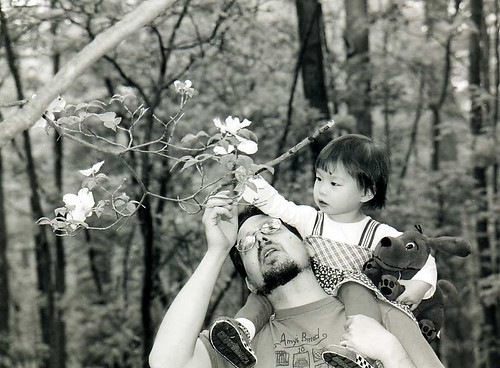


 Dave Barber of The Great Whatsit