|
|
Monday, March 23rd, 2009
 Orhan Pamuk was awarded an honorary doctoral degree by the University of Rouen last week; in his acceptance speech, he reflects on the modernist ideal of the reclusive author, and what he and other authors have taken from Flaubert. h/t LanguageHat. Orhan Pamuk was awarded an honorary doctoral degree by the University of Rouen last week; in his acceptance speech, he reflects on the modernist ideal of the reclusive author, and what he and other authors have taken from Flaubert. h/t LanguageHat.
posted morning of March 23rd, 2009: Respond
➳ More posts about Orhan Pamuk
|  |
|
By way of Saramago's Notebook,  I see that Mauricio Funes, of the FMLN, has been elected President of El Salvador; ARENA will leave office peacefully after 2 decades in power. This strikes me as fantastic news. In El PaÃs, MoÃses NaÃm speculates as to whether the new center of power in Latin America will be Hugo Chávez of Venezuela, or Luiz Inácio Lula da Silva of Brazil. It is natural to think an FMLN victory would give Chávez more influence; and Lula's recent meeting with Obama can be seen as the end of "a long period of disengagement between the US and Latin America." I see that Mauricio Funes, of the FMLN, has been elected President of El Salvador; ARENA will leave office peacefully after 2 decades in power. This strikes me as fantastic news. In El PaÃs, MoÃses NaÃm speculates as to whether the new center of power in Latin America will be Hugo Chávez of Venezuela, or Luiz Inácio Lula da Silva of Brazil. It is natural to think an FMLN victory would give Chávez more influence; and Lula's recent meeting with Obama can be seen as the end of "a long period of disengagement between the US and Latin America."
Saramago notes that Mauricio Funes shares his surname with Funes the Memorious, and advises him:
...Thousands of men and women [have witnessed] at last, the birth of hope. Do not disappoint them, Mister President. The political history of South America breathes deception and frustration, whole peoples tired of lies and deceit; it is time, it is urgent that all that change.
posted morning of March 23rd, 2009: 1 response
➳ More posts about Politics
|  |
Thursday, March 19th, 2009
By way of Scott Esposito, I see that two more novels of Horacio Castellanos Moya will be published in translation this year: She Devil in the Mirror and Dances With Snakes. Exciting! and searching around for more information about the novels, I notice Dr. Albrecht Buschmann of the Universität Potsdam maintains a fairly extensive site devoted to Castellanos Moya's work: Horacio Castellanos Moya: Hechos, Libros, Temas (bilingual in German and Spanish, with the occasional page translated into English). The site appears to be dedicated to reading his work as a literature of the survivor: "Reading the more important novels of Horacio Castellanos Moya may leave the impression that all of his protagonists are damaged goods... Figures with mutilated identities, deteriorated memories, who interact frequently with a choice between themselves exerting violence or being made into victims of violence, when they try to survive. For this is certainly what they intend to do: survive."
posted evening of March 19th, 2009: Respond
➳ More posts about Horacio Castellanos Moya
|  |
Wednesday, March 18th, 2009
At Orbis Quintus today, I found Maureen Freely's new Washington Post piece on translating Pamuk, on trying "to recreate the narrative trance that makes the novel so hypnotic in Turkish." It's a lovely essay, a look into the translator's creative experience -- at the "shadow novelist [who is] present in every translator. Though she must serve the text, she can recreate the author's voice only if she gets so close to the heart of the novel that she can convince herself it briefly answers to hers." (Now I'm just dying to hear from Gün and from Göknar...) At the same page is an audio clip of a conversation between Freely and the Post's writer-at-large Marie Arana.
posted evening of March 18th, 2009: Respond
|  |
Sunday, March 15th, 2009
I've been meaning to post this passage from The Amber Spyglass, which I found deeply moving and which I think sums up the entire trilogy in a couple of paragraphs. I don't have much to say about it beyond that, so will just quote. (Note: if you are reading or planning to read the series and do not like spoilers, don't read this entry.) The setting is the world of the dead; Lyra and Will are planning to create an opening which will allow the ghosts of the dead to escape into the world of the living, that they might be annihilated, allowed truly to die. Long quote below the fold.
↷read the rest...
posted morning of March 15th, 2009: 5 responses
➳ More posts about His Dark Materials
|  |
|
 How I come to be reading The Hobbit now: Sylvia and I are pretty close to finishing up The Amber Spyglass now; I was casting about for what book to read next and realized that His Dark Materials is reminding me in some key ways of Tolkien's trilogy. That made me think about how much I had loved The Hobbit as a kid -- if memory serves I loved it much more deeply than the trilogy, it seems like I read The Lord of the Rings less whole-heartedly, with an eye mostly toward keeping up with my D&D-enthusiast friends... Anways -- so I asked Sylvia if she would like to read this next, she said she would (unsurprising -- she's really getting into fantasy novels nowadays), and I thought I would look through it beforehand. How I come to be reading The Hobbit now: Sylvia and I are pretty close to finishing up The Amber Spyglass now; I was casting about for what book to read next and realized that His Dark Materials is reminding me in some key ways of Tolkien's trilogy. That made me think about how much I had loved The Hobbit as a kid -- if memory serves I loved it much more deeply than the trilogy, it seems like I read The Lord of the Rings less whole-heartedly, with an eye mostly toward keeping up with my D&D-enthusiast friends... Anways -- so I asked Sylvia if she would like to read this next, she said she would (unsurprising -- she's really getting into fantasy novels nowadays), and I thought I would look through it beforehand.
And I'm falling in love all over again. I had forgotten how attractively witty and cultured Tolkien's narrative voice is -- it reminds me a lot of Grahame's voice in The Wind in the Willows. I wonder if this is true of the trilogy as well -- I expect it is, and suddenly I'm looking forward to rereading those books, and thinking I might get a lot more out of them than I did back in my childhood.
posted morning of March 15th, 2009: 4 responses
➳ More posts about The Hobbit
| |
Friday, March 13th, 2009
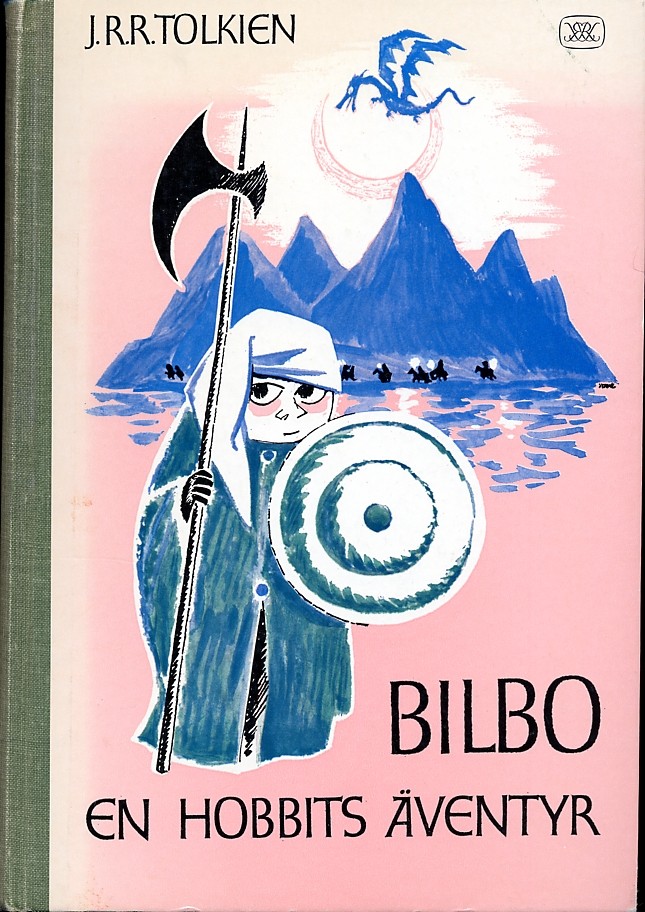 My memory of reading The Hobbit (which happened about 30 years ago) has always been a very positive one, of being into the book in a pre-analytical way and just loving it, and I was always scared to pick it up to reread for fear that quality of the experience would be gone. I am happy to report (a few chapters in) that the quality is not only present but is augmented by seeing the page with a little more experienced (hopefully wiser but certainly more familiar with the world) eye. My memory of reading The Hobbit (which happened about 30 years ago) has always been a very positive one, of being into the book in a pre-analytical way and just loving it, and I was always scared to pick it up to reread for fear that quality of the experience would be gone. I am happy to report (a few chapters in) that the quality is not only present but is augmented by seeing the page with a little more experienced (hopefully wiser but certainly more familiar with the world) eye.
 Don't miss Tove Jansson's illustrations for a Swedish edition of The Hobbit. (And it just occurs to me, oh yeah! Hobbits and Moomins have certain distinct similarities! Also Hobbits and Hemulens.)
posted evening of March 13th, 2009: Respond
➳ More posts about J.R.R. Tolkien
| |
Sunday, March 8th, 2009
Saramago posts today about International Women's Day:
I've just been watching the TV news, demonstrations by women all over the world, and I'm asking myself one more time what disgraceful  world this is, where half the population still has to take to the streets to demand what should be obvious to everyone... world this is, where half the population still has to take to the streets to demand what should be obvious to everyone...
They say that my greatest characters are women, and I believe this is correct. At times I think the women whom I've described are suggestions which I myself would like to follow. Perhaps they are just models, perhaps they do not exist, but one thing I am sure of: with them, chaos could never have established itself in this world, because they have always known the scale of the human being.
I'm not completely sure about the translation in that last paragraph; it sounds pretty stilted the way I have written it. Possibly this is true of the original as well -- "chaos could never have established itself in this world" strikes me as a very strange thing to say, when the world is fundamentally chaotic -- and I don't see Saramago's women as imposers of order on natural chaos. This may be a clue into Saramago's understanding of the universe; I could see a reading of The Stone Raft in which the world is understood as an inherently ordered structure, and the characters (male and female, but particularly Joana) are keyed in to this natural order in opposition to humanity's chaos. Alternately I could be mistranslating, always a possibility.
posted evening of March 8th, 2009: Respond
➳ More posts about Saramago's Notebook
| |
Friday, March 6th, 2009
 I got in touch with the friend to whom I loaned Blindness; she sent me the authorized translation of the epigraph I've been wondering about for the past few days. I got in touch with the friend to whom I loaned Blindness; she sent me the authorized translation of the epigraph I've been wondering about for the past few days.
If you can see, look.
If you can look, observe. This is just right -- "If you can see" makes much better sense as an opening phrase than "If you can look"; and then on the second line, "If you can look" reads alright because you already have the structure set up to understand it in.
Saramago attributes this line to the "Book of Exhortations", which if I'm understanding right is Deuteronomy. It would be interesting to find out where it is in that book and see how e.g. the King James translation renders it. ...Looking further, it seems like "Book of Exhortations" is a pretty generic term -- it can refer to a lot of different prophetic writings. I wonder what Saramago's source for this line is. Update: Further investigation of the source here.
posted morning of March 6th, 2009: 2 responses
➳ More posts about Blindness
|  |
Thursday, March 5th, 2009
Saramago takes another look at the epigraph, and makes me understand that I had been misreading it in a key way:
In a conversation yesterday with Luis Vázquez, closest of friends and healer of my ailments, we're talking about the film by Fernando Meirelles, just premiered in Madrid, even though we could not be in attendance, Pilar and I, as we intended to be, for a sudden bout of chills obligated me to retire to my chamber, or confined me to bed, in the elegant phrasing in use not so long ago. The conversation soon turned to the public's reactions during the exhibition and afterwards, highly positive according to Luis and to other trustworthy witnesses... We moved from there, naturally, to talking about the book and Luis asked me if we could look over the epigraph which opens it ("Si puedes mirar, ve, si puedes ver, repara"), for in his opinion, the action of seeing [ver] encompasses the action of looking [mirar], and therefore, the reference to looking could be omitted without bias to the meaning of the phrase. I could not come up with a reason to give him, but I thought that I should have other reasons to consider, for example, the fact that the process of vision occurs three stages, successive but in some manner autonomous, which can be stepped through as follows: one can look and not see, one can see and not observe, according to the degree of attention which we pay to each of these actions. We know the reaction of a person who, having just checked his wristwatch, returns to check it when, at that moment, somebody asks him the time. That was when light flooded into my head concerning the origin of the famous epigraph. When I was small, the word "observe", always supposing I already knew it, was not for me an object of primary importance until one day an uncle of mine (I believe that it is Francisco Dinis of whom I am speaking in this brief memoir) called my attention to a certain way of looking that bulls have, which almost always, he then demonstrated, is accompanied by a certain way of raising the head. My uncle said: "He has looked at you, when he looked at you, he saw you, and now it is different, he is something else, he is observing." This is what I told Luis, which immediately won the argument for me, not so much, I suppose, because it convinced him, but because the memory made him remember a similar situation. A bull looked at him as well, and again this movement of the head, again this looking which was not simply seeing, but observation. We were at last in agreement.
So, reparar is not "fix" as I had been thinking, but "observe" or "contemplate". The dictionary entry confirms that the word can be used in this sense. I'm still (like Luis) a bit dissatisfied with the relationship between mirar and ver in the first part of the epigraph.
posted evening of March 5th, 2009: 1 response
➳ More posts about José Saramago
| Previous posts about Readings
Archives  | |
|
Drop me a line! or, sign my Guestbook.
•
Check out Ellen's writing at Patch.com.
| |


 Kate Beaton has two posts up today about the War of 1812: a