|
|
Wednesday, April 22nd, 2009
I've been enjoying having vivid dreams lately. I still do not remember nearly as many or as much of them as I would like, but the experience of dreaming them is very entertaining. It is starting to seem like an obvious choice to re-read Burroughs' My Education: a Book of Dreams, which is a pasting together of thirty years of his dreams, with some conversational writing in between talking about dreams, sometimes noting the circumstances of a dream, never analyzing the content of the dream. I read this quickly when it came out 14 years ago but did not, perhaps, let it sink in enough. Opening it now and looking at some of the dream passages, I notice Burroughs is not making any kind of effort to persuade me of the reality of the dream; instead he is flatly asserting he had this dream, and leaving it up to me to put myself in the dreaming head so that I can experience it. I'm up in a room with a high ceiling and a door at one end. The room is full of light and has a feeling of being open and airy. I float up to the ceiling and bob along to the door and out. There is a porch or balcony over the room and now I am up under the porch about thirty feet off the ground. I move out from under the porch and pick up speed and direction. Very little descriptive language, just a straight narration of the events in the dream. This is seeming at first glance like exactly the right way to present dreams. The style and furnishing of the room, the sensation of floating, the colors in my field of vision are all for me to experience for my own part as I in effect have the dream I'm reading about.
posted evening of April 22nd, 2009: Respond
➳ More posts about My Education
|  |
Tuesday, April 21st, 2009
I dreamt last night, at first, that I had made my way to Santiago and had sought out a famous poet (I cannot remember who; he was also a professor of literature) with the idea that he was going to enlighten me about Chilean poetry. We were sitting in the (oddly very noisy) university library and I was asking him, in better Spanish than I speak but still hardly fluent, to show me which books I should read to learn about poetry in Chile -- as we walked up the staircase I specified, yelling to make myself heard over the din, that I was interested in the latter half of the twentieth century. He brought me to the shelf of books on the topic; there was very little there, maybe 20 dog-eared books, half of them in translation -- it seemed very strange to me. I picked up the heavy Oxford Companion to Chilean Verse and started leafing through it. In the second half of the dream I was debugging a web server I had written to render the work of Nicanor Parra. (Highly specialized, yes.) Sylvia and her friend Giulia came in and wanted to read the poems, also they wanted to play baseball -- I gave them the computer and while swinging their bats, they read three short poems about morning -- the poems were lovely, though they did not sound much like Parra; the only one I remember is: On my birthday I arose
And drank the subtle
Health of morning.
posted morning of April 21st, 2009: Respond
➳ More posts about Dreams
|  |
Saturday, April 18th, 2009
I am finding book IV of The Lord of the Rings, the story (so far) of Frodo, Sam and Sméagol journeying towards Mordor, to be the most compelling reading of the first two volumes. I'm really tuned in to each of the three characters and sensitive to what's happening with them. In most of the rest of the book I have been liking it more as a visual experience -- a painting of words -- than as a story. I am very much in awe of Tolkien's ability to create a world, even if the story is not always making it for me -- this is making me feel good about the idea of reading the Silmarillion next, which I understand to be mostly world-creation rather than story. I found this dialogue between Frodo and Faramir (at the end of Chapter 6) very moving -- suddenly this style of writing dialogue, which has been seeming very stilted to me, is making sense:
‘...Do not approach their citadel. ...It is a place of sleepless malice, full of lidless eyes. Do not go that way!’
"But where else will you direct me?" said Frodo. "You cannot yourself, you say, guide me to the mountains, nor over them. But over the mountains I am bound, by solemn undertaking to the Council to find a way or perish in the seeking. And if I turn back, refusing the road in its bitter end, where then shall I go among Elves or Men? Would you have me come to Gondor with this Thing, the Thing that drove your brother mad with desire? What spell would it work in Minas Tirith? Shall there be two cities of Minas Morgul, grinning at each other across a dead land filled with rottenness?" "I would not have it so," said Faramir. "Then what would you have me do?" "I know not. Only I would not have you go to death or to torment. And I do not think that Mithrandir would have chosen this way." "Yet since he is gone, I must take such paths as I can find. And there is no time for long searching."
Some bits of the language in the book are coming back to me from my previous reading of it. I seem to remember that when I read Chapter 9 of book III, "Flotsam and Jetsam", that was the first time I had ever seen those terms, and I looked them up in the dictionary and endeavored to throw them into conversation for the next little while. (If memory serves the distinction is that flotsam is wreckage floating away from the wrecked ship, where jetsam is wreckage that was jettisoned from the ship prior to its sinking.) I remember the name "Morgul" but thought somehow it was the name of an evil character or species, not part of an evil city's name... Either way it is certainly a bad-sounding handle.
posted evening of April 18th, 2009: 1 response
➳ More posts about The Lord of the Rings
| |
Monday, April 13th, 2009
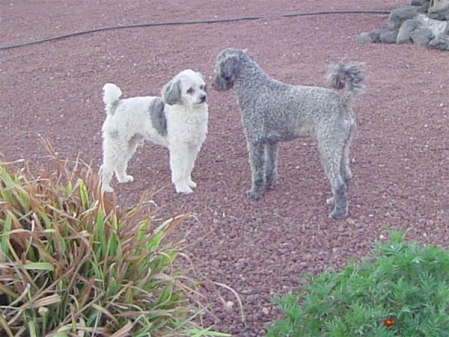 Last month, Saramago wrote a note about his dogs Camões and Pepe, and speculated that a Portuguese dog in the White House would be "an important diplomatic success, from which Portugal should work to get the maximum advantage in its bilateral relations with the United States..." -- today Bo is in the White House -- "the Great Danes and the hounds of Pomerania are dying of envy" -- but Saramago is critical: Last month, Saramago wrote a note about his dogs Camões and Pepe, and speculated that a Portuguese dog in the White House would be "an important diplomatic success, from which Portugal should work to get the maximum advantage in its bilateral relations with the United States..." -- today Bo is in the White House -- "the Great Danes and the hounds of Pomerania are dying of envy" -- but Saramago is critical:
In any case, allow me to say that I have a serious reservation that I must express: one cannot have any idea what a Portuguese Water Dog is, to put around his neck, to photograph him, a collar of flowers, as if he were a Hawai`ian dancer. At only six months of age, Bo is not yet fully aware of the respect that he owes the canine branch into which he had the luck to be born. ...
posted evening of April 13th, 2009: Respond
➳ More posts about Saramago's Notebook
|  |
Thursday, April 9th, 2009
The 14th, untitled poem in The Romantic Dogs is only three lines: I dreamt of frozen detectives in the great
refrigerator of Los Angeles
in the great refrigerator of Mexico City.
This introduces a series of five poems about "lost detectives" and "frozen detectives" and "crushed detectives" -- they moan desperately, they stare at their open palms, they are "intent on keeping their eyes open/ in the middle of the dream." These poems -- which are all about dreams -- make me think of Raymond Chandler; there is no stylistic similarity to speak of but I read "detectives" and "Los Angeles" and that is where my mind goes -- and they make me want to read Bolaño's novel The Savage Detectives to find out what his dream-detectives do when they are fleshed out into characters...The fourth poem in this sequence, "The Frozen Detectives," has another painting reference in it: I dreamt of detectives lost
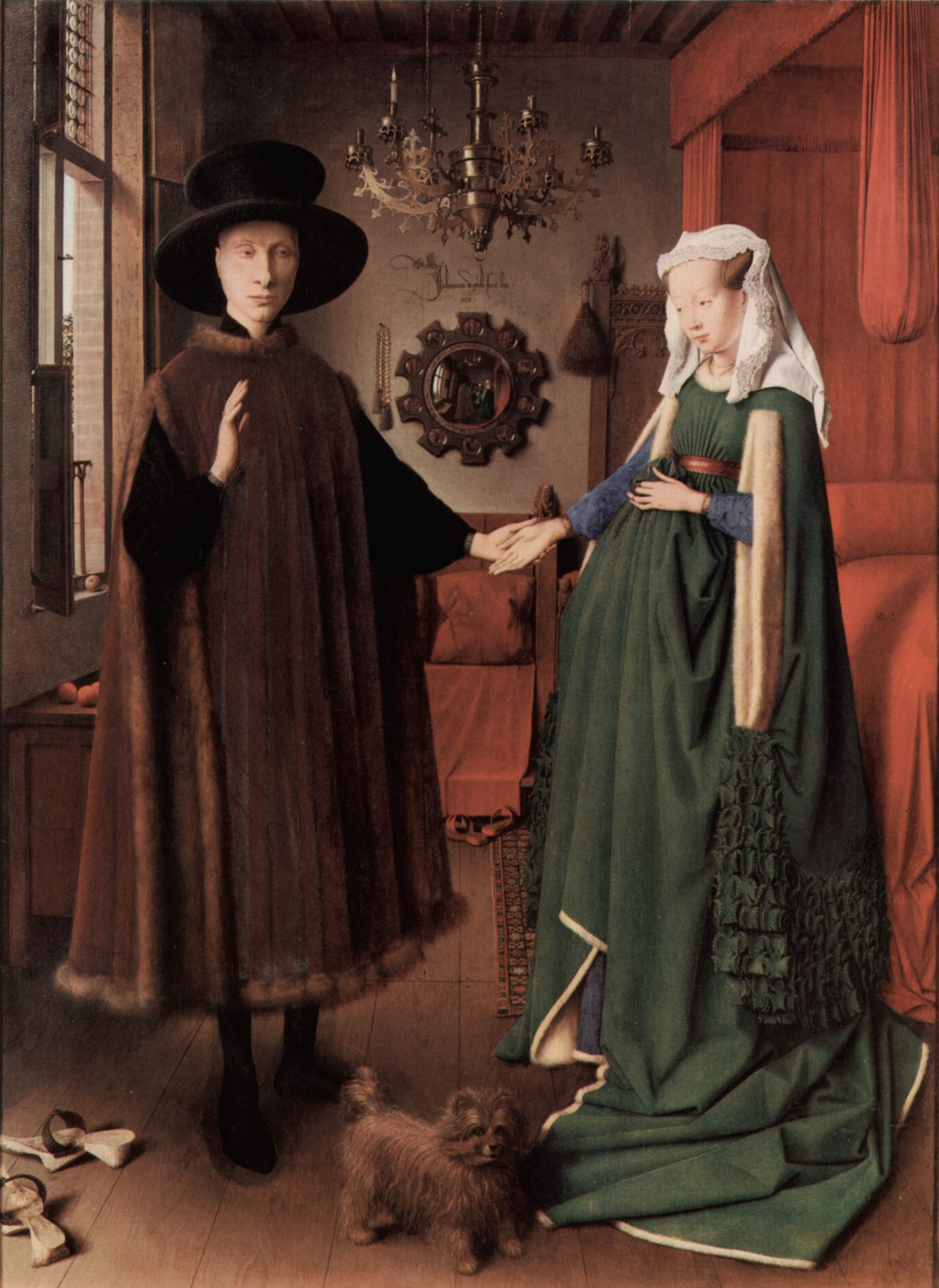
In the convex mirror of the Arnolfinis:
Our generation, our perspectives,
Our models of Fear. I had to look this up -- turns out to be a painting I've seen many times and read a bit about at some point lost to my memory, "The Betrothal of the Arnolfinis," by Jan van Eyck:

An amazing, incredible picture; I don't have much to say about it here but that mirror seems like a fine place for dream-detectives to get lost. Anyway Sylvia was looking over my shoulder as I looked this up and she immediately recognized it as appearing in her book Dog's Night, which is the story of the dogs in all the paintings in an art gallery getting loose after hours one night -- it's a fine book and I recommend it if you are looking for a present for a young kid -- as I recall it's best suited for about a five- or six-year-old.
posted evening of April 9th, 2009: Respond
➳ More posts about The Romantic Dogs
| |
Wednesday, April 8th, 2009
Michael Bérubé has a long post today about His Dark Materials and a few other things (thanks for pointing it out, Levi) -- it is a bit dense but as near as I can tell, he means to defend The Amber Spyglass against critics who think it is the weakest book in the series because it is too preachy, and simultaneously to point out a weakness in the series -- that it is written on too grand a scale -- and to talk about some other fantasy series, like LOTR and C.S. Lewis' science fiction books, in this context. I'm grateful to Dr. Bérubé for what he says about the world of the dead scene in The Amber Spyglass -- I had been having some cognitive dissonance over the last few weeks from failing to acknowledge the lameness of the Lyra's-hair bomb plot device. I had gotten up on a horse about the great beauty of the descent into the world of the dead, but was having trouble riding it. That said I don't think the idea that the harpies want to hear true stories of the world of the living is as bad as Bérubé does; I kind of like it, and I didn't attach a huge amount of importance to its role in the plot as I was reading. I'm tentatively working on a response to people who complain about the preachiness of His Dark Materials, and which I think would also work as a response to Bérubé's complaint about Tolkien's stilted language -- making the argument against the church seems to be a huge part of Pullman's goal in writing these books. I did not (generally) find that the pedantry detracted from the story; but he is not only telling a story. Saying that the pedantry detracts from the story is like, well, like saying that Tolkien's archæic usages detract from his story -- I think Tolkien is at least as interested in creating a world where these usages will work, as he is in telling a story about a hobbit's quest. But this needs a fair amount of work before it will actually be an argument of any sort.
 Some great discussion in the comments thread over there as well -- particularly from Kathleen, Alan Jacobs, Rich Puchalsky. I'm reluctant to enter into it myself because I like the books so much -- the tone of the comment thread seems to be focusing on the faults of the books, if I join the discussion mooning about how great the trilogy is, I am just going to look silly and thoughtless -- and yet I find my response to the criticisms is mostly just along the lines of "yeah that's true, but still it is a wonderful read..."
posted evening of April 8th, 2009: Respond
➳ More posts about His Dark Materials
|  |
Tuesday, April 7th, 2009
Bolaño's poem "El Mono Exterior", "The Monkey Outside", starts out by asking, "Do you remember the Triumph of Alexander the Great, by Gustave Moreau?" -- I did not -- never seen it, I'm pretty sure, and did not recognize the painter's name. Here is an image of it: The poem is difficult to make much sense of, either by itself or in the context of the painting, but it's an attractive jumble of images. He seems to be addressing somebody who is blasé about the purported power of this painting (I can't see it; but then I am just looking at a little jpg of it), who "walked like a tireless ape among the gods,/ For you knew -- or maybe not -- that the Triumph was unfurling/ its weapons inside Plato's cavern: images,/ shadows without substance, sovereignty of emptiness." I'm not sure if he's reproaching the person he's talking to -- and indeed he might be talking to himself. The poem is difficult to make much sense of, either by itself or in the context of the painting, but it's an attractive jumble of images. He seems to be addressing somebody who is blasé about the purported power of this painting (I can't see it; but then I am just looking at a little jpg of it), who "walked like a tireless ape among the gods,/ For you knew -- or maybe not -- that the Triumph was unfurling/ its weapons inside Plato's cavern: images,/ shadows without substance, sovereignty of emptiness." I'm not sure if he's reproaching the person he's talking to -- and indeed he might be talking to himself.
 Update: This poetry course from Aula de Poesia de Barcelona (PDF format, Spanish language) has some questions for writing about "El Mono Exterior", on page 5. Also featured: Borges, José Jorge Letria, Juan López de Ael, Claudia Groesman. (Why is the school's name not spelled "Aula de PoesÃa"? Is this a Catalán thing?)
Late Update: Bolaño also references Moreau in the first section of 2666.
posted evening of April 7th, 2009: Respond
➳ More posts about Roberto Bolaño
|  |
|
Saramago posts today about how he came by his writing style. Interesting in the context of Edmond's calling it "Baroque":
This, what people call my style, arises from a great admiration for the language which was spoken in Portugal in the 16th and 17th Centuries. Let us look at the sermons of Father António Vieira and we'll see that in everything he wrote, there is a language filled with flavor and rhythm, as if this were not exterior to the language but rather something intrinsic.We do not know how people spoke in this epoch, but we know how they wrote. Language back then was an uninterrupted flow. Admitting that we could compare it to a river, we feel that it's like a great mass of water that slips along with weight, with splendor, with rhythm, including when at times, its course is interrupted by cataracts. Some days of vacation have arrived, a fine time for wading deep into these waters, into this language written by Father Vieira. I'm not advising anyone to do anything, just saying that I'm going to go swimming in the greatest prose and, for this reason, will be gone for a few days. Would anyone like to come along?
posted evening of April 7th, 2009: 1 response
➳ More posts about José Saramago
|  |
|
 William Wordsworth is just turning 239 years old today -- he is 200 years and a few months older than I. (In the picture at left he is 28, ten years my junior.) William Wordsworth is just turning 239 years old today -- he is 200 years and a few months older than I. (In the picture at left he is 28, ten years my junior.)
Wordsworth is a poet whom I'm always thinking I ought to be more familiar with than I am. I know a couple of his poems but I don't really have any clear sense of his persona as an author -- know him better by way of his influence on some of my favorite writers and thinkers. (And come to think of it, here I am thinking more of "the English romantics" than of Wordsworth individually.) And O, ye Fountains,
Meadows, Hills, and Groves,
Forebode not any severing of our loves!
Yet in my heart of hearts I feel your might;
I only have relinquished one delight
To live beneath your more habitual sway.
I love the Brooks which down their channels fret,
Even more than when I tripped lightly as they;
The innocent brightness of a new-born Day
Is lovely yet;
The Clouds that gather round the setting sun
Do take a sober colouring from an eye
That hath kept watch o'er man's mortality;
Another race hath been, and other palms are won.
Thanks to the human heart by which we live,
Thanks to its tenderness, its joys, and fears,
To me the meanest flower that blows can give
Thoughts that do often lie too deep for tears. -- from "Intimations Of Immortality From Recollections Of Early Childhood"
posted morning of April 7th, 2009: Respond
➳ More posts about Birthdays
| |
Monday, April 6th, 2009
In this chapter there are two passages that strike me as very cinematic -- I can see them playing out animated on the screen. (Granted Tolkien was writing before the advent of anime, so he probably did not have that style in mind; but I think it is suited very well to his words.)
She lifted up her hand and from the ring she wore there issued a great light that illuminated her alone and left all else dark. She stood before Frodo seeming now tall beyond measurement, and beautiful beyond enduring, terrible and worshipful. Then she let her hand fall, and the light faded, and suddenly she laughed again, and lo! she was shrunken: a slender elf-woman, clad in simple white, whose gentle voice was soft and sad. This is just great. I can see her holding the ring up, it shining down on her, her transformation into something fearful -- it could be lifted right out of Howl's Moving Castle. Then there was a pause, and many swift scenes followed that Frodo in some way knew to be parts of a great history in which he had become involved. The mist cleared and he saw a sight which he had never seen before but knew at once: the sea. Darkness fell. The sea rose and raged in a great storm. Then he saw against the Sun, sinking blood-red into a wrack of clouds, the black outline of a tall ship with torn sails riding up out of the West. Then a wide river flowing through a populous city. Then a white fortress with seven towers. And then again a ship with black sails, but now it was morning again, and water rippled with the light, and a banner bearing the emblem of a white tree shown in the sun. A smoke as of a fire and a battle arose, and again the sun went down in a burning red that faded into a grey mist; and into the mist a grey ship passed away, twinkling with lights. It vanished, and Frodo sighed and prepared to draw away. I'm not as crazy about this. I think it could work really well on screen; but in the text something seems wrong with it. Those images are flashing by quickly, my gut reaction is that Frodo cannot be processing them as quickly as the narrator is telling us, and it makes it seem like a cheat. In the movie you would see all those images but you would not be able to narrate them in real-time like this -- you would have to assemble the narrative after the images had passed -- which is what I think Frodo would need to do, and by serving it up to us like this the narrator is taking us away from the story. Not sure this makes any sense, I'm trying to convey my impression here. Magic and prophesy are another element that LOTR has in common with Narnia and His Dark Materials -- maybe I did not mention this last time because it seemed obvious, magic and prophesy are sort of defining features of the fantasy genre -- but I think it would be worth a post at some point examining how magic and prophesy in the story, and the characters' response to them, affect my reading experience. I don't read very much fantasy, so I am noticing this part of the reading as something unusual.
posted evening of April 6th, 2009: 3 responses
➳ More posts about J.R.R. Tolkien
| Previous posts about Readings
Archives  | |
|
Drop me a line! or, sign my Guestbook.
•
Check out Ellen's writing at Patch.com.
| |