|
|
Friday, May first, 2009
The NY Times reviews the Roundabout Theater's production of Waiting for Godot today. It sounds great, and makes me happy I'm going to see it in a few weeks. Lots of cool photos at the link (under "Multimedia"); I especially like this picture:
 Gogo, Pozzo, Didi -- Didi's expression is just fantastic.  I just noticed a pretty cool, subtle optical illusion. This photo was clearly taken by a camera in front of the stage, on approximately the same level as John Goodman's midriff. But if you look at it the right way, it's easy to convince yourself that the camera was in the air, looking down at the trio at a fairly sharp angle. Try it out, see what you think. (Works best if you are only looking at the upper ¾ of the photo.)
posted morning of May first, 2009: 3 responses
➳ More posts about Samuel Beckett
|  |
Monday, April 27th, 2009
(Searching for an image to illustrate this post with; but all the stills from Viridiana that are out there on the web seem to be of the title character, or of the Last Supper scene... Aha! found a picture of Don Jaime.) I met up with Christine this evening to watch Viridiana at the Film Forum; it was really nice to see it again after a couple of years, and yet I find much of what I was thinking about it was in regards to its shortcomings as a story -- this is probably symptomatic of a rebound from being madly in love with it and unable to admit any problems with it... I met up with Christine this evening to watch Viridiana at the Film Forum; it was really nice to see it again after a couple of years, and yet I find much of what I was thinking about it was in regards to its shortcomings as a story -- this is probably symptomatic of a rebound from being madly in love with it and unable to admit any problems with it... Anyway, I don't really want to write about the shortcomings just now besides to say that the visually brilliant second half of the movie did not seem to me very interesting on a human level, and that the ending was wretched; what I wanted to talk about was how strongly I identified with Don Jaime, and how disconcerting that was. For me the moment that really makes this movie worth it is the moment when Don Jaime suddenly realizes that he has gone too far, overstepped the limits of Viridiana's patience and that she is never going to think of him as a human being any more -- his pathetic pleading with her is all-too real.
posted evening of April 27th, 2009: Respond
➳ More posts about Viridiana
|  |
Sunday, April 26th, 2009
I've been enjoying the stories in Zoetrope: All-Story's Latin American fiction issue. Reading them very slowly, moving back and forth between the Spanish and the translation; this is definitely helping get them anchored in my thoughts... Ronaldo Menéndez' story "Insular Menu", about Cubans trying to get by during a period of rationed food, makes me hungry! The story is funny and colorful, the narrator's neighbors raising pigs and crocodiles in their apartments, the zoo director fattening and slaughtering the ostrich, the neighborhood kids fishing from the rooftop for cats; it closes with a dazzling description of the Cuban cuisine that the narrator is missing. The entire long paragraph is well worth your while, I'm just going to quote a bit of it: it closes with a dazzling description of the Cuban cuisine that the narrator is missing. The entire long paragraph is well worth your while, I'm just going to quote a bit of it:
I saw the populous sea that surrounds the islands, and in the sea saw nets and in the nets saw multitudes of shrimp and prawns, saw them populating long familial tables below smiling faces, saw dishes of avocados in slivers and slivers, making a green zebra out of the ceramic, saw oxtail gleaming under chili cream sauce, saw squid and octopi drowning in their ink, saw plantains, mameys, star apples, sapotes, sweetsop, chirimoyas, mangos, saw extra-large lobsters letting their fragrance touch all noses equally...
This is a passage where rhythm is really key. Take a look at the original:
Vi el populoso mar que rodea la isla, y del mar vi redes y de las redes vi muchedumbres de camarones y langostinos, los vi poblando largas mesas familiares bajo rostros risueños, vi fuentes de aguacates en lascas y lascas y lascas, haciendo de la cerámica una cebra verde, vi rabo de toro encendido bajo crema de ajÃ, vi pulpos y calamares ahogados en su tinta, vi plátanos, mameyes, caimitos, zapotes, anones, chirimoyas y mangos, vi langostas de talla extra larga dejando que su olor tocara por igual todas las narices,...
...What to say? I like the English passage, and there does not seem to be any mistranslation (though "in slivers and slivers" is not great), but it does not hold a candle to the Spanish.
 Update: Jim Tucker posts his own attempt at an English translation in comments, and does it very well indeed.
posted morning of April 26th, 2009: 4 responses
➳ More posts about Zoetrope: All-Story
|  |
Saturday, April 25th, 2009
I've been having mixed feelings about Book V of LOTR -- I mean the whole trilogy has been fairly warlike, with men who thrive in battle and women who are mostly absent; but the sadistic, drawn-out glamour of the battle for Minas Tirith is freaking me out a bit. Also the timeline of the Riders of Rohan arriving at Minas Tirith and Aragorn arriving leading an army of the dead. (And why no mention is made of their being dead, after he initially hooks up with them in Dunharrow.*) OTOH some of the imagery is just breathtaking, and I like how some of the characters are drawn. Legolas and Gimli are growing on me in a way they have not thus far. Take a look at this passage in Chapter 9, after the two have told Imrahil he is needed at Aragorn's tent:
"That is a fair lord and a great captain of men," said Legolas. "If Gondor has such men still in these days of fading, great must have been its glory in the days of its rising.""And doubtless the good stone-work was wrought in the first building," said Gimli. "It is ever so with the things that Men begin: there is a frost in Spring, or a blight in Summer, and they fail of their promise."
"Yet seldom do they fail of their seed," said Legolas. "And that will lie in the dust and rot to spring up again in times and places unlooked-for. The deeds of Men will outlast us, Gimli." "And yet come to naught in the end but might-have-beens, I guess," said the Dwarf. "To that the Elves do not know the answer," said Legolas.
* Ah ok, not too many pages later it becomes clear that Aragorn was no longer leading an army of the dead, when he arrived at Minas Tirith. This makes the course of events make much more sense.
posted afternoon of April 25th, 2009: Respond
➳ More posts about The Lord of the Rings
| |
Thursday, April 23rd, 2009
I am having a lot of fun with listening to Sylvia coming up with ways that Bilbo and the dwarves could get out of their scrapes -- if they tell Smaug there are fifteen gallons of gold in Hobbiton, then he will fly there and they will be able to get his treasure away (and the hobbits of the Shire will be safe because Smaug "can't smell hobbits"); or Bilbo could loan the ring to Thorin and Thorin would creep down into Smaug's lair and say something that caused the dragon to freak out and run around in circles, until he bumped his head and was out of commission... She's particularly interested in the ring, coming up with ways it could be used to make the entire party invisible. If it's big enough, two of them could put their pinkies together and squeeze it on. (I have myself been wondering how the ring comes to be the right size for Bilbo's halfling fingers.) Bilbo could go to each of their cells in the elf-king's dungeon as the door was being opened to give them food, and toss them the ring, and they could slip out in a flash. She asked a question tonight that plagues me every time Bilbo or Frodo puts on the ring: do the objects he is holding also turn invisible? I don't see any very consistent approach to this question in the texts -- obviously the ring-wearer's clothing becomes invisible, and any paraphernalia in his pocketses; but at one point there was a reference to Frodo swordfighting while wearing the ring, and the sword was said to be visible*. I am not sure what the rule is, or if it's just a matter of the needs of the story-teller at each particular juncture.
 * (And if I'm remembering right, the sword became invisible once more when he slipped it into its sheath -- how does this make sense?)
posted evening of April 23rd, 2009: 2 responses
➳ More posts about The Hobbit
| |
Wednesday, April 22nd, 2009
I've been enjoying having vivid dreams lately. I still do not remember nearly as many or as much of them as I would like, but the experience of dreaming them is very entertaining. It is starting to seem like an obvious choice to re-read Burroughs' My Education: a Book of Dreams, which is a pasting together of thirty years of his dreams, with some conversational writing in between talking about dreams, sometimes noting the circumstances of a dream, never analyzing the content of the dream. I read this quickly when it came out 14 years ago but did not, perhaps, let it sink in enough. Opening it now and looking at some of the dream passages, I notice Burroughs is not making any kind of effort to persuade me of the reality of the dream; instead he is flatly asserting he had this dream, and leaving it up to me to put myself in the dreaming head so that I can experience it. I'm up in a room with a high ceiling and a door at one end. The room is full of light and has a feeling of being open and airy. I float up to the ceiling and bob along to the door and out. There is a porch or balcony over the room and now I am up under the porch about thirty feet off the ground. I move out from under the porch and pick up speed and direction. Very little descriptive language, just a straight narration of the events in the dream. This is seeming at first glance like exactly the right way to present dreams. The style and furnishing of the room, the sensation of floating, the colors in my field of vision are all for me to experience for my own part as I in effect have the dream I'm reading about.
posted evening of April 22nd, 2009: Respond
➳ More posts about My Education
| |
Tuesday, April 21st, 2009
I dreamt last night, at first, that I had made my way to Santiago and had sought out a famous poet (I cannot remember who; he was also a professor of literature) with the idea that he was going to enlighten me about Chilean poetry. We were sitting in the (oddly very noisy) university library and I was asking him, in better Spanish than I speak but still hardly fluent, to show me which books I should read to learn about poetry in Chile -- as we walked up the staircase I specified, yelling to make myself heard over the din, that I was interested in the latter half of the twentieth century. He brought me to the shelf of books on the topic; there was very little there, maybe 20 dog-eared books, half of them in translation -- it seemed very strange to me. I picked up the heavy Oxford Companion to Chilean Verse and started leafing through it. In the second half of the dream I was debugging a web server I had written to render the work of Nicanor Parra. (Highly specialized, yes.) Sylvia and her friend Giulia came in and wanted to read the poems, also they wanted to play baseball -- I gave them the computer and while swinging their bats, they read three short poems about morning -- the poems were lovely, though they did not sound much like Parra; the only one I remember is: On my birthday I arose
And drank the subtle
Health of morning.
posted morning of April 21st, 2009: Respond
➳ More posts about Dreams
| |
Saturday, April 18th, 2009
I am finding book IV of The Lord of the Rings, the story (so far) of Frodo, Sam and Sméagol journeying towards Mordor, to be the most compelling reading of the first two volumes. I'm really tuned in to each of the three characters and sensitive to what's happening with them. In most of the rest of the book I have been liking it more as a visual experience -- a painting of words -- than as a story. I am very much in awe of Tolkien's ability to create a world, even if the story is not always making it for me -- this is making me feel good about the idea of reading the Silmarillion next, which I understand to be mostly world-creation rather than story. I found this dialogue between Frodo and Faramir (at the end of Chapter 6) very moving -- suddenly this style of writing dialogue, which has been seeming very stilted to me, is making sense:
‘...Do not approach their citadel. ...It is a place of sleepless malice, full of lidless eyes. Do not go that way!’
"But where else will you direct me?" said Frodo. "You cannot yourself, you say, guide me to the mountains, nor over them. But over the mountains I am bound, by solemn undertaking to the Council to find a way or perish in the seeking. And if I turn back, refusing the road in its bitter end, where then shall I go among Elves or Men? Would you have me come to Gondor with this Thing, the Thing that drove your brother mad with desire? What spell would it work in Minas Tirith? Shall there be two cities of Minas Morgul, grinning at each other across a dead land filled with rottenness?" "I would not have it so," said Faramir. "Then what would you have me do?" "I know not. Only I would not have you go to death or to torment. And I do not think that Mithrandir would have chosen this way." "Yet since he is gone, I must take such paths as I can find. And there is no time for long searching."
Some bits of the language in the book are coming back to me from my previous reading of it. I seem to remember that when I read Chapter 9 of book III, "Flotsam and Jetsam", that was the first time I had ever seen those terms, and I looked them up in the dictionary and endeavored to throw them into conversation for the next little while. (If memory serves the distinction is that flotsam is wreckage floating away from the wrecked ship, where jetsam is wreckage that was jettisoned from the ship prior to its sinking.) I remember the name "Morgul" but thought somehow it was the name of an evil character or species, not part of an evil city's name... Either way it is certainly a bad-sounding handle.
posted evening of April 18th, 2009: 1 response
➳ More posts about J.R.R. Tolkien
| |
Monday, April 13th, 2009
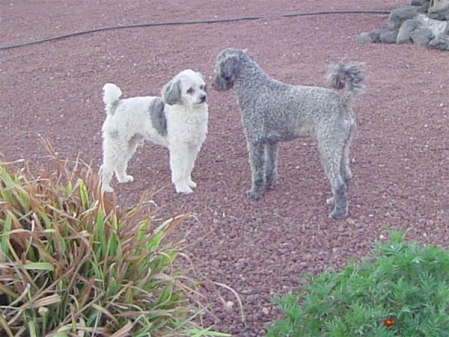 Last month, Saramago wrote a note about his dogs Camões and Pepe, and speculated that a Portuguese dog in the White House would be "an important diplomatic success, from which Portugal should work to get the maximum advantage in its bilateral relations with the United States..." -- today Bo is in the White House -- "the Great Danes and the hounds of Pomerania are dying of envy" -- but Saramago is critical: Last month, Saramago wrote a note about his dogs Camões and Pepe, and speculated that a Portuguese dog in the White House would be "an important diplomatic success, from which Portugal should work to get the maximum advantage in its bilateral relations with the United States..." -- today Bo is in the White House -- "the Great Danes and the hounds of Pomerania are dying of envy" -- but Saramago is critical:
In any case, allow me to say that I have a serious reservation that I must express: one cannot have any idea what a Portuguese Water Dog is, to put around his neck, to photograph him, a collar of flowers, as if he were a Hawai`ian dancer. At only six months of age, Bo is not yet fully aware of the respect that he owes the canine branch into which he had the luck to be born. ...
posted evening of April 13th, 2009: Respond
➳ More posts about Saramago's Notebook
| |
Thursday, April 9th, 2009
The 14th, untitled poem in The Romantic Dogs is only three lines: I dreamt of frozen detectives in the great
refrigerator of Los Angeles
in the great refrigerator of Mexico City.
This introduces a series of five poems about "lost detectives" and "frozen detectives" and "crushed detectives" -- they moan desperately, they stare at their open palms, they are "intent on keeping their eyes open/ in the middle of the dream." These poems -- which are all about dreams -- make me think of Raymond Chandler; there is no stylistic similarity to speak of but I read "detectives" and "Los Angeles" and that is where my mind goes -- and they make me want to read Bolaño's novel The Savage Detectives to find out what his dream-detectives do when they are fleshed out into characters...The fourth poem in this sequence, "The Frozen Detectives," has another painting reference in it: I dreamt of detectives lost
In the convex mirror of the Arnolfinis:
Our generation, our perspectives,
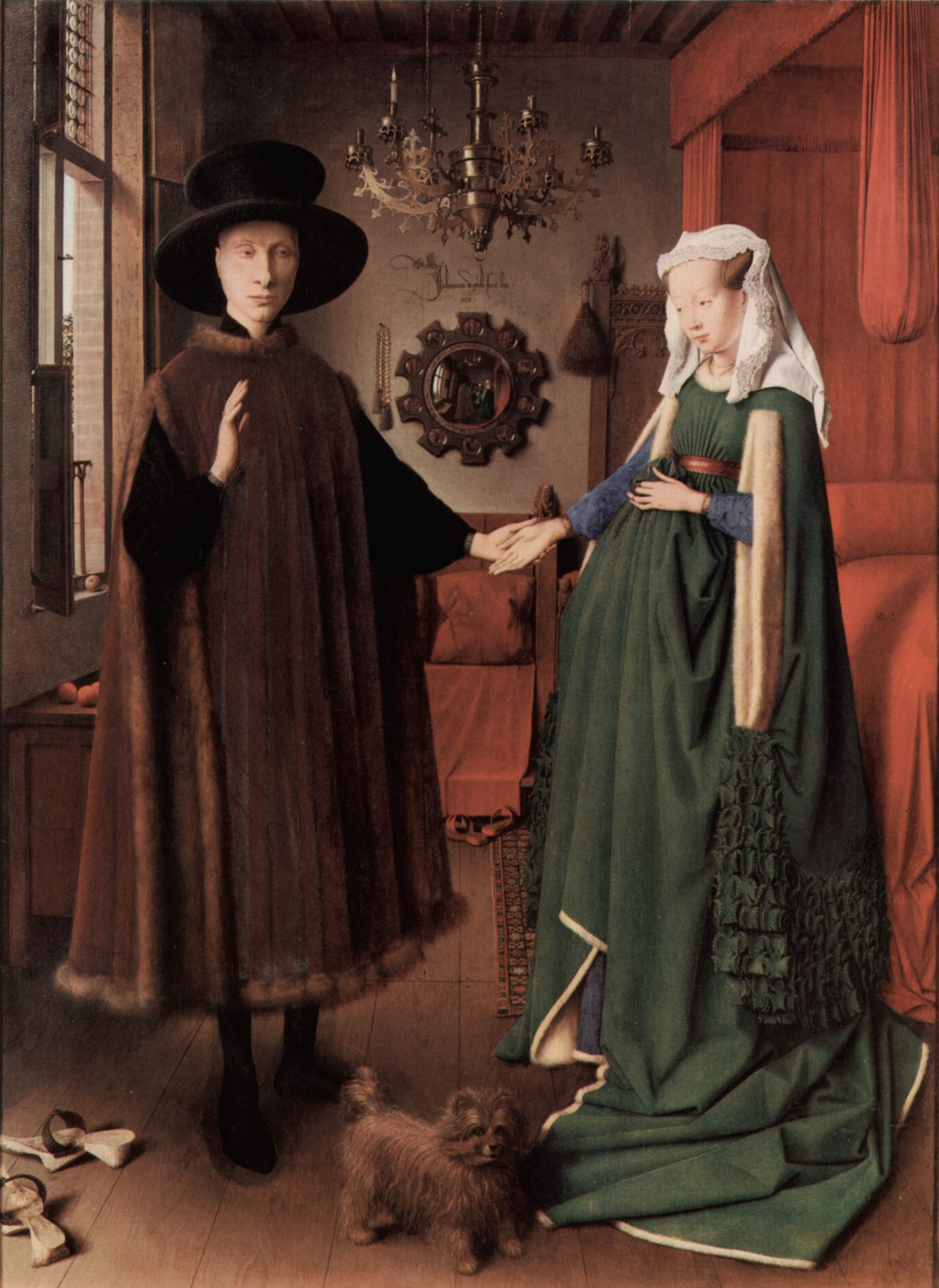
Our models of Fear. I had to look this up -- turns out to be a painting I've seen many times and read a bit about at some point lost to my memory, "The Betrothal of the Arnolfinis," by Jan van Eyck:

An amazing, incredible picture; I don't have much to say about it here but that mirror seems like a fine place for dream-detectives to get lost. Anyway Sylvia was looking over my shoulder as I looked this up and she immediately recognized it as appearing in her book Dog's Night, which is the story of the dogs in all the paintings in an art gallery getting loose after hours one night -- it's a fine book and I recommend it if you are looking for a present for a young kid -- as I recall it's best suited for about a five- or six-year-old.
posted evening of April 9th, 2009: Respond
➳ More posts about The Romantic Dogs
| Previous posts about Readings
Archives  | |
|
Drop me a line! or, sign my Guestbook.
•
Check out Ellen's writing at Patch.com.
| |



 Beautiful: