|
|
Monday, July 27th, 2009
The bedroom door, which was only pushed to, opened softly in the darkness. Tomarctus, the household dog, had come in. He came to find out if this master, who only turns up very  infrequently, was still here. He is a medium-sized dog, and inky black, not like other dogs that, when seen from up close, are really gray. infrequently, was still here. He is a medium-sized dog, and inky black, not like other dogs that, when seen from up close, are really gray.
Nice to see the dog making his appearance -- I think there have been dogs in every Saramago book I've read so far -- it is a nice linking thread. Tomarctus is the name of a prehistoric species which is an ancestor of canis familiaris.I am wondering about the roles of the female characters in this book, Maria, Helena, and Tertuliano's mother. Each one of them seems pretty cryptic in her own way.
posted evening of July 27th, 2009: Respond
➳ More posts about The Double
|  |
Saturday, July 25th, 2009
They say that if you meet your double, you should kill him -- or that he will kill you. I can't remember which; but the gist of it is, that two of you is one too many.-- Double Take
I'm midway through The Double now, and still not sure how to approach reading it. It seems at times like a Woody Allen movie, exploring the humorous consequences of its main character's depression/inferiority complex; at other times I think Saramago has something enlightening to say about depression, but the (overly?) dismissive tone of his narrator makes it impossible to develop this much -- every thing he says, he cuts down. I'm pretty sure the intent of the book is neither broad comedy nor pedagogy, but I'm sort of alternating between these poles in my reading -- I'm hoping Saramago will show his hand a bit when the doubles meet.Bill of Orbis Quintus linked to an interview with screenwriter Tom McCarthy, in which he discusses among other things his most recent project, the movie Double Take (a longer article about the movie is at Art in America). Sounds great -- he says it is based on "a Borges tale about meeting his own double" -- at first I thought this was referring to "Borges and I", but this is probably wrong, unless the relationship between the source text and the movie is very loose indeed.* He's changed it around so that the movie is about Alfred Hitchcock rather than Borges, which seems to me like a excellent move -- not that I wouldn't be glad to see a movie about Borges, but throwing Hitchcock into the mix can only produce good consequences. Here is a clip: ...And yikes! another, mind-boggling, clip underneath the fold.
* (The story referenced is "The Other", from The Book of Sand.)
 (...And thinking further, I'd say the relationship between source text and movie is indeed very loose, and who knows, "Borges and I" may have been the inspiration for this. I need to see more of the movie to have any actual opinion about this, though.)
↻...done
posted afternoon of July 25th, 2009: 3 responses
➳ More posts about José Saramago
|  |
Sunday, July 19th, 2009
The video Máximo Afonso rents at the beginning of The Double is called Quem Porfia Mata Caça -- internet translation sites seem to think this proverb should be translated as "Where there's a will, there's a way"; Jull Costa chooses "The race is to the swift" -- which does sound like a good title for a movie, though from checking with imdb, it does not appear to have been used that way yet. This title is repeated several times in the first few pages -- makes it seem like riffing on the adage is going to be an important part of the book. I think the literal translation is something like "He who perseveres will kill his prey."
posted morning of July 19th, 2009: 3 responses
|  |
Saturday, July 18th, 2009
Yikes! I am starting another book by José Saramago -- namely The Double. I haven't heard much about this one, I think Jorge has referenced it once or twice as an enjoyable read. It is from 2003, after The Cave and before Seeing. Just want to say up front, with each book I read of his I am more deeply in awe at the breadth of his writing -- what is prompting this is one of the few explicit references I've seen him make within a novel to his other work. On page 2, Saramago is describing Máximo Afonso as a solitary man who has "succumbed to the temporary weakness of spirit ordinarily known as depression."
What one mostly sees, indeed it hardly comes as a surprise anymore, are people patiently submitting to solitude's meticulous scrutiny, recent public examples, though not particularly well known and two of whom even met with a happy ending, being the portrait painter whom we only ever knew by his first initial, the GP who returned from exile to die in the arms of the beloved fatherland, the proofreader who drove out a truth in order to plant a lie in its place, the lowly clerk in the Central Registry Office who made off with certain death certificates,...
Gosh! four of his other novels and only two that I have read! (plus one that is on my reading list.) I wonder if the portrait painter is the main character of Manual of Painting and Calligraphy. ...Somehow I had been going along thinking that Baltasar and Blimunda was his first major novel, that I was close to mastering his back catalog. Somehow I had formed the silly impression that Manual of Painting and Calligraphy was what it claimed to be, that based on this and Journey to Portugal, Saramago's previous, untranslated works were not fiction. That is clearly false and it looks like if I really want to know his work, I need to learn Portuguese -- or at least get better at Spanish, it looks like almost all of his novels are translated into that language. As far as his poetry, I've been reading some of it in Spanish online; I think the combination of reading in Spanish for understanding and Portuguese for the sound will be sufficient for getting it, at least once I figure out how to pronounce Portuguese.
posted morning of July 18th, 2009: 3 responses
|  |
|
In the course of reading the second half of Baltasar and Blimunda I had sort of begun to assume that the end of the novel would feature the cripple and the clairvoyant repairing Bartolomeu's flying machine and taking again to the air -- I have come to expect a romantic vision of Saramago's novels in which the protagonists transcend their gritty reality through love. (This is a little simplistic, and it certainly does not apply to every one of his books, but speaking very broadly it is a common feature of a lot of his fiction -- and it just seemed like it would be the natural ending for this book.) The fairy-tale imagery was making me expect a fairy tale. Do not want to give away the ending, exactly -- I am recommending this book very strongly and it is always a better reading experience not to know just what's coming -- suffice to say that while the airship does fly again and while broadly speaking, the ending does involve the protagonists transcending their gritty reality through romantic love, it is much, much darker and less pat than what I was imagining.
posted morning of July 18th, 2009: Respond
➳ More posts about Baltasar and Blimunda
| |
Tuesday, July 14th, 2009
As in tales of yore, a secret word was uttered and before a magic grotto there suddenly arose a forest of oak trees that could be penetrated only by those who knew the other magic word, the one that would replace the forest with a river and set thereon a barge with oars. Here, too, words were uttered, If I must die on a bonfire, let it at least be this one, the demented Padre Bartolomeu Lourenço had once exclaimed, perhaps these bramble thickets are the forest of oak trees, this woodland in flower the oars and the river, and the distressed bird the barge, what word will be spoken that will give meaning to all of this.
This scene feels like a critical juncture. Baltasar and Blimunda have already been into the sky and back to land, back to Malfa and the drudgery and toil of building the convent, and now for the first time they are venturing together back to the wrecked airship. And suddenly Saramago is speaking in terms of a fairy tale and wondering what word can be spoken that will give meaning to all this. This passage illuminates his earlier efforts to give meaning to the labour of the six hundred men transporting a stone from the quarry to the construction site, by naming them and telling their story; it casts a subtle light on Saramago's project in telling this story.
posted evening of July 14th, 2009: Respond
| |
Sunday, July 12th, 2009
There are other fellows too, named José, Francisco, and Manuel, very few named Baltasar, but many named João, Ãlvaro, António, and Joaquim, and perhaps even the odd Bartolomeu though never the one who disappeared, as well as Pedro, Vicente, Bento, Bernardo, and Caetano, every possible name for a man is to be found here and every possible kind of existence, too, especially if marked by tribulation and, above all, by poverty, we cannot go into the details of the lives of all of them, they are too numerous, but at least we can leave their names on record, that is our obligation and our only reason for writing them down, so that they may become immortal and endure if it should depend on us, ...
I'm noticing how well Saramago draws his minor characters -- in this chapter of transporting the huge stone for the convent's balcony, there are hundreds of workers, and those that he spends any time on come through very clearly and distinctly -- I'm thinking specifically of Francisco Marques, Manuel Milho (who I believe is a stand-in for Saramago), and José Pequeno. This passage is a funny piece of that, Saramago is lamenting that he does not have space and time to make characters of all the workers in this scene. 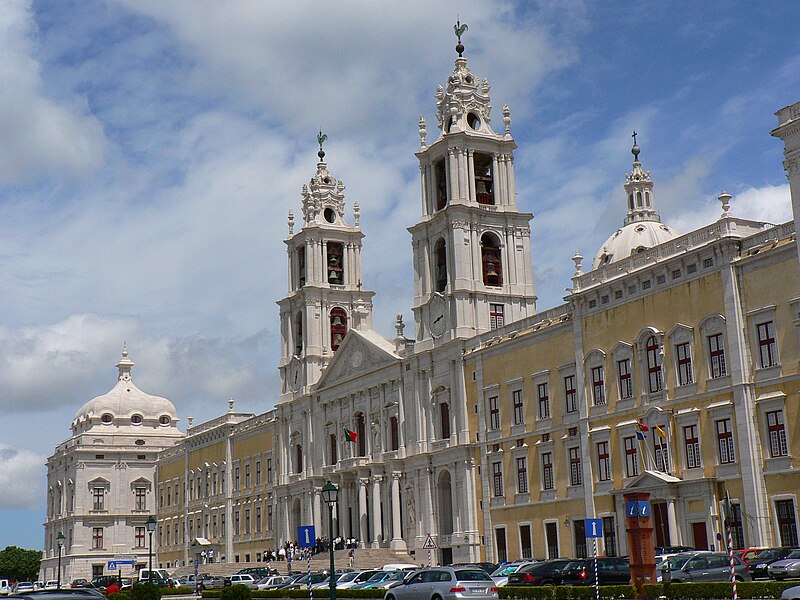 The Convent at Mafra -- I believe the balcony referenced here is the one at the center of the façade, above the main entrance -- behind the lamp post in this picture. Below the fold, a bit of the story about moving this stone.
 Let others testify who may know more than we do. Six hundred men desperately clinging to the twelve cables that had been fixed to the back of the platform, six hundred men who felt that with time and continuous effort they were gradually losing the stiffness in their limbs, six hundred men who were six hundred creatures terrified of being there, and now more than ever, for, compared with this, yesterday was child's play and Manuel Milho's story a fantasy, for that is all man really is, when he is only the strength he possesses, when his is nothing other than the fear that he might not be able to summon the strength to detain this monster that implacably drags him on, and all because of a stone that never had to be so huge, with some three or ten smaller stones the balcony could have been built just as easily, even though we would no longer have been able to tell His Majesty with pride, It is made from a single stone, or to tell visitors before they pass into the next room, It is made from a single stone, and by means of these and other foolish vanities, absurdities become rife, with all their national and individual characteristics, such as the following statement one reads in manuals and history books, The Convent of Mafra was built by Dom João V in fulfillment of a vow he made should God grant him an heir, here go six hundred men who did not make the Queen pregnant yet they are the ones who pay for that vow and carry the can, if you will pardon that old-fashioned expression.
↻...done
posted morning of July 12th, 2009: Respond
|  |
Tuesday, July 7th, 2009
Take a look at Saramago's blog today for some beautiful pictures of Castril de la Peña, in the northern part of Granada. His reflections on its age are reminding me pretty strongly of One Hundred Years of Solitude:
The river which passes through Lisbon is not called Lisbon, it's called Tagus, the river which passes through Rome is not called Rome, it's called Tiber, and that other one which passes through Seville, neither is it called Seville, it's called Guadalquivir.... But the river which passes through Castril, this one is called Castril. Many inhabited places will right away be given the name of that which they are known for, not just rivers. For thousands and thousands of years, patiently, every river in the world had to wait for someone to show up and to baptize it, in order to be able to appear on maps as something more than a scribble, sinuous and anonymous. Through centuries and centuries the waters of a river as yet nameless would pass tumultuously through the place where one day Castril would have to erect itself and, while passing by, would look up at the cliff and say one to the other, "Not yet." And they would continue their journey to the sea thinking, with the same patience, that in time, a time would come, and that new waters would arrive, would meet women washing their clothing against the stones, children inventing swimming, men fishing for trout and all the rest that would rise to the bait. At this moment the waters knew that they had been given a name, that henceforth they would be not the River Castril, but the River of Castril, so strong would be the pact uniting them with the people building their first rustic houses on the slopes of the mountainside, who would later construct second and third dwellings, one next to the other, one over the ruins of the others, generation after generation, until today....
The José Saramago Center in Castril funds and promotes cultural, literary and artistic projects.
posted evening of July 7th, 2009: Respond
➳ More posts about Saramago's Notebook
|  |
|
Another point of comparison for Padre Bartolomeu Lourenço that hit me this morning, as I was reading about Signor Scarlatti proposing to bring his harpsichord aboard the Passarola, is Moominpappa in Moominpappa's Memoirs -- holed away in his retreat, working at the pleasure of the whimsical monarch, building a mystical flying vessel... Interesting how Baltasar and Blimunda is bringing children's books to mind.
posted afternoon of July 7th, 2009: Respond
➳ More posts about Moomins
| |
Monday, July 6th, 2009
In a funny way Baltasar and Blimunda is reminding me of The Golden Compass. Obviously far more is different between the two books than is similar; the passage that initially made me think of comparing the two was Padre Bartolomeu Lourenço's statement that he believed Blimunda would be able to see people's will if she looked: I have never seen their will, just as I have never seen their soul, You do not see their soul because the soul cannot be seen, you have not seen their will because you were not looking for it, What does will look like, It's like a dark cloud, What does a dark cloud look like, You will recognise it when you see it,... -- so he is looking for Dust to power his airship! That makes sense... There are some other parallels I could draw between the two works; the opposition to the Catholic church, clearly -- though Saramago's anti-Church streak is far less strident than Pullman's -- and something else as well, some similarity of atmosphere that I haven't been able to pinpoint.
posted morning of July 6th, 2009: Respond
➳ More posts about His Dark Materials
| Previous posts about Readings
Archives  | |
|
Drop me a line! or, sign my Guestbook.
•
Check out Ellen's writing at Patch.com.
| |