|
|
Wednesday, February 24th, 2010
Sylvia has gotten pretty interested in learning about the gods and heroes of Greece and Rome -- prompted in part by a study unit her class did and in part by Rick Riordan's Percy Jackson and the Olympians books; and one thing that has occupied a bit of her attention lately is learning which Latin names correspond to which Greek names. I remember doing this too, probably at about the same age; and ever since I've walked around with a sort of simple equivalence in my head, Zeus is Jupiter, Ares is Mars, Venus is Aphrodite, etc. -- that the two names identify the same entity. But I wonder how this could be? Recently I have formed a sort of vague notion that the Greeks  and the Romans, living close to each other over the millenia, had developed their mythologies roughly in parallel -- that there were two separate entities named Athena and Minerva who featured in similar stories. and the Romans, living close to each other over the millenia, had developed their mythologies roughly in parallel -- that there were two separate entities named Athena and Minerva who featured in similar stories. But how closely similar could they have been? In The Golden Bough, Frazer seems to refer to Diana and Artemis almost interchangeably, and not only that but likewise to Hippolytus and Virbius. Not only does it seem strange that the legends would be so similar that you could do this, it seems like it would be sloppy on Frazer's part to confuse two different god-and-hero pairs like this -- which brings me back to my old way of thinking, that Diana and Artemis are just two different names for the same figure. I'm puzzled though, trying to see a mechanism for this to come about -- it seems like if the religion was imparted from one group (I guess I would assume from the Greeks) to the other, the names would go along with it. I sort of thought a tribal religion was a sine qua non of a Classical civilisation, I guess.
Also kind of interesting, Frazer seems to imply at the outset that the story of Diana and Hippolytus was made up to account for the tradition of Rex Nemorensis, that this was an ancient tradition incorporated into the Greek/Roman religion à la Solstice rituals into Christianity.
posted evening of February 24th, 2010: 9 responses
➳ More posts about Sylvia
|  |
Tuesday, February 23rd, 2010
In his case, would you say that the habit you describe, of treating feelings as provisional, of not committing himself emotionally, extended beyond relations with the land of his birth into personal relations too?
I don't know. You are the biographer. If you find that train of thought worth following up, follow it.
This passage illustrates what I think the best thing is about Summertime -- Coetzee is talking about a third person, a fictional entity named Coetzee; and I have a constant undertone to my reading that well, he could very well be talking about himself you know; and in moments like this it hits me that he could just as well be talking about me. Leaving aside any therapeutic benefits this kind of introspection may have, it's just a lovely sensation to feel yourself inside the book looking out, inhabiting the roles of speaker, person being addressed, and subject of discussion.
posted evening of February 23rd, 2010: Respond
➳ More posts about Summertime
|  |
Sunday, February 21st, 2010
I'm in awe:
One morning... John appeared at the front door. 'I won't stay,' he said, 'but I thought you might like this.' He was holding a book. On the cover: Dusklands, by J M Coetzee.I was completely taken aback. 'You wrote this?' I said. ...
'I didn't know your father was a historian,' I remarked the next time we met. I was referring to the preface to his book, in which the author, the writer, this man in front of me, claimed that his father, the little man who went off every morning to his bookkeeping job in the city, was also an historian who haunted the archives and turned up old documents.
'You mean the preface?' he said. 'Oh, that's all made up.'
So J.M. Coetzee is writing a story with a fictional character named J.M. Coetzee who writes a book with a fictional character named Coetzee -- which book was also coincidentally written by the primary Coetzee...I have got to read Dusklands now...
posted afternoon of February 21st, 2010: 4 responses
➳ More posts about J.M. Coetzee
|  |
|
...Not really, I think... But if you want to read Coetzee's Summertime with no foreknowledge, skip this post. Otherwise, look below the fold.
↷read the rest...
posted morning of February 21st, 2010: Respond
|  |
Saturday, February 20th, 2010
 ...A nice title to pick up when the weather outside is so cold... But it does not look from the first few pages like it is intended as a low-key beach read. ...A nice title to pick up when the weather outside is so cold... But it does not look from the first few pages like it is intended as a low-key beach read.
How to escape the filth: not a new question. An old rat-question that will not let go, that leaves its nasty, suppurating wound. Agenbite of inwit*.
'I see the Defense Force is up to its old tricks again,' he remarks to his father. 'In Botswana this time.' But his father is too wary to rise to the bait. When his father picks up the newspaper, he takes care to skip straight to the sports pages, missing out the politics -- the politics and the killings.
His father has nothing but disdain for the continent to the north of them. Buffoons is the word he uses to dismiss the leaders of African states: petty tyrants who can barely spell their own names, chauffeured from one banquet to another in their Rolls-Royces, wearing Ruritanian uniforms festooned with medals they have awarded themselves. Africa: a place of starving masses with homicidal buffoons lording it over them.
'They broke into a house in Francistown** and killed everyone,' he presses on nonetheless. 'Executed them. Including the children. Look. Read the report. It's on the front page.'
His father shrugs. His father can find no form of words spacious enough to cover his distaste for, on the one hand, thugs who slaughter defenceless women and children and, on the other, terrorists who wage war from havens across the border. He resolves the problem by immersing himself in the cricket scores. As a response to a moral dilemma it is feeble; yet is his own response -- fits of rage and despair -- any better?
This is the first of Coetzee's books that I've read to address directly the question of living in South Africa under Apartheid. Interesting -- this passage in particular sounded to me like it could apply very well to our own times as well:
Their talk of saving civilization, he now tends to think, has never been anything but a bluff. Behind a smokescreen of patriotism they are at this very moment sitting and calculating how long they can keep the show running (the mines, the factories) before they will need to pack their bags, shred any incriminating documents, and fly off to Zürich or Monaco or San Diego, where under the name of holding companies with names like Algro Trading or Handfast Securities they years ago bought themselves villas and apartments as insurance against the day of reckoning (dies iræ, dies illa).
You can read the beginning of Summertime at The NY Review of Books website.
 * Interesting: ayenbite of inwyt is mediæval Kentish dialect for "prick of conscience" -- it is the title of a 1340 translation (which Clara Thomson described as the work of "a very incompetent translator") of a French treatise on Christian morality; full text here. ** I don't know if Coetzee is referring to particular historical incident here.
posted morning of February 20th, 2010: Respond
|  |
Thursday, February 18th, 2010
The river of my village does not make one think of anything.
Whoever is on its banks is only on its banks.
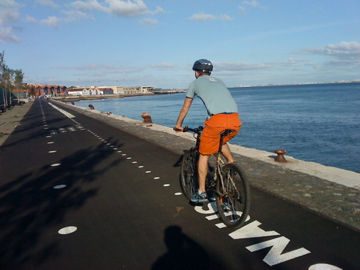
My dad sent along a link to a cool new bike path in Lisbon, painted with the words of Fernando Pessoa/Alberto Caeiro's ode to the Tagus. You can follow Vimeo user Abilio Vieira as he pedals the length of the poem. Here is Richard Zenith's translation:
The Tagus is more beautiful than the river that flows through my village,
But the Tagus is not more beautiful than the river that flows through my village
Because the Tagus is not the river that flows through my village.
The Tagus has enormous ships,
And for those who see in everything that which isn't there
Its waters are still sailed
 By the memory of the carracks.
The Tagus descends from Spain
And crosses Portugal to pour into the sea.
Everyone knows this.
But few know what the river of my village is called
And where it goes to
And where it comes from.
And so, because it belongs to fewer people,
The river of my village is freer and larger.
The Tagus leads to the world.
Beyond the Tagus there is America
And the fortune of those who find it.
No one ever thought about what's beyond
The river of my village.
The river of my village doesn't make one think of anything.
Whoever is next to it is simply next to it.
I'm a little bit puzzled by one thing: The direction Mr. Vieira is riding is obviously the intended direction for reading the poem; if you were going the other way the words would be backwards and it would be difficult to read. But traveling in this direction, one sees the stanzas of the poem in reverse order, (sort of) as if one were reading up from the bottom of the page -- the order of lines within stanzas is preserved. I wonder what the thinking behind this was. Also, why the mirror-image "s" in "O Tejo desce de Espanha"? Just carelessness?
 Update: Mr. Vieira has a blog entry about the bike path. it is the ciclovia do Tejo, running 7 km from Belém to Cais do Sodré along the northern bank of the Tagus. ...I'm finding myself fascinated by this coincidence: The Portuguese which Mr. Zenith translates as "Whoever is next to it is simply next to it" is "Quem está ao pé dele está só ao pé dele" -- the repeated pédele pédele seems just like the perfect text for a bike path...
posted evening of February 18th, 2010: Respond
➳ More posts about Fernando Pessoa
| |
Wednesday, February 17th, 2010
I no longer strive to strive towards such things
(Why should the aged eagle spread its wings?)...
Consequently I rejoice, having to construct something
Upon which to rejoice
Hm. Time for Lent...(Speaking of Eliot: Sybil Vane at Bitch, Ph.D. links to a LOLcatz take on The Waste Land...)
posted evening of February 17th, 2010: 2 responses
|  |
Saturday, February 13th, 2010
 Nearing the end of La Sombra del Viento... I'm getting really agitated about the identity of the being who calls himself Lain Coubert. For a long time I was thinking this was Jorge Aldaya, consumed utterly by his hatred for Carax -- and that's still my fallback assumption; but Carax killed Aldaya in Paris, according to Nuria Monfort's narrative. So either Ruiz Zafón is going to need to explain how Monfort got it wrong, Aldaya/Coubert survived and returned to Barcelona and somehow sustained himself for the next 20 years... Or he will need to bring the supernatural into the story in a more immediate way than it has been -- I mean there have been a lot of ghosts in the book but it has not seemed like a "ghost story" in quite the way it would if Coubert is in fact a supernatural presence. Possibly I am overthinking this. Nearing the end of La Sombra del Viento... I'm getting really agitated about the identity of the being who calls himself Lain Coubert. For a long time I was thinking this was Jorge Aldaya, consumed utterly by his hatred for Carax -- and that's still my fallback assumption; but Carax killed Aldaya in Paris, according to Nuria Monfort's narrative. So either Ruiz Zafón is going to need to explain how Monfort got it wrong, Aldaya/Coubert survived and returned to Barcelona and somehow sustained himself for the next 20 years... Or he will need to bring the supernatural into the story in a more immediate way than it has been -- I mean there have been a lot of ghosts in the book but it has not seemed like a "ghost story" in quite the way it would if Coubert is in fact a supernatural presence. Possibly I am overthinking this.
(Ooh -- or another possibility just occurred to me as of p. 395, one which would be a pretty fantastic twist if it were to come to pass...)
posted afternoon of February 13th, 2010: 1 response
➳ More posts about La sombra del viento
| |
Monday, February 8th, 2010
Ruiz Zafón is apparently a composer as well as an author -- I was searching on YouTube with the thought that some scenes from Shadow of the Wind might have been produced with an eye towards making a movie of it -- it seems like it would lend itself well to cinema -- and what did I find but this record of songs composed by Ruiz Zafón to accompany the book:
Well, wow: impressive. I am still thinking this is not a great book, though I'm liking the second half a lot better than the first. But I think it would make a really good movie, and filming it in black-and-white definitely seems like the way to go, and this soundtrack would go really well. It goes nicely with the reading, too.Track listing below the fold.
- The Shadow of the Wind
- Remembering Ghosts
- The Graveyard of Forgotten Books
- I Cannot Remember her Face
- Laim Coubert
- Penélope and Julián
- The Mansion of the Aldayas
- Bea
- Children's Games
- Piano Lessons
- 1919
- Daniel Remembers
- Days of Ash
- Plaza Real
- FermÃn and Bernarda
- Clara Barceló
- Fumero and the Angel of the Fog
- Paris
- FermÃn and Daniel, Detectives
- The Snowstorm
- November 27th, 1995
- The Wedding
- Dramatis Personæ
- The Closing Credits
↻...done
posted evening of February 8th, 2010: 2 responses
➳ More posts about movie soundtracks
| |
Sunday, February 7th, 2010
At 3% today, I read about the forthcoming Op Oloop, which will be the first of Juan Filloy's 27 novels to appear in English. Nice! It was also the first I had heard of Filloy, who appears to have had a long and important career. In honor of the occasion, I will try my hand at translating his short story "La vaca y el auto."

The cow and the car
by Juan Filloy
The rain has firmed up the unpaved road's surface. The recently rinsed atmosphere is fresh and clean. The sun's glory shines down at the end of March.
A car comes along at a high velocity. Beneath the pampa's skies -- diaphanous tourmaline cavern -- the swift car is a rampaging wildcat.
The moist fields give off a masculine odor, exciting to the lovely young woman who's driving. And accelerating, accelerating, until the current of air pierces her, sensuous. But...
All of a sudden, a cow. A cow, stock-still in the middle of the roadway. Screeching of brakes, shouting. The horn's stridency shatters the air. But the cow does not move. Hardly even a glance, watery and oblique, she chews her cud. And then, she bursts out:
-- But señorita!... Why all this noise? Why do you make such a hurry, when I'm not interested in your haste? My life has an idyllic rhythm, incorruptible. I am an old matron who never gives way to frivolity. Please: don't make that racket! Your clangor is scaring the countryside. You do not understand why; you don't even see it. The countryside flies past, by your side; your velocity turns it into a rough, variegated visual pulp. But I live in it. It is where I hone my senses, they are not blunt like yours... Where did you find this morbid thirst which absorbs distance? Why do you dose yourself with vertigo? You subjugate life with urgency, instead of appreciating its intensity. Come on! lay off the horn. Time and space will not let themselves be ruled by muscles of steel and brass. Speed is an illusion: it brings you sooner to the realization of your own impotence. The signifier of all culture is the intrinsic slowness of the unconscious, which unconsciously chooses its destiny. But you already know yours, girl: to crash into matter before you crash into materialism. So, good. Don't get mad! I'm moving. Let your nerves once again become one with the ignition. Reanimate, with explosions of gas, your motor and your brain. The roadway is clear. Adiós! Take care of yourself...
The car tears away, muttering insults in malevolence and naphtha.
Parsimonious, chewing and chewing, the cow casts a long, watery gaze. And then a lengthy, ironic moo, which accompanies the car towards the curve of the horizon...
And while I'm doing this: I get a lot of misdirected Google hits by people looking for "a translation of El dios de las moscas" or similar phrases -- I had never heard of this story until people started coming to my site looking for it; but I like it. (But do your own homework, people!) It is by Marco Denevi. Dare I say, a little bit in the manner of Borges.
The god of the fliesby Marco Denevi
The flies imagined their god. It was another fly. The god of the flies was a fly, sometimes green, sometimes black and golden, sometimes pink, sometimes white, sometimes purple, an unrealistic fly, a beautiful fly, a monstrous fly, a fearsome fly, a benevolent fly, a vengeful fly, a righteous fly, a young fly, an aged fly, but always a fly. Some of them augmented his size until he was enormous, like an ox, others pictured him so tiny he could not be seen. In some religions he had no wings («He flies, he sustains himself, but he has no need of wings»), in others he had an infinite number of wings. Here his antennæ were arranged like horns, there his eyes consumed all of his head. For some he buzzed constantly, for others he was mute, but it meant the same thing. And for everyone, when flies died, they would pass in rapid flight into paradise. Paradise was a piece of carrion, stinking, rotted, which the souls of dead flies would devour for all eternity and which was never consumed; for this celestial offal would continually be replenished and grow beneath the swarm of flies. --of the good ones. For also there were evil flies; for them there was a hell. The hell of the condemned flies was a place without shit, without waste, without garbage, without stink, with nothing at all, a place clean and sparkling and to top it off, illuminated by a dazzling light; that is to say, an abhorrent place.
posted evening of February 7th, 2010: 1 response
➳ More posts about Translation
| Previous posts about Readings
Archives  | |
|
Drop me a line! or, sign my Guestbook.
•
Check out Ellen's writing at Patch.com.
| |