|
|
Saturday, May 28th, 2011
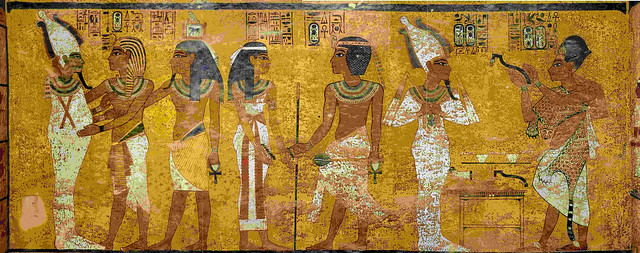 The key to [the King Tut] exhibit is...back in the Valley of the Kings on the north wall of the burial chamber. ...The second figure from the right is a depiction of the mummy as if it had just been stood up erect from where it lay and dressed as Osiris, the god of gods that each king becomes at what we call death.Facing him... is Tutankamun's successor, Ay, caped in the sacramental leopard skin usual in such succession scenes. In his hand is a wrench-like prying instrument... What Ay is doing is well known and described in hieroglyphics that translate as "The Opening of the Mouth" of Tutankhamun's mummy. A strange phrase. ...But not so strange to anyone remembering the history of a thousand miles to the east and a few centuries earlier In the great city-states along the Tigris and Euphrates, gods were wooden statues or idols, elaborately dressed, jeweled, and anointed, which from time to time underwent a ceremony called in cuneiform "The Washing of the Mouth." The idol was ritually carried to the river, where its wooden mouth was washed out with solutions of exotic ingredients as it was faced in various directions. And cuneiform texts state that such statues spoke and commanded their votaries what to do. -- Julian Jaynes
"The Meaning of King Tut"
Art/World Magazine, 1979
My archetypal reaction to Jaynes' writing: the bicameral-mind explanation of this mural seems completely plausible, so strongly so that I can't imagine its not being correct. But on the other hand... this is not at all my area of expertise. I can confirm via Google that the ceremonies Jaynes is referring to existed historically. So... I am just going to treat Jaynes' ideas as historically accurate and see where that leads me. Here is what the Egyptian Book of the Dead has to say about the mouth-opening ceremony, in Miriam Lichtheim's translation: Here is what the Egyptian Book of the Dead has to say about the mouth-opening ceremony, in Miriam Lichtheim's translation:
My mouth is opened by Ptah,
My mouth's bonds are loosed by my city-god.
Thoth has come fully equipped with spells,
He looses the bonds of Seth from my mouth.
Atum has given me my hands,
They are placed as guardians.
My mouth is given to me,
My mouth is opened by Ptah,
With that chisel of metal
With which he opened the mouth of the gods.
I am Sekhmet-Wadjet who dwells in the west of heaven,
I am Sahyt among the souls of On.
posted afternoon of May 28th, 2011: Respond
➳ More posts about The Bicameral Mind
|  |
Sunday, May 22nd, 2011

Holding as we do that, while knowledge of any kind is a thing to be honoured and prized, one kind of it may, either by reason of its greater exactness or of a higher dignity and greater wonderfulness in its objects, be more honourable and precious than another, on both accounts we should naturally be led to place in the front rank the study of the soul.--Aristotle
De Anima
(tr. J.A. Smith)
An interesting tidbit from Scott Greer's essay "A Knowing Noos and a Slippery Psychê: Jaynes's Recipe for an Unnatural Theory of Consciousness": Jaynes' estate library includes a copy of The Basic Works of Aristotle, in which the pages of De Anima are (unlike anything else in the library) covered with marginalia -- clearly it was an important book for Jaynes.Funnily enough I have the same edition of Aristotle -- I have not read any of his works but I did make a brief stab at De Anima 11 years ago.* My pages of De Anima have some annotations, the early pages, but they are generally more of the "trying to unravel the syntax" sort than the "introducing original insight" sort. Next to the opening sentence (quoted above) I have written, "There are types of knowledge; some types are more desirable. The best type is the study of the soul."
 *And there must have been some sort of faking-having-read Politics or portions thereof in freshman year of college. I've also (that I can remember) made attempts to read Metaphysics and On Generation and Corruption, but not really gotten anywhere with any of them.
posted evening of May 22nd, 2011: Respond
|  |
Saturday, May 21st, 2011
All joking aside, the final word on the recent prophecies of tribulation comes (by way of the Slacktivist) from my ranine namesake, prophet Jeremiah:
Build houses and live in them; plant gardens and eat what they produce. Take wives and have sons and daughters; take wives for your sons, and give your daughters in marriage, that they may bear sons and daughters; multiply there, and do not decrease. But seek the welfare of the city where I have sent you into exile, and pray to the Lord on its behalf, for in its welfare you will find your welfare. For thus says the Lord of hosts, the God of Israel: Do not let the prophets and the diviners who are among you deceive you, and do not listen to the dreams that they dream, for it is a lie that they are prophesying to you in my name; I did not send them, says the Lord.
 Update: mediævalists.net, relieved that the world has not ended, is linking some articles on mediæval references to rapture and tribulation. First in the series is Francis Gumerlock's 2002 essay on The History of Brother Dolcino (pdf), an early instance of pretribulationism.
posted evening of May 21st, 2011: Respond
➳ More posts about The Bible
|  |
I shut my eyes and try not to think, but consciousness still streams on, a great river of contents in a succession of different conditions which I have been taught to call thoughts, images, memories, interior dialogues, regrets, wishes, resolves, all interweaving with the constantly changing pageant of exterior sensations of which I am selectively aware.-- Julian Jaynes
The Origin of Consciousness in the Breakdown of the Bicameral Mind Here is something that has been running through my head as I read John Limber's essay "Language and Consciousness: Jaynes' 'Preposterous Idea' Reconsidered":
What about meditation? I have had mixed results with my occasional attempts over the years to meditate; but my understanding is that it is intended to address precisely this state of streamingly verbal consciousness. When one is in a successfully meditative state, so I believe, the stream of thoughts, images, memories, interior dialogues, regrets, wishes, resolves falls away and one is left with quiet interiority... Is this a reversion to bicamerality? In his piece "The Self as Interiorized Social Relations," Brian McVeigh suggests (if I am taking his point correctly -- it is an extremely dense essay) that hypnosis and spiritual possession can be seen as forms of reversion to the bicameral mentality. I wonder if meditation is another point in the same continuum -- I have heard meditative prayer described as "listening to the voice of God" which is certainly suggestive of something along these lines.
posted afternoon of May 21st, 2011: 2 responses
|  |
Thursday, May 19th, 2011
 For my birthday gift, Ellen and Sylvia gave me Reflections on the Dawn of Consciousness: Julian Jaynes' Bicameral Mind Theory Revisited, recently published by Marcel Kuijsten of the Julian Jaynes Society. Thanks, Ellen and Sylvia! It was just what I wanted. For my birthday gift, Ellen and Sylvia gave me Reflections on the Dawn of Consciousness: Julian Jaynes' Bicameral Mind Theory Revisited, recently published by Marcel Kuijsten of the Julian Jaynes Society. Thanks, Ellen and Sylvia! It was just what I wanted.
Started reading the book last night -- not much to say about it yet other than it is a lot of fun to read and thought-provoking. I wanted to quote some passages about occurrences of hallucinated imagery in visual and textual art. (The first essay in the book, after a prefatory biography of Jaynes, is a short piece Jaynes wrote for Art/World magazine in 1981 called "The Ghost of a Flea: Visions of William Blake", about Blake as a transcriber of heard voices.) I'm interested to read Jaynes' 1979 article "Paleolithic Cave Paintings as Eidetic Images", not reprinted in this volume but referenced a few times -- this is a great book if considered only as a source of outside references. Kuijsten references a couple of other writers in support of the idea that cave paintings are transcribed hallucinations, including
David Lewis-Williams, who argues that cave art was painted by individuals hallucinating in trance states. Lewis-Williams noticed similarities between recent rock art of the San tribe of the Kalahari and that of much older European cave art. He learned that modern San shaman engage in trance dances to "contact another world" for various purposes such as healing the sick, then noticed that the San rock art from past generations did not depict scenes from daily life but in fact represented spiritual experience and trance.
Kuijsten also talks about European and American writers, poets and artists who
have been known to draw inspiration from actual hallucinations. Judith Weissman discusses this in her book, Of Two Minds: Poets Who Hear Voices [ooh! another ref. to follow up...]. V.S. Ramachandran... describes visual hallucinations in the writer and artist James Thurber. Thurber was blind by the age of 35 and experienced visual hallucinations that he incorporated into his work. ...While in Egypt in 1904, [Aleister Crowley] claims that for three days between the hour of noon and 1pm his "Holy Guardian Angel" Aiwass dictated the Book of the Law to him. In his book Equinox of the Gods, Crowley describes the event in detail, saying that as he sat at his desk, the voice of Aiwass came from over his left shoulder in the furthest corner of the room. ...Crowley himself did not entirely rule out the possibility that the voice came from his own mind:
Of course I wrote them, ink on paper, in the material sense; but they are not My words, unless Aiwass be taken to be no more than my subconscious self, or some part of it; in that case, my conscious self being ignorant of the Truth in the Book and hostile to most of the ethics and philosophy of the Book, Aiwass is a severely suppressed part of me. Such a theory would further imply that I am, unknown to myself, possessed of all sorts of præternatural knowledge and power.
posted evening of May 19th, 2011: Respond
| |
Sunday, May 15th, 2011
I picked up Krakauer's Into the Wild at the South Orange Public Library's annual sale yesterday, and read it last night and today. It is a great read, hard to put down: it takes you into McCandless' world and into various historical frames with remarkable clarity. I have always admired Krakauer as a journalist; what he is doing here is not so much journalism as memoir -- he is examining himself through the lens of the research he did into McCandless' life and death. I wrote at the time I saw the movie that I found it sappy and that I expected the sappy qualities were Penn's additions to the story rather than Krakauer's writing. But they're not, or not precisely -- the book is an exercise in romanticization. What keeps it from being sappy is Krakauer's clarity about what he is doing in writing the book, about why he is romanticizing McCandless' life. The reflexive element of Krakauer's authorial voice was missing from the movie, so the problem was not additions by Penn but rather omission. Anyways: I found myself crying on the last pages of the book, and it came as something of a surprise how emotionally invested in the story, in the author's voice, I had become. Another beautiful thing about the book which was (as best I can recall) missing from the movie, is the epigraphs. Every chapter is headed with excerpts from the books McCandless was reading at the end of his life, and from other books Krakauer finds relevant to the case. His judgement is superb.
posted afternoon of May 15th, 2011: 2 responses
➳ More posts about Into the Wild
| |
Saturday, May 14th, 2011
Últimamente publicaba Jorge López unas fotografÃas increÃbles de su viaje a San Pedro de Atacama, y hoy me ha dejado sin hablar con los colores de su imagen de un momento perfecto:
posted morning of May 14th, 2011: Respond
➳ More posts about Desert Memories
| |
 bust of Pindar: National
Archæological Museum
of Naples
ἄÏιστον μὲν ὕδωÏ, ὠδὲ χÏυσὸς αἰθόμενον πῦÏ
ἅτε διαπÏÎπει νυκτὶ μεγάνοÏος ἔξοχα πλοÏτου
-- Pindar, Olympian Ode â… :
for Hieron of Syracuse
I got interested in this passage yesterday... I was trying to find out more about Œdipus and about Thebes, and one of the references was to Pindar's second Olympian ode. That particular reference* didn't turn up so much of interest; but I found the beginning of the first Olympian ode enchanting. Diane Svarlien translates it as "Water is best, and gold, like a blazing fire in the night, stands out supreme of all lordly wealth." I don't know Greek, but let's see how this works. The Perseus Digital Library makes it easy:
- ἄÏιστον μὲν ὕδωÏ: Water is best. This seems clear enough, I know "arist-" from its use in English, and "udor" is close enough to "water" for my ear. What does Pindar mean? That water is the most virtuous/noblest of the elements? It looks sort of like he's setting up water in opposition to gold; the lexicon at Perseus says μὲν ... δὲ can be rendered as "on the one hand... on the other hand" -- this does not come through in Svarlien's translation.
- χÏυσὸς αἰθόμενον Ï€á¿¦Ï á¼…Ï„Îµ... νυκτὶ: Gold blazing just like fire at night.
- διαπÏÎπει: It catches the eye.
- μεγάνοÏος ἔξοχα πλοÏτου: It looks to me like this phrase is meant to modify "gold" -- it's not too clear to me what "meganoros" is meant to do -- maybe in English this could be rendered as "but then again gold, the greatest wealth of great men, catches the eye; it blazes just like fire in the nighttime."
What does it all mean? ...Pindar is setting up some standards of greatness, it looks like, and then he is going to say that the greatest of all is the exploits of the Olympic contestants. Today in the NY Times magazine, Gary Wolf uses a different superlative in a similar construction when he calls gold "the most primitive form of wealth" -- seems like you could argue against that assertion, but anyways it caught my eye on the heels of reading Pindar.Another sort of amusing detail, for me anyways: AOTW one of the top Google hits for this passage is Belle Waring's post a few years ago at Crooked Timber about the badness of comments sections at various moderate-left political blogs.
 * "In such a way does Fate, who keeps their pleasant fortune to be handed from father to son, bring at another time some painful reversal together with god-sent prosperity, since the destined son met and killed Laius, and fulfilled the oracle of Pytho, spoken long before." -- Svarlien's translation
Update: I found my copy of Lattimore's translation of Pindar. (Which also is online at archive.org.) His rendering of the opening lines:
Best of all things is water; but gold, like a gleaming fire
by night, outshines all pride of wealth beside.
rings most pleasantly in my ears.
posted morning of May 14th, 2011: Respond
➳ More posts about Language
| |
Tuesday, May 10th, 2011
I picked up Ferlinghetti's Landscapes of Living and Dying again this weekend and found myself entranced again by the crystal clarity of his images and by the sparse beauty of his syllables.
For years the old Italians have been dying
all over America
For years the old Italians in faded felt hats
have been sunning themselves and dying
You have seen them on the benches
of the park in Washington Square
the old Italians in their black high button shoes
the old men in their old felt fedoras
with stained hatbands
have been dying and dying
day by day
This old Italian (nearly 60 when he was writing these poems, in his 90's today) paints his landscapes all over America, from Washington Square to Spartanburg, SC, to Washington, DC, Wisconsin, Michigan, Springfield, San Francisco, San Jose... In each location he captures the perfect details to bring the scene to life.
posted evening of May 10th, 2011: Respond
➳ More posts about Lawrence Ferlinghetti
|  |
Saturday, May 7th, 2011
 A question I need to ask myself about The Origin of Consciousness in the Breakdown of the Bicameral Mind: What does it mean for me to say I like this book, to say that it has influenced my thinking? A question I need to ask myself about The Origin of Consciousness in the Breakdown of the Bicameral Mind: What does it mean for me to say I like this book, to say that it has influenced my thinking?
I read a lot of novels and stories, and the notion of being influenced by a book I've read is a familiar one to me in the case of fiction -- it means the images from the story have become part of my intellectual currency, part of the landscape of imagery on which I live my internal life... Jaynes' book is clearly not a novel; in order to assimilate his imagery do I need to make the assertion that I believe his psychological theory to be true? That would be
a difficult assertion for me to make. I am not a historian or a neurologist -- while some of the historical and neurological evidence he lays out to back up his theory sounds convincing, some sounds strained, I don't ultimately have the background to judge it valid or not. I appreciate his literary analysis of The Iliad -- it greatly enriches my reading of the poem -- but have trouble accepting that as the basis for a historical theory of consciousness. So I am going to go with the much weaker assertion that Jaynes' model resonates with me: that it gives me a plausible means of understanding my own consciousness, one that matches up with the moments of inspiration which have been part of my experience.
And ultimately that is really what I'm looking for -- a way to understand inspiration. What I'm looking for is a way to write, and to write I need inspiration. The idea that the inspiration coming all-too-seldom to me is the pre-conscious voice of an internal God, and that the perspiration necessary to turn that voice into writing is the process of giving birth to consciousness, well... it works for me. YMMV. (And note, this blog post like most of my posts is almost completely inspiration-free -- a couple of wording choices may have the freshness of inspiration, but in general it is written self-consciously, a product of striving to get at the source of inspiration... That is for me a necessary part of the process.)
posted morning of May 7th, 2011: 2 responses
| Previous posts about Readings
Archives  | |
|
Drop me a line! or, sign my Guestbook.
•
Check out Ellen's writing at Patch.com.
| |