|
|
Thursday, June 30th, 2011

"However much you feed a wolf, it always looks to the forest. We are all wolves in the dense forest of Eternity." This was written by the Russian poet Marina Tsvetaeva, the man said softly as he stroked the silver fur of the animal crouched in his arms. The animal pricked up its ears, then strained to look back at the dark copse of trees where shadows moved as if alive. As if alive and waiting to move out into the open.
Listen, this process called poetry is an exercise in imagining memory, and then having that memory snare and cherish imagination. Yet, every poem is and will be a capsule of territory in the perpetual present tense, a vessel taking on the ever-changing colors of the sea.-- Breyten Breytenbach
"Poetry is the Breath of Awareness"
Intimate Stranger
 (The Tsvetaeva quote is from her book of essays, Art in the Light of Conscience, tr. Angela Livingstone.)
posted evening of June 30th, 2011: Respond
➳ More posts about Intimate Stranger
|  |
|
A new poem from Pelele had the happy effect of reminding me of one of my very favorite poems, Kenneth Koch's "Lunch" -- and the funny thing is, I was noticing similarities to "Lunch" 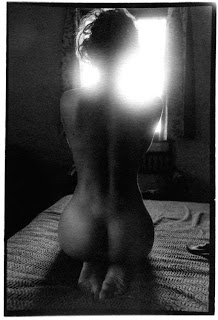 even before I looked up to the top of the poem and noticed Pelele's title... even before I looked up to the top of the poem and noticed Pelele's title...
Breakfastby Eduardo Valverde
Last night I dreamed of you -- or of your father:
a tall man under his hat.
The place I found myself reminded me,
its silence, of a bird -- a bird that’s sleeping,
an engine, maybe, lying in the junkheap.
He came along, his face drawn long, like kids
when they play at grown-up
or like a bankrupt god
who tallies up his mornings carefully
and finds that all that glitters is not gold;
he carried a green bottle in his hands
and the analgesic pain that comes of touching earthly things.
He spoke enthusiastically of the sea's paternal womb,
of land unmapped, unconquered, which begins off in the darkness --
in every single letter of the word, “desperation†--
He spoke of a taste like olives, of the flavor in her breasts,
in hers who never aged but who had brought forth many daughters
each with olive nipples;
of the unease that he feels before the window in a photo
in which a bowl of fruit is standing lonesome on the floor
of the hallway in a vacant house --
or I should say, before the light that’s coming through the window,
an angel hewn of green basalt;
a solid angel, weak Annunciation.
He poured me out a cup and took the bottle by its neck.
Could not remember you; but he said,
with joy in his eyes, he said My kids were like the rattle
of the hills when trains are rolling by;
like a pack of dogs, dogs baying in the distance
to push your weary heart along the journey.
It must have been getting dark, I guess -- a solitary lamp
was turning back to ash his eyes and moustache
And me, I was anxious, I needed to pee;
I felt my dress was falling into shadow --
its weight returning --
raised my hands to my cheeks and found I was not dying
nor was I really back among the living.
 Two images in particular seem like they could have come from Koch's pen, the woman "who never aged but who had brought forth many daughters/ each with olive nipples", and the man boasting, "My kids were like the rattle/ of the hills when trains are rolling by" -- also the general flow of the text and of voice reminds me of Koch. (I have probably intensified this similarity in my translation; but I believe it is present in the original as well.) The "analgesic pain that comes of touching earthly things" is going to stay with me for a long time.
posted evening of June 30th, 2011: 2 responses
➳ More posts about Translation
|  |
Sunday, June 26th, 2011
I find myself fascinated by Steven White's statement about Alfonso Cortés, Nicaragua's "poeta loco," that he "was prone to fits of violence that coincided with the full moon" -- I am finding in Cortés' poetry some beautiful fragments without its yet coming together for me as a whole. Inscribed on Cortés' tomb in León (adjacent to the tomb of Rubén Dario) is his poem "Supplication." Inscribed on Cortés' tomb in León (adjacent to the tomb of Rubén Dario) is his poem "Supplication."
Time is hunger, space is cold
pray, pray: only supplication
can satisfy the longings of the void.
Dreaming is a lonely rock
where the eagle of the soul can build his nest:
dream, dream, dream the whole day long.
(I see a couple of references, in the few of Cortés' poems that White includes, to ether -- I wonder if he was a recreational user and if so, whether that had anything to do with his reputation for insanity.)
posted evening of June 26th, 2011: 2 responses
➳ More posts about Poets of Nicaragua
|  |
Wednesday, June 22nd, 2011
A lot of writing, and a fair amount of interesting writing, has been done at The Hooded Utilitarian over the past few weeks on the topic of racist images in R. Crumb's work. At the beginning of the month Domingos Isabelinho's strongly negative reference to Angelfood McSpade provoked an enormous, vituperative comments thread. (A large portion of the posts coming from one embarrassingly devoted Crumb fan who will not hear any evil spoken of his object of adoration -- but with plenty of worthwhile thinking as well.) Today, Robert Stanley Martin devotes a lengthy post to the issue, with reference to McSpade, the Cheap Thrills album cover, and Al Jolson(!) And in comments, Noah Berlatsky promises a post of his own about the Cheap Thrills cover.* Well, I'm not sure quite what to make of this... I think of Crumb as a great cartoonist and of the racist and misogynistic imagery as a key, integral part of his work. Certainly worth reading and writing about.
 * Update: Noah's post is here.
Update II: and Sean Michael Robinson's contribution to the conversation.
posted evening of June 22nd, 2011: Respond
➳ More posts about R. Crumb
|  |
Chad Post of 3% links to an interview with Sergio Chejfec at Fric-Frac Club (and in translation at Read This Next), which includes a hilarious anecdote about Chejfec's first experience (as "a very and consistently bored child" -- which "was a common thing for my generation, at least it’s what I’ve got to think") writing fiction:
One day, it occurred to me to send a fictitious postcard to my mother : it would be written by a sister she had never heard of, who would announce therein that she had numerous revelations to disclose : a dark and scandalous family past, a very sad past, and so on, a real melodrama. In order that the story seem truer, I had to send the card from another country: Paraguay. During my childhood, Paraguay had been for me an exotic country (it was by way of Paraguay that my parents had come secretly into Argentina, after the Second World War). The text was written and I was ready to go buy the postcard at the corner bookstore, on which to to copy it out. But once there, I realized that they didn’t sell postcards for Paraguay, and more problematically even, that I could not send a card from Paraguay! These obstacles proved insurmountable, I had to resign myself finally to the plan’s failure.
I don’t know if there’s some lesson to be taken from this story, or whether to consider it a major defeat. I think that today I would not assign so much importance to details, which seemed so essential then to the making of a credible story. But it was the first time I wrote a fiction and I still remember my anxiety on the walk to the bookstore, in search of a postcard for Asunción del Paraguay.
posted evening of June 22nd, 2011: Respond
➳ More posts about Sergio Chejfec
|  |
Saturday, June 18th, 2011
I cooked dinner tonight from my very favorite cookbook, one that I've been going back to for more than 20 years now. It was an excellent dinner; and finding that  I've never written about this cookbook on this blog, I feel I should remedy that oversight -- if you're interested in learning to cook this style of food, I can't recommend this book highly enough. I've never written about this cookbook on this blog, I feel I should remedy that oversight -- if you're interested in learning to cook this style of food, I can't recommend this book highly enough.
The book is The Spice Box: Vegetarian Indian Cookbook, by Manju Singh. It is a thin book, about 200 pages, filled with terse recipes generally a half-page long or so. The first few pages describe cooking techniques and spice mixtures and repay endless re-reading; with this information in mind the brief recipes are easy to follow and delicious. Singh's genius lies in not over-specifying ingredients and cooking directions. All instructions are simple and to the point; and it is easy to vary the recipes to your own tastes and to use what ingredients you have on hand. Dinner tonight (which was inspired by the need for something to complement the delicious mango pickles Huzefa gave us) was a vegetable curry with cauliflower and potatoes, pink lentil curry, coriander chutney, and an improvised raita; the four dishes took a total of about 40 minutes preparation time.
posted evening of June 18th, 2011: Respond
➳ More posts about Recipes
|  |
 On the first anniversary of José Saramago's death, Pilar del RÃo scatters his ashes at the foot of an olive tree in Lisbon. (The tree was transplanted from Saramago's birthplace, Azinhaga.) image via elpais.com
posted evening of June 18th, 2011: 1 response
➳ More posts about José Saramago
|  |
Thursday, June 16th, 2011
Happy Bloomsday! In case you're looking for something to read today, I see the Calypso episode is now complete at Ulysses, Seen. Mr. Leopold Bloom ate with relish the inner organs of beasts and fowls...
Oh wow! Also, Robert Berry (author of Ulysses, Seen) is Twittering the events of Ulysses throughout the day today. (He is doing it on Dublin time.) Right now, Stephen is walking down the beach to Sandymount Strand.
posted morning of June 16th, 2011: Respond
➳ More posts about Ulysses
| |
Monday, June 13th, 2011
This is my translation of Pelele's poem "Mutilaciones," which touched me so strongly when I read it last week.
Hacking it Apart
by Eduardo Valverde
The cripple in the morning
is the flight, the flight to nowhere,
is the light, the graveyard's light
that's shining, shining in my windows,
it's the bus, the line of buses
stinking sweetly on the roadway,
it's the cat up on the rooftop
where it's watching over the bells.
Half-blindness in the morning
is the frigid bite of dawn,
and forgetfulness's knockers
have no prince, have just a frog,
with the freezing rain foreseen
inside the blossom of my eyes,
inside the corpses of my
promised lands, still warm.
Half-lameness in the morning
is the spirit of the road,
and I've got my eyes wide open,
got my shrunken spirit's cough;
the sun, the half-lit sun, oh
how it's burning in their motors,
it's the end of every heartbreak,
they're in mourning for their games.
The birds get off scot-free,
my reading glasses going blind,
with whole decades slowly
dawning on this Monday.
A tantalizing thought I had on the train home this evening: with fairly minor rewrites, this poem could be set to the tune of David Rawling's "I Hear Them All".
posted evening of June 13th, 2011: 4 responses
➳ More posts about Writing Projects
|  |
Saturday, June 11th, 2011
Here are a couple of poems I have written recently. Experimenting with story-telling and with prosody.
Horizon
The best-laid tracks converge, they meet
way out there by the setting sun
confounding engineering dreams perspective in the desert
where the train runs off the vanished rails and crashes, yes,
it's tragic, sad-sack Sam the goldrush pioneer will never see his lover
who was riding west to meet him, look how Jesse and his outlaws
are confused, the hold-up won't play out, they may just ride their horses over the edge behind the train or else perhaps they'll turn back just in time, they'll skirt impending doom and spend their days retelling stories of the one that got away.
Crystal Armies
Fit the image to the meter
We can print it when you're done
When the armies that you're dreaming
Wander sleepy off the page and
Wave their effervescent banners
To the rhythm of your drum.
Marching softly, scarcely there,
You have to strain to make them out
Their dusty footprints on the pages
Almost like a printer's error
When they finally encamp
Inside your thawed out cerebellum
They'll build ghostly fires and sing
About the journeys of their fathers
And you'll scratch your forehead wondering
(In your clarity of vision)
Where the simple, crystal image
Of your verbal armies went.
I'd like to thank Pelele of Muchacha Recostada, who has posted what I believe to be a great poem, Mutilaciones (from 2009) -- my working definition of a great poem is one the reading of which alters how you read and write poetry -- I believe that "Mutilaciones," with its frantic, driving meter and its clarity of vision, will have a permanent effect on my reading of poetry and on my poetic output. "Crystal Armies" is written strongly under the influence of Pelele's piece. I'm working on a translation of "Mutilaciones"* which will be my first time (even dreaming of) translating a metered poem -- I do not think I am going to be able to keep the rhyme, but the meter is coming through very naturally.
 * Update: translation is here.
posted morning of June 11th, 2011: Respond
➳ More posts about Poetry
| Previous posts about Readings
Archives  | |
|
Drop me a line! or, sign my Guestbook.
•
Check out Ellen's writing at Patch.com.
| |


 From Scratch