|
|
Tuesday, October 25th, 2011
 I'm happy to find a couple of new Lovecraft links this week -- I'm happy to find a couple of new Lovecraft links this week --
- The Fungi from Yuggoth is a sequence of 36 sonnets, the narrative of a man's encounter with the spawn of the Nameless Ones; YouTube user ChurchofTjolGtjaR has uploaded a reading of it with spacey music. Wikipædia lists 5 recordings of the sequence; I do not know which one this is.
- Chris Lackey and Chad Fifer's H.P. Lovecraft Literary Podcast features weekly readings from Lovecraft and discussion. Good stuff! (Thanks for the link, Eleanore!)
 (Speaking of the Elder Gods, they put in an appearance in Dorothy Gambrell's latest Very Small Array cartoon: What is Coming to Get Us?)
posted evening of October 25th, 2011: Respond
➳ More posts about Reading aloud
|  |
Sunday, October 23rd, 2011
(from Chapter 3 of Our lady of the dark flowers)
From the four points of the compass they came, the strikers on their way to Alto de San Antonio in their long, dusty caravans. The village was boiling over with excitement. As you looked into the chaos of the crowds streaming through the village's streets, you could see signs bearing the names of salitreras, La Gloria, San Pedro, Palmira, Argentina, San Pablo, Cataluña, Santa Clara, La Perla, Santa Ana, Esmeralda, San AgustÃn, Santa LucÃa, Hanssa, San Lorenzo, others that we hadn't even heard of. And that's not all -- covered with dirt from their heads to their feet,the strikers came singing, shouting, not only the oficinas in San Antonio's district, but from every district in the Pampa del Tamarugal. The influx of people showed no signs of letting up. The strike had spread across the pampa like a duststorm -- "Good dust, the dust of righteousness, my brothers" crowed Domingo Dominguez, walking among the crowd. To the bird's eye, there were more than five thousand of us, pushing together into the streets of the village, bringing our power to the strike. Men of every race and nationality, groups which had clashed in bitter fratricidal wars, were coming together now under the sun, under a single standard -- that of the proletariate.
posted afternoon of October 23rd, 2011: Respond
➳ More posts about Our Lady of the Dark Flowers
|  |
Saturday, October 22nd, 2011
I feel like I give short shrift here at READIN to quick, intense reads, like it is mostly the books that take me a long time to read that I am moved to write about. (This is not always true, Costaguana was a pretty quick read -- but anyways.) Three books that I've devoured recently and found most satisfying, nourishing meals.
- Feeding on Dreams by Ariel Dorfman.
His memoir on revolution and repression in Chile and principally on the paths of exile and seeking a home (and seeking a voice) that his life has followed in the decades of the dictatorship and the decades since.
- Golden Boy, Emerald Girl by Yiyun Li.
Short stories about life in China and as an immigrant. Fascinating sense of dread and pointlessness. You can read the title story in the New Yorker.
- In the sea there are crocodiles by Fabio Geda and translated from Italian by Howard Curtis.
Telling the emigrant story of Enaiatollah Akbari, his journey in his tenth through fifteenth years from Afghanistan to Italy by way of Pakistan, Iran, Turkey and Greece. Akbari's encounters -- friends and strangers who help him survive and make his way to his home in Italy, soldiers and thugs and police who make his way more difficult, the family that ultimately decides to foster him and help him seek asylum -- are gripping, moving, haunting stuff.
 (It is not until after mentioning these three in the same breath that I realize they share (very loosely) a common theme of homeland and exile. Not sure what to make of this...)
posted evening of October 22nd, 2011: 1 response
| |
Saturday, October 15th, 2011
Sylvia got a lovely birthday present from my parents, a bunch of merch from Moomin Shop, in Finland. A "Little My" nightgown, a mug with a likeness of Moominmamma, copies of "The Book About Moomin, Mymble, and Little My" in both English and Finnish --  Sylvia and I spent a little while watching this (beautiful) 2009 production of "Kuinkas Sitten Kävikään?" and reading along... Sylvia and I spent a little while watching this (beautiful) 2009 production of "Kuinkas Sitten Kävikään?" and reading along...
posted evening of October 15th, 2011: Respond
➳ More posts about Moomins
|  |
Sunday, October 9th, 2011
One of the big attractions for me about reading this edition of Cosmicomics was its completeness -- all the Cosmicomics stories Calvino ever published, including seven that have never previously been translated. The collector in me loves getting the opportunity to read and reread them all at once... The collector in me loves getting the opportunity to read and reread them all at once... And what about it? I'm nearly at the end of the book now, is it a good thing to have the stories all bundled up like this for reading together? I think it is. My memory of first reading Cosmicomics (just the first 12 stories) is of being excited and stimulated and pulled through the book -- that is very similar to what's happening this time with the 34 stories. While the first volume felt complete on its own, the subsequent additions certainly hold their own and complement it. The newly translated stories (translated by Martin McLaughlin, who also wrote the introduction to this collection) are seven stories from the 1968 collection World Memory and other Cosmicomics Stories. They are not all in the vein of the earlier stories -- some certainly are similar, such as "The Meteorites", and some are distinctly different, such as the exquisite "Solar Storm." The title story, "World Memory" (the only one that was already translated, by Tim Parks) is a... well a sui generis story, but sort of a murder mystery. They reinforce the themes and ideas of the earlier stories, and they branch out and diverge into their own stylistic innovations and subtleties.
posted evening of October 9th, 2011: Respond
➳ More posts about Cosmicomics
|  |
Saturday, October 8th, 2011
Ellen and I watched The Stone Raft (2002) tonight. A good, solid movie and a faithful adaptation of the book. It did not give me the sense of being in the presence of genius, as the book did; but then it also did not take weeks to watch. There is a lot of beauty in the movie and I would certainly recommend it. This book was half road trip/buddy story/love story, half weird unresolvable meandering about the metaphysical/metahistorical status of Spain and Portugal; the team that turned it into a movie made the wise choice to focus on the more filmable aspects of the book. And the dog! What a sweet dog!
posted evening of October 8th, 2011: Respond
➳ More posts about The Stone Raft
|  |
It is a leap backward that we take from 1830 to
1810. We are in Odense, that old city, which takes its name from Odin.
The common people there have still a legend about the origin of the name of the city. Upon Næsbyhoved's Hill there once stood a castle; here lived King Odin and his wife:
Odense city was not then in existence, but the first building of it was then begun. The court was undecided as to the name which
should be given to the city. After long indecision it was at last agreed that the first word which either King or Queen should speak the next morning should be the name given to it. In the early morning the Queen awoke and looked out from her window over the wood. The first house in the city was erected to the roof, and the  builders had hung up a great garland, glittering with tinsel, upon the rooftree. "Odin, see!" exclaimed the Queen; and thenceforward the city was called Odensee, which name, since then, has been changed by daily speech to Odense. builders had hung up a great garland, glittering with tinsel, upon the rooftree. "Odin, see!" exclaimed the Queen; and thenceforward the city was called Odensee, which name, since then, has been changed by daily speech to Odense. O.T.: A Danish Romance
Hans Christian Andersen Jens Galschiøt will today be sinking his statue of Hans Christian Andersen into the harbor at Odense, Andersen's home town, to become covered with barnacles and seaweed, to watch the ships come and go and to "keep an eye on the mermaids." If you're in Denmark, it sounds like a great time -- go drink some funeral beer with Galschiøt and watch his creation disappear beneath the waves.
posted morning of October 8th, 2011: 1 response
|  |
|
 I'd like to quote at length a paragraph from "t zero," below the fold -- so we can observe and appreciate and meditate upon the crystalline beauty of the writing and of the ideas, you and I, and so that I can briefly mount one of my favorite hobby horses. I'd like to quote at length a paragraph from "t zero," below the fold -- so we can observe and appreciate and meditate upon the crystalline beauty of the writing and of the ideas, you and I, and so that I can briefly mount one of my favorite hobby horses.
So now that I have decided to inhabit forever this second t0 -- and if I hadn't decided to it would be the same thing because as Q0 I can inhabit no other -- I have ample leisure to look around and to contemplate my second to its full extent. It encompasses on my right a river blackish with hippopotamuses, on my left the savannah blackish-white with zebras, and scattered at various points along the horizon some baobab trees blackish-yellow with toucans, each of these elements marked by the positions occupied respectively by the hippopotamuses H(a)0, H(b)0, H(c)0 et cetera, by the zebras Z(a)0, Z(b)0, Z(c)0 et cetera, the toucans T(a)0, T(b)0, T(c)0 et cetera. It further embraces hut villages and warehouses of importers and exporters, plantations that conceal underground thousands of seeds at different moments of the process of germination, endless deserts with the position of each grain of sand G(a)0 G(b)0... G(nn)0 transported by the wind, cities at night with lighted windows and dark windows, cities during the day with red and yellow and green traffic lights, production graphs, price indices, stock market figures, epidemics of contagious diseases with the position of each virus, local wars with volleys of bullets B(a)0 B(b)0... B(z)0 B(zz)0 B(zzz)0... suspended in their trajectory, bullets which may strike the enemies E(a)0 E(b)0 E(c)0 hidden among the leaves, airplanes with clusters of just-released bombs suspended beneath them, airplanes with clusters of bombs waiting to be released, total war implicit in the international situation (IS)0 which at some unknown moment (IS)X will become explicit total war, explosions of supernovæ which might change radically the configuration of our galaxy...
I'm interested in what it means to take an instantaneous slice of reality this way. As Calvino/Qfwfq noted in the first volume of Cosmicomics, in the story "The Light-Years," every object is, to observers, a sphere expanding at the speed of light -- the observer perceives the object at the instant when the skin of that sphere crosses his/her location. The instant t0 has to be identified with Q0's location in space, and the subscript zero as applied to zebras, hippopotamuses, bullets, international situations, if it is to mean the same thing as the subscript zero applied to Qfwfq and his instant, has to refer to the surfaces of their spheres, all intersecting at locus Q. But at the moment when this happens (again, as pointed out in "The Light-Years"), that zebra over there is no longer Z(n)0, it has gone on to become some Z(n)a which will at some later tx become visible to Qx...
↻...done
posted morning of October 8th, 2011: Respond
➳ More posts about Italo Calvino
|  |
Friday, October 7th, 2011
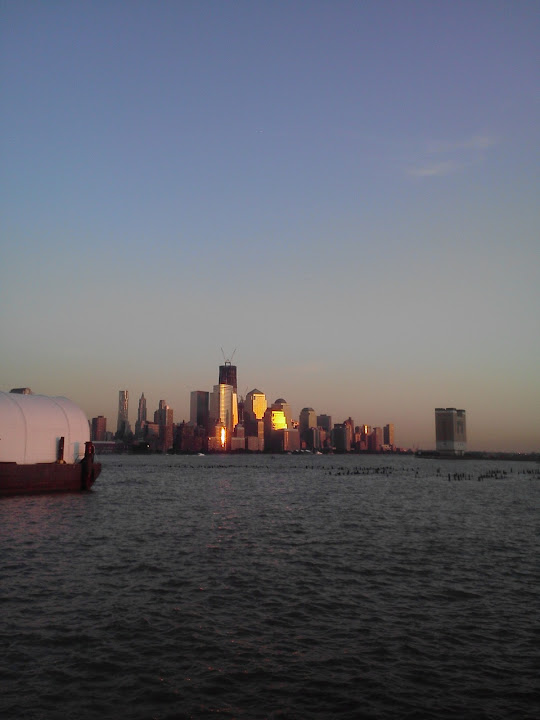 Cluster of prisms, rising into the sunset Cluster of prisms, rising into the sunset
The last section of Time and the Hunter, "t zero" is a great relief after the frenzied anxiety of "More of Qfwfq" and the dizzying (for me insuperable) complexity of "Priscilla." The calm voice of the narrator from the first volume is back. He wants to talk about duration here -- how events follow one another in their stream, what a slice of that stream might look like if it could be frozen in place. Less attention is paid here to character and plot -- indeed the stories in this section read more like essays than like works of fiction.
posted evening of October 7th, 2011: Respond
➳ More posts about Pretty Pictures
| |
Thursday, October 6th, 2011
 Cluster of prisms seen from Hoboken Cluster of prisms seen from HobokenThis trilogy of stories makes up the middle section of Time and the Hunter -- exploring Qfwfq's relationship with his beloved Priscilla through the eyes of the trillions of cells which make up their multicellular beings. I am finding these stories pretty difficult to process -- there is a hint of beauty and insight lurking in the text but the shrill verbosity of it is keeping me from finding any clarity. Some exceptional passages to be sure. Take for instance Qfwfq's deterministic understanding of his passions and desires as serving the needs of his cells --
This is how we live, not free, surrounded by freedom, driven, acted on by this constant wave which is the combination of the possible cases and which passes through those points of space and time in which the range of pasts is joined to the range of futures.... The ancient tide rises at intervals in me and in Priscilla following the course of the moon...
And the scene at the end of "Meiosis," the two of them as camels, is utterly fantastic.
posted evening of October 6th, 2011: Respond
| Previous posts about Readings
Archives  | |
|
Drop me a line! or, sign my Guestbook.
•
Check out Ellen's writing at Patch.com.
| |


