|
|
Wednesday, December 7th, 2011

Iñaki me miró y lugo miró el mar y sólo entonces comprendà que la escena tenÃa algo de irremediablemente ridÃculo y que lo ridÃculo no era ajeno a mi presencia allÃ.
—Jaume Planells
June, 1994
A couple of episodes in part 2 of Savage Detectives are retold several times by successive narrators/interviewees, from their different vantage points. I think these are my favorite parts of the book -- here Bolaño uses the form he has chosen to its fullest extent. One of these is Belano's ludicrous duel with Iñaki Echavarne, fought off-season on a nude beach near Barcelona sometime in the early 90's (as close as I can tell) -- it is told first by unsuspecting Susana Puig, Belano's nurse and lover when he was hospitalized for pancreatitis, then by Guillem Piña, who hatches the scheme with Belano and serves as his second, then by Jaume Planells, who is drawn in against his better judgement as Echavarne's second. I'd like to think about what it means that Duchamp's Nude Descending a Staircase #2 serves as a leitmotif for this episode. Piña repeatedly says he "felt like the Nude Descending a Staircase" in relation to Belano and that he "waited, which is what the Nude Descending a Staircase did" -- Planells picks up on this when he says he thinks Echavarne mentioned the painting when telling him about the duel, wonders "what did Picasso have to do with it?" And, well, I'm not sure what Picasso or Duchamp has to do with this absurd duel. The whole thing works nicely as a way of keeping the image in your mind when you're reading the episode, as a backdrop to its events. Bolaño has not used visual art this way very much in Savage Detectives -- many of the poems in Romantic Dogs have a painting as their centerpiece.
 I ran into a woman on the subway this morning who was reading The Skating Rink, and we chatted for a few minutes about how Bolaño is the greatest thing ever. That was fun.
posted evening of December 7th, 2011: 2 responses
➳ More posts about The Savage Detectives
|  |
Tuesday, December 6th, 2011

Y Cesárea me miró, una mirada cortita, asà como de lado, y dijo que ése era el porvenir común de todos los mortales, buscar un lugar donde vivir y un lugar donde trabajar.
—Amadeo Salvatierra
January, 1976
While I was reading Amadeo Salvatierra's narrative this afternoon, it occurred to me to wonder whether he has ever referred to either of his two guests individually -- he is always saying things to "the boys" or recounting what they say to him, never (if memory serves) either one of the two by himself. A little funny because everywhere else in the book there seems to be a pretty strong distinction drawn between the two of them.
posted evening of December 6th, 2011: Respond
➳ More posts about Roberto Bolaño
|  |
Monday, December 5th, 2011
In Savage Detectives Group Read news, Rise links to two videos: Laura Healy reading from Romantic Dogs, and Natasha Wimmer talking with Daniel Alarcón about how she discovered Bolaño's work. (Wimmer's biographical essay "Bolaño and the Savage Detectives" is online at Anagrama.)
posted evening of December 5th, 2011: Respond
➳ More posts about The Romantic Dogs
|  |
Sunday, December 4th, 2011

Un poquito sublime y un poquito siniestro. Como en todo amor loco, ¿no? Si al infinito uno añade más infinito, el resultado es infinito. Si uno junta lo sublime con lo siniestro, el resultado es siniestro. ¿No?
—Felipe Müller
October, 1991
The narratives in the latter half of part 2 of Savage Detectives are spinning farther and farther away from the core of the book (which I stubbornly continue to insist is Belano and Lima's search for Cesárea Tinajero in 1975-6) -- long narratives by minor characters which involve Belano and Lima only glancingly or only in parts. Look at Felipe Müller's narrative from October, 1991 -- Müller summarizes a short story by Theodore Sturgeon, one which he is pretty sure Belano told him, "since he was the only one of our crowd who read science fiction."The story is "When You Care, When You Love" -- it strikes me as curious and interesting that a full three pages are spent on relating this story, more adjacent space than has been devoted to any other work referenced in this book so far. Add another entry to the long list of influences for Bolaño, I guess...
posted morning of December 4th, 2011: 2 responses
|  |
Saturday, December third, 2011
photo by Sylvia Daniel Grossman, sentado en un banco de la Alameda, México df, febrero 1993.
posted afternoon of December third, 2011: Respond
➳ More posts about Pretty Pictures
| |
Tuesday, November 29th, 2011

...el Impala aún seguÃa aquÃ, por lo que deduzco quie actué con una velocidad sólo concedida a ciertos locos, y vi el Impala con mis gafas, esas gafas que hasta ese momento no sabÃa que poseÃa...
—Quim Font
August, 1987
The more I read from Quim Font's monologues, the more I like him. He is beginning to remind me of Amadeo Salvatierra, who I think is the only other narrator in the same age bracket... The two are not at all the same person, but they share a few endearing mannerisms.
 I'm knocked a bit for a loop by Andrés RamÃrez' monologue from December 1988. The first sentence is "I was destined to be a failure, Belano, take my word for it." (Wimmer's rendering -- had to look this up to make sure I was understanding correctly what he was saying.) This is the first time any of the narrators has addressed an interviewer by name -- so the interviewer here is Belano. But for a lot of reasons Belano cannot be the interviewer elsewhere...
posted evening of November 29th, 2011: Respond
| |
Monday, November 28th, 2011
Brandon Holmquest's analysis of the practice of translating poetry is well worth reading. Holmquest translates Borges' poem "El general Quiroga va en coche al muere" and examines closely the decisions he is making at each juncture.
posted morning of November 28th, 2011: Respond
➳ More posts about Jorge Luis Borges
| |
Sunday, November 27th, 2011

¿Qué ocurre?, dije yo. No ocurre nada, todo se ha acabado, dijo Albertito.
— Luis Sebastián Rosado
February, 1984
It is good to know that Pieldivina's death in Savage Detectives is not part of the historical infrastructure of the book -- that he is alive and "in fact did not die a singularly depressing death of a brain tumor." He is (to my ear) a fantastic sculptor of syllables -- check out his poem "Tell them who you are", in both English (Brandon Holmquest's able rendering) and Spanish at that link.
posted evening of November 27th, 2011: 1 response
|  |
|

Todo habÃa empezado, según Piel Divina, con una viaje que Lima y su amigo Belano hicieron al norte, a principios de 1976.
— Luis Sebastián Rosado
March, 1983
Piel Divina, homeless poet in Mexico City, puts together a paranoid narrative in which Lima has been pursued by some nameless, evil organization since the trip to Sonora; that his disappearance in Managua is part of his flight from the organization. Interesting... This is the approximate halfway point of the book, and we see Piel Divina putting himself forward as a detective. I had been thinking of the "savage detectives" as being Belano and Lima searching for Cesárea Tinajero; but this works too, and it makes the reader also into a savage detective, one on the trail of the visceral realists.When Piel Divina leaves Rosado's house, he takes with him some clothing and "a novel by Fernando del Paso", which given the date of Rosado's narration has to be either José Trigo or Palinuro de México.
 In Savage Detectives group read news, Rise links to a podcast of a reading at Symphony Space: Roberto Bolaño and the authors he admired, from last November.
posted morning of November 27th, 2011: Respond
| |
Saturday, November 26th, 2011
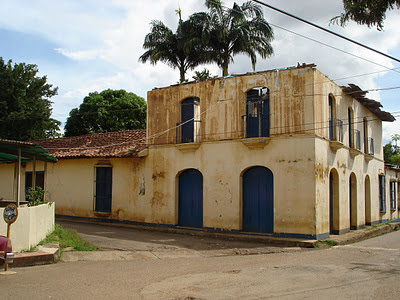
The concept of
Impermanence manifests itself frequently enough in Buddhist philosophy. It asserts that life "is like a dream, just like a dream. Completely hallucinatory -- like lightning -- of a transitory nature. Lightning brings with it an explosion of light and disappears immediately. That's how things are, that's life."*
Since I laid eyes on this house I have not been able to stop thinking about it. Its beauty is incredible, in spite of its state of deterioration.
Passing by, the years have softened the memories: the laughter of children in its hallways, the extraordinary aromas that would come from the kitchen when grandma was cooking, grandpa's old Victrola, which played before the lovely parties they threw in their spacious main hall; the southern songbirds which filled the house and its grounds with such beautiful tones, which cheered them up.
None of this exists any longer. It's just the memories and ghosts that remain to live there. The house is a mute testament to those parties, which once filled those old walls of brick and adobe.
If anyone is interested in knowing -- it's in San Francisco Javier de Lezama, in Guárico, Venezuela. A bit closer down to where the wind comes from.
 *The words enclosed in quotation marks above, concerning life and "impermanence", are by the Lama Kyabje Zopa Rinpoche, who spoke them in Kuala Lumpur, Malasia, in February, 2002.
posted evening of November 26th, 2011: Respond
➳ More posts about Translation
| Previous posts about Readings
Archives  | |
|
Drop me a line! or, sign my Guestbook.
•
Check out Ellen's writing at Patch.com.
| |




 entrevista