|
|
Sunday, March 11th, 2012
The Pacific is really a tranquil ocean now, as white as a large basin of milk. The waves have warned it that the earth is approaching. I try to measure the distance between two waves. Or is it time that separates them, not distance? Answering this question would solve my own mystery. The ocean is undrinkable, but it drinks us. ... What will the new day illuminate? I'd like to give you a very fast answer because I'm losing the words to tell you, the survivors, this tale.
I started looking at Carlos Fuentes' Destiny and Desire (tr. Edith Grossman) this weekend -- I must say this book is going to take me a long, long time to read. It is a thick enough book to be sure, more than 500 pages; but what is slowing it down for me is the inability to start anywhere else besides the first page when I pick the book up. I've read the opening pages several times over now and they are not losing any of their appeal.Fun bit of intertextuality -- last thing I remember reading that is narrated by a murder victim, was the opening chapter of My Name is Red. So Destiny and Desire (a title I find corny, oh well) is starting out with a very positive association... Fuentes is a bit of a hole in my literary experience -- I made a couple of stabs fairly recently at Artemio Cruz but got nowhere -- this new book sure seems at first impressions like it will be a good place to start.
posted evening of March 11th, 2012: Respond
➳ More posts about My Name is Red
|  |
Sunday, March 4th, 2012
In Juan Villoro's phrase, the column is the platypus of prose.
These approaches -- and more besides -- are outlined in Jaramillo's introduction: fifty pages determined, with the help of Norman Sims and of the columnists themselves, to bring the reader to the river where this platypus bathes.
Juan Gabriel Vásquez' column this week, La crónica, o cómo ponerle cercas al rÃo, is sending me scrambling to look up references... Vásquez is here a columnist writing about understanding the genre of the column. Some of the references:
posted afternoon of March 4th, 2012: Respond
➳ More posts about Juan Gabriel Vásquez
|  |
...one could only conclude that humanity, rather than being a ballast against the arbitrary, was, through paperwork and foms and stamps and considered judgments and all that was officialdom, its very agent. There was something amusing in the time it took the universe to make its point to this white kid who lived in a very nice suburb and who had to work really hard to add things to his list of traumas, which still consisted of lost toys and, lower down, dead grannies.
Jack Viljee, 11-year-old narrator of Jacques Strauss' The Dubious Salvation of Jack V. (my reading material in yesterday's family album post), spends the 250 pages of Strauss' first novel coming of age. Or perhaps not -- the narrator is an older Jack Viljee looking back on his childhood -- he is still a child at the end of the novel. As a reader you get the sense that the events of the story are what set in motion the process of his coming of age, which will then happen outside of the pages of the book. I reckon this is a good thing as it allows Strauss to get away with some vagueness about what growing up actually consists in, and concentrate on the immature character of his subject and his responses to those events, and to the circumstances of his childhood. Jack grows up in a northern suburb of Johannesburg, the son of a Boer father and an English mother and cared for by a black maid, unsure about where he fits in to the spectrum of South African life in the waning days of Apartheid. His discoveries and his intuitions about his family, about his friends and neighbors and schoolmates, about the society he is living in, make for great, thought-provoking reading.
posted morning of March 4th, 2012: Respond
|  |
Friday, February 24th, 2012
By this time
I was beginning to get very popular around that good old town of mine. I had many offers to leave Kid Ory's band, but for some time none of them tempted me. One day a redheaded band leader named Fate Marable came to see me. For over sixteen years he had been playing the excursion steamer Sydney. He was a great piano man and he also played the calliope on the top deck of the Sydney. Just before the boat left the docks for one of its moonlight trips up the Mississippi, Fate would sit down at this calliope and damn near play the keys off of it. He was certainly a grand musician.
When he asked me to join his orchestra I jumped at the opportunity. It meant a great advancement in my musical career because his musicians had to read music perfectly. Ory's men did not. Later on I found out that Fate Marable had just as many jazz greats as Kid Ory, and they were better men besides because they could read music and they could improvise. Fate's had a wide range and they played all the latest music because they could read at sight. Kid Ory's band could catch on to a tune quickly, and once they had it no one could outplay them. But I wanted to do more than fake the music all the time because there is more to music than just playing one style. I lost no time in joining the orchestra on the Sydney.
Satchmo: My Life in New Orleans
Just because you're not a drummer, doesn't mean that you don't have to keep time.
Pat your foot & sing the melody in your head, when you play.
Stop playing all those weird notes (that bullshit), play the melody!
Make the drummer sound good.
Discrimination is important.
You've got to dig it, you dig?
All reet!
T. Monk's Advice
posted evening of February 24th, 2012: Respond
➳ More posts about Satchmo
|  |
|
 Reading Fug You this morning, I had a pleasant surprise -- a photo of old favorite Jim Kweskin and the Jug Band playing, and right in front is Maria D'Amato on the fiddle! I had completely forgotten she played violin, have just thought of her as a singer for years now. Reading Fug You this morning, I had a pleasant surprise -- a photo of old favorite Jim Kweskin and the Jug Band playing, and right in front is Maria D'Amato on the fiddle! I had completely forgotten she played violin, have just thought of her as a singer for years now.
So I've got some inspiration for the weekend, I want to get "Richland Woman Blues" happening on fiddle. (Also, I want to record "John Hardy was a desperate man", which I've been working on this week.) Here is a bit of reminiscence about Maria, from Joe Boyd's White Bicycles. Joe went to the 1962 Cornell Folk Festival with Geoff Muldaur: "We got lost on the campus and by the time we arrived the show - a double bill of Sleepy John Estes and Doc Watson - was over. At the post-gig party, the two men - both blind - sang old hymns shared by the white and black communities of the rural south. We noticed a dark-eyed beauty with a long black braid accompanying the Watson party on fiddle or keeping time with a set of bones. Geoff was too shy to talk to her, but swore that he would marry her. It was the young Maria D'Amato..."
posted evening of February 24th, 2012: Respond
➳ More posts about Fiddling
|  |
Wednesday, February 22nd, 2012
Just then Slippers, the bouncer, came into the bar and yelled: "Hello, Mayann. What in the world are you doing out on the stroll tonight?"
When she told him we were making the rounds he thought it was the cutest thing he had seen in a long time. Then he insisted that we have a drink with him.
By this time my mother and I were getting pretty tight, and we had not visited even half of the joints. But we were determined to make them all; that was our agreement and we intended to stick to it. Besides we were both having a fun time meeting the people who loved us and spoke our language. We knew we were among our people. That was all that mattered. We did not care about the outside world.
Autobiography and memoir have never been my cup of tea, really. But right now I am reading two autobiographies and digging them (Fug You, and Satchmo: My life in New Orleans), and I'm thinking I may have figured out how to read and enjoy the genre. Essentially it is this: don't read the book as the life story of the person who wrote it; read it as you would read a novel, and paying special attention to the "minor characters", that is to say the people around the author. A well-written memoir -- and these very different books are both well-written -- will give you some insight into the lives of the people who are not its primary subject, and this insight can allow you to see yourself in the picture.
posted evening of February 22nd, 2012: 2 responses
➳ More posts about Fug You
|  |
Tuesday, February 21st, 2012
Fug You is Ed Sanders' new autobiography. Check out Sanders reading from it at the launch, at Boo-Hooray gallery on Canal St. Boo-Hooray is currently hosting an exhibit of Fuck You/ A magazine of the arts.
posted evening of February 21st, 2012: Respond
➳ More posts about Reading aloud
| |
Sunday, February 19th, 2012
I am embarking on a new project this week. Recently Yascha Mounk of The Utopian contacted me to ask if I'd like to contribute some short translated pieces to their site's blog. Naturally (given that I've been reading and thinking about Vásquez' work so much lately) the first thing to come to mind was Juan Gabriel Vásquez' weekly column for El espectador, which seems almost perfectly suited for this format. I made contact with Anne McLean and received permission to give this a try -- the first column is up, his January 26th column about Salman Rushdie's canceled appearance at the Jaipur literary festival: Bullies and their certainties.
posted morning of February 19th, 2012: Respond
➳ More posts about Translation
| |
Thursday, February 16th, 2012
Thanks to Damir Galaz-Mandakovic Fernández of Tocopilla y su historia for running this report on Domingo Zárate Vega's visit to Tocopilla in 1932. The photo is from a local newspaper.

In 1932, in a time of chaos, misery and crisis in the country and likewise at the local level, there appeared in Tocopilla a figure both picturesque and controversial, of national fame, named Domingo Zárate, alias ‘The Christ of Elqui.’ He was a preacher who had taken up travelling throughout Chile and the neighboring countries, Bolivia and Peru, after he learned of his mother's death in 1922. Ever since then, as a form of penitence, he had devoted his life to evangelical sermons, had given up his clothing for a simple sackcloth and sandals, had let his hair and his beard grow unchecked. Hundreds of people came to hear his preachings; children were scared by his strange appearance, which provoked jeers and catcalls from the unfaithful -- he would reply in his own defense, ‘...better to be serious than to jest, especially when we are dealing with the Gospel. They will laugh at me, perfect, it is not the first time, not for Our Lord Jesus Christ; the public will have its say...’ (Revista Sucesos 1932 p. 7: Universidad de Tarapacá archive)
posted evening of February 16th, 2012: Respond
➳ More posts about The Art of Resurrection
| |
Sunday, February 12th, 2012
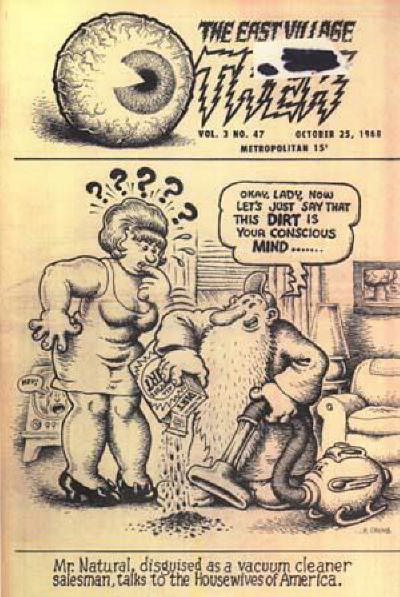
posted evening of February 12th, 2012: Respond
➳ More posts about Comix
| Previous posts about Readings
Archives  | |
|
Drop me a line! or, sign my Guestbook.
•
Check out Ellen's writing at Patch.com.
| |