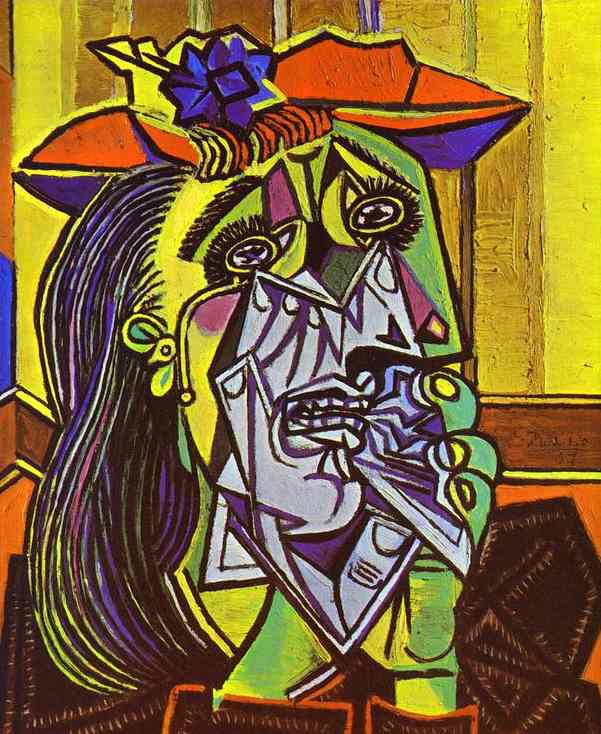
I'm with Picasso and "Fernande in a Black Mantilla" looking tragic with turpentine like rain running down her shoulder
And I'm in Pontoise with Pisarro
And with Gauguin in "The Vanilla Grove"
And in the "Mountains of St. Remy" with Van Gogh
And at "The Bend in the Road through the Forest" with Cézanne
And with Vuillard in "The Place Vintimille"
And with Picasso and "El Loco" and his blue acrobats
And with Picasso shaking his fist at the sky in "Guernica"
And I'm Durer's Steeple-jack
seen by Marianne Moore
And those harpies "The Demoiselles of Avignon" are glaring at me personally
And Degas' ballet dancers are dancing for Matisse and Monet and Renoir and all the Sunday painters of Paris and John Sloane and all the Sunday painters of America and most of the painters of the Hudson River School floating along so calm and holding hands with most of the West Coast Figurative painters and their Have a Nice Day cohorts
But I'm also with Malevich in his "Red Square" in the Beautiful Corner
And with Delacroix' "Liberty Leading the Masses"
And with Goya's groaning masses in "The Disasters of War"
And I'm rocking across the Atlantic with "Whistler's Mother"
And I'm crossing the Delaware with Washington standing in the boat against Navy regulations
And I'm with Bierstadt crossing the Rockies on a mule
And with Motherwell and DeKooning and Kline and Pollock and Larry Rivers in the broken light in the shaken light of the late late late twentieth century
And then I'm walking through a huge exhibition in the Whole World Museum of Art containing all the greatest paintings of the entire fine arts tradition of all the centuries of western civilization
When suddenly a wild-haired band bursts into the Museum and starts spraying paint-solvent onto all the paintings
And all the paint in all the paintings starts to run down onto the floors of all the galleries forming fantastic new and exciting images of the end of our little universe
And elite curators in Gucci shoes rush in and cut up the painted floors and hang them on the walls while picturesque bohemian painters in berets stagger through the halls weeping
posted afternoon of March 24th, 2012: 3 responses
➳ More posts about Lawrence Ferlinghetti
 |
As I grow older I perceive
Life has its tail in its mouth
and other poets other painters
are no longer any kind of competition
It's the sky that's the challenge
the sky that still needs deciphering— from "Poet as Fisherman"
Happy birthday Mr. Ferlinghetti! |  |
posted morning of March 24th, 2012: Respond
➳ More posts about Birthdays
|
 |
Friday, March 23rd, 2012
To make your shadow dance, dance. To make your shadow talk, stand on a streambank.
Learn from your shadow. Broken glass won’t cut it, barbed wire can’t stop it, mud doesn’t stick.
Dave Bonta of Via Negativa today posted How to Cast a Shadow, the 27th and final poem in his series Manual. Go read (and if you likeby all means, listen to his recitations) -- some great stuff is present. Start from the beginning! You have to start from a position of strength. Leave a window open for cat-burglars and cats, either of whom may have a lot to teach you.
posted evening of March 23rd, 2012: 3 responses
➳ More posts about Reading aloud
|
 |
Thursday, March 22nd, 2012
 Today I happened on another story by Zupcic, "Girasoles Funeral Home: The Autobiography of a Hearse" -- here we learn the (rather sordid) story of Bárbula Copies, after Benavides and his friends graduate and sell out to the fat lady who runs the numbers game next door. Today I happened on another story by Zupcic, "Girasoles Funeral Home: The Autobiography of a Hearse" -- here we learn the (rather sordid) story of Bárbula Copies, after Benavides and his friends graduate and sell out to the fat lady who runs the numbers game next door.
posted evening of March 22nd, 2012: Respond
➳ More posts about Slavko Zupcic
|
 |
Wednesday, March 21st, 2012
 — Death takes us all. — That was all we would say when customers asked us how we had made the decision to go into the funeral home business here next to the medical school, when they asked us how we could have chosen such a name for our business as Bárbula Copies. — Death takes us all. — That was all we would say when customers asked us how we had made the decision to go into the funeral home business here next to the medical school, when they asked us how we could have chosen such a name for our business as Bárbula Copies.
posted evening of March 21st, 2012: Respond
➳ More posts about Translation
|
|
Tuesday, March 20th, 2012
I had forgotten about the fifth chapter of The Art of Resurrection -- it is an extremely dense, 7-page long paragraph of a sort of context-switching stream of consciousness. Last time I read this book, I'm pretty sure I mostly skipped over it. It is valuable for the way it gets inside Zárate Vega's head, and by switching back and forth between the narrator's voice and the Christ of Elqui's, makes explicit the identification between reader and writer and character -- also we see the use of first-person plural, not used in this book anything like as much in Santa MarÃa de las flores negras, to make explicit the identification between the narrator and the workers who live in the salitreras.
posted evening of March 20th, 2012: Respond
➳ More posts about The Art of Resurrection
|
 |
“War is hell,†said Leon Panetta, Secretary of Defense in the Obama administration:  he said it following the killing of 16 civilians, among them children, by a deranged sergeant in the Afghan province of Kandahar. This massacre unleashed on the world a series of images that one cannot look at without being reminded of similar massacres from the Vietnam War — for instance, My Lai. he said it following the killing of 16 civilians, among them children, by a deranged sergeant in the Afghan province of Kandahar. This massacre unleashed on the world a series of images that one cannot look at without being reminded of similar massacres from the Vietnam War — for instance, My Lai.-- "Shame", by Juan Gabriel Vásquez
The Utopian's blog publishes my translation of Vásquez' latest column for El Espectador: the original is "Los Avergonzados", from last Thursday.
 On the subject of shameful killings: Founderstein's Michael Austin has exactly the right take on the killing of Treyvon Martin in Florida last month. (via Russell Arben Fox)
posted evening of March 20th, 2012: Respond
➳ More posts about Juan Gabriel Vásquez
|
|
Monday, March 19th, 2012
Chapter 3 of The Art of Resurrection is more setting-up of the story, as Zárate Vega makes his way from Los Dones to Sierra Gorda, the closest railway stop to Providencia. There is a lot to like about the writing and the scenery here, but I am aching for the real story to start in Chapter 4.
posted evening of March 19th, 2012: Respond
➳ More posts about Hernán Rivera Letelier
|
|
Sunday, March 18th, 2012
In college, I used to underline sentences that struck me, that made me look up from the page. ... I noted them for their clarity, their rhythm, their beauty and their enchantment. For surely it is a magical thing for a handful of words, artfully arranged, to stop time.
In the NY Times Sunday Review*, novelist Jhumpa Lahiri reflects on the "urge to convert experience into a group of words that are in a grammatical relation to one another" -- I empathize with her as far as this being a primary motivation. I love her description of reading Italian, which captures perfectly how I enjoy reading Spanish.
I sometimes underline sentences too, though I don't remember having done so in college -- it's a habit come by recently, until only a few years ago I could not hilight a book without its feeling forced and unproductive. Just last night I started a reread of The Art of Resurrection, which happily contains lots of underlining and margin notes from 2010. I believe a part of blogging my reread is going to be quoting from these, seeing if I am still finding these artfully arranged bunches of words to hold the same beauty and enchantment, how my reactions have evolved over the time since I first read it -- which time of course includes my translation of and revising of the first chapter , and reading Santa Maria de las flores negras... I'm thinking I'll try to keep fairly good bloggy notes about this reread. (As for Chapter 1 though, I am going to let my translation stand without discussing it.)
The second chapter (which I call "In Transit" in my notes) is slightly tedious compared to the opening (although, well, what would not be) -- there is a shift of tense from the imperfect narrative to a remembered preterite, the camera zooms out for a little setting up of the plot of the book. Here Magalena Mercado is introduced (again not in person, but via a story told by a traveling salesman) and we get some of Zárate Vega's back story. My only hilight in this chapter is the last line -- ¡Aleluya, Padre Santo! -- where I note a transition into Zárate Vega's voice. Switches between tenses and between voices are a very, very important part of this novel I think -- based on the two books I've read of Rivera Letelier's it seems to me like these switches are almost the key feature of his prose style. In this regard, the Christ of Elqui makes an ideal character for Rivera Letelier to draw.
* and/or in the online "opinionator" section of the Times website? I am no longer sure with this newspaper what is the print organ and what is the digital presence. This piece is certainly printed on the front page of the "Review" section of the hardcopy Times delivered to my stoop this morning. However its url identifies it as part of the site's blog section -- perhaps there is no longer any distinction to be made between these venues.
posted afternoon of March 18th, 2012: Respond
➳ More posts about Rereading
|
 |
Thursday, March 15th, 2012
How exciting: the current issue of Guernica features the first half of the story "Things", from Saramago's short story collection Objecto Quase (1978) -- the second half will be published in April. To the best of my knowledge, it is the first time any of these stories has been seen in English translation. The full collection will be published by Verso Books at the end of April, under the title The Lives of Things. Really great news -- Saramago's signature style begins to take shape in these stories, and themes that will occupy his writing throughout his career. It is also great news to see that the translation is by Giovanni Pontiero, the master who translated so many of Saramago's early books before his untimely death in 1996. Clearly the translation has been out there for a long time, at last it will be available to the public.
Speaking of translation -- I had good news today, word from the editors of Words Without Borders that they'll be publishing my translation of Fernando Iwasaki's "A Troya, Helena," my project of last weekend. It will appear in their April issue.
posted evening of March 15th, 2012: 5 responses
➳ More posts about An Object, Almost
|
Previous posts about Readings
Archives  |


 In honor of the man's