|
|
Thursday, May 11th, 2006
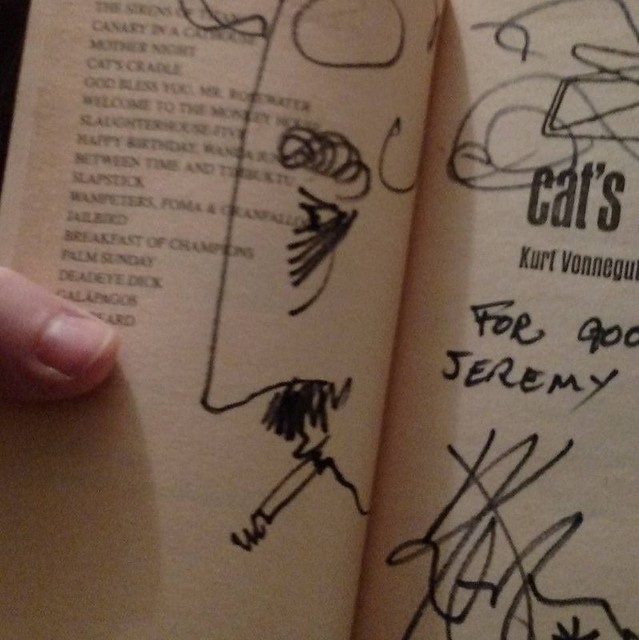
I'm back in Modesto for a few days, visiting my parents, and how exciting! The book that I have looked through my old bookshelf for every time I have been back here, but never found, just jumped out at me this time. It is Cat's Cradle, with a self-portrait by Mr. Vonnegut on the title page, and an inscription: "FOR GOOD OLD JEREMY ----- (signed) Kurt Vonnegut OCT 12 88"
posted afternoon of May 11th, 2006: Respond
➳ More posts about Cat's Cradle
|  |
Friday, April 7th, 2006
Guns, Germs and Steel serves as a really good prophylactic against romantic nostalgia -- the evolution of society depicted in the "Egalitarianism to Kleptocracy" chapter does not at all make you want to go back to the days of egalitarianism.
posted morning of April 7th, 2006: Respond
|  |
Thursday, March 30th, 2006
A statistic, from the opening chapter of Guns, Germs and Steel, to make the mind reel: of roughly 6,000 known human languages, 1,000 are spoken only on the island of New Guinea. This seems incredible to me; but Teofilo, who knows more of these things than I, confirms that it is straight up. Some Googling brings up a list of Papua New Guinean languages, and there are certainly a lot. Also the full text of Papuan Linguistics is online in PDF form. Update: there is also about a ton of interesting stuff on PapuaWeb, from beautiful pictures to scholarly articles.
posted evening of March 30th, 2006: Respond
|  |
|
I've never been much of a reader of non-fiction. Maybe part of the reason is I fear writing style like that found in Unequal Childhoods, which I finished the other day -- full of potentially useful information but written in such a way as to stymie concentration in even the most willing reader. But today I started Jared Diamond's Guns, Germs and Steel; if the first chapter is any basis for expectation, reading it will be a different story. His voice is clear, engaging, direct. I've encountered Diamond's name a number of times over the years, mainly referred to by Crooked Timber posters, and always thought his stuff sounded interesting. I'm looking forward to this book. (And I realize on reflection that Crooked Timber has been responsible for encouraging a good deal of my non-fiction reading over the past couple of years.) Note: Here is a Crooked Timber post with pointers to a wide-ranging controversy about GGS.
posted morning of March 30th, 2006: Respond
➳ More posts about Unequal Childhoods
|  |
|
Yesterday I read The Quitter, Harvey Pekar's new book about his childhood. I've always loved American Splendor and this book is a fine addition. (It actually reminded me quite a bit of the AS movie -- Pekar as a kid in the main story, and Pekar as an old man stepping in occationally to comment.) Lovely art, moving story. Definitely recommended to the Mineshaft crowd, who I think will identify.
posted morning of March 30th, 2006: Respond
➳ More posts about The Quitter
| |
Friday, March 24th, 2006
I am reading Unequal Childhoods by Annette Lareau currently, on the recommendation of Harry Brighouse. I like the slice-of-life aspect of it but the narrative style is kind of freaking me out. She switches constantly between a first-person where (as near as I can reckon) she is the narrator, and block-quoted observation notes in first-person where the narrator is the person who did the observation, who is never identified by name. I am finding this really frustrating, not to have an identity for the observer -- clearly there are several different people doing the observations but I have no way of distinguishing them, and it sounds like sometimes it it Dr. Lareau herself, but again no way to verify this. Maybe this is a standard style in sociology -- it just seems weird to me. The families being observed are named (though I don't know if they are real names or pseudonyms), so why not the observers?
posted evening of March 24th, 2006: Respond
|  |
Wednesday, March 15th, 2006
Yesterday I started reading the stories in Close Range by Annie Proulx. This will bring my Proulx-reading arc full circle in a way, since I got interested in her by reading "Brokeback Mountain", which is in this book, and the first book I read was Bad Dirt, to which this is sort of a sequel. My early reaction to the book is that the stories are good, but don't blow me away in the same way that the stories in Bad Dirt did -- with those there was a sense of immediacy and freshness that I'm not getting as much here. But that may be because I know what to expect a little better. Also I am missing the thread of connection which was one of my favorite features of Bad Dirt -- at least half the stories there had characters and setting in common, whereas here all that seems to be shared is that the stories occur in Wyoming or feature characters from Wyoming.
posted evening of March 15th, 2006: Respond
➳ More posts about Close Range
|  |
Monday, March 6th, 2006
My current reread of V. is officially over, bogged down in the course of reading about Fausto Maijstral. Over the course of this chapter my relationship to the book went from loving it, to sweating my way through and hoping that the next chapter would be easier going, to reading the sentences for sound with no comprehension. I put a bookmark in on Thursday and haven't picked it up since. So, better luck next time through.
posted evening of March 6th, 2006: Respond
➳ More posts about V.
| |
Monday, February 27th, 2006
Lots of good V. stuff from last February at Josh Blog.
posted morning of February 27th, 2006: Respond
➳ More posts about Thomas Pynchon
|  |
|
A question: are the dreams of 1904 which Mondaugen undergoes at Foppl's Siege Party, based on experiences that Foppl had in 1904? Or is that even what's going on? The story switches out from what's happening to Mondaugen, into the dreams -- there's no direct statement that Mondaugen is the dreamer, and there are constructions like "Firelily's rider" to keep him masked -- but I'm pretty sure it is Mondaugen. Ad first I thought the experiences were Godolphin's, but now I don't think that would make as much sense as if they were Foppl's. Update: Yes, the dreamer is definitely Mondaugen -- I found this passage at HyperArts: "His horse drowsed and collected dew while Mondaugen squirmed on the seat, trying to control anger, confusion, petulance; and below the farthest verge of the Kalahari, that vast death, the tardy sun mocked him."
posted morning of February 27th, 2006: Respond
| Previous posts about Readings
Archives  | |
|
Drop me a line! or, sign my Guestbook.
•
Check out Ellen's writing at Patch.com.
| |