|
|
Saturday, November 14th, 2009
I'm glad I watched La Pointe-Courte when I did, as I'm now seeing loose parallels between it and everything I am reading... Sort of the archetypal melancholy romance.
Paco se habÃa sentado en cuclillas, algo más lejos y antes de abandonarme del todo, le pregunté:
--¿De qué vive la gente aqu�
Se entretenÃa en escurrir la arena entre sus dedos y no levantó, siquiera, la cabeza:
--De la pesca.
--¿Y tú? --Me extendà boca arriba y cerré los ojos--. ¿Qué quieres ser?
Su respuesta, esta vez, llegó en seguida:
--Mecánico.
Me dormÃ. TenÃa conciencia de que, al cabo de unas horas, olvidarÃa la fatiga del viaje y no deseaba otra cosa que cocerme lentamente, cara al sol.
En una o dos ocasiones, me desperté y vi que Dolores dormÃa también.
Con la vista perdida en el mar, Paco hacÃa escurrir aún la arena entre sus dedos.

Paco was squatting a bit further down the beach; before giving myself up to sleep, I asked him:
--What do people live on, here?
He was distractedly letting the sand run through his fingers; he didn't even raise his head:
--On fish.
--And you? --I turned my mouth up(?) and closed my eyes--. What do you want to be?
His response, this time, came directly:
--Mechanic.
I slept. I was aware that after a few hours, I'd forget the fatigue of the journey; I didn't want anything besides to let myself bake slowly, my face to the sun.
Once or twice, I woke up and saw that Dolores was sleeping too.
His gaze lost in the sea, Paco was still letting the sand run between his fingers.
I'm thinking I will work on a full translation of this story.
posted morning of November 14th, 2009: Respond
➳ More posts about Juan Goytisolo
|  |
Sunday, November 8th, 2009
Buscaba inútilmente la forma de soportar el dolor, daba vueltas por la casa, me daba un baño muy caliente, me acostaba, me volvÃa a levantar, daba un paseo, me dejaba caer sobre el sofá, de nuevo fatigada...
Soledad Puértolas, "Masajes"
I'm not at all sure how to translate much of this story -- it is only the second thing I have read in Spanish without a translation available to help me flesh out what the meanings of the words and constructions were. I'm understanding it only in a pretty rough, impressionistic way, the images are quite out of focus. This makes the impact of the words as words stronger in a way, the sound of the language a larger proportion of the experience: and I'm really struck by the shift in tense here between me acostaba and me volvía a levantar -- "I was walking around the house, drawing myself a very hot bath, was putting myself to bed, I got up again, I was going for a walk, letting myself fall on the sofa, suddenly fatigued..." Many of the constructions in this story seem strange to me and hard to make sense of -- this is contributing certainly to the fuzziness of my reading experience.
Me inquietó y acabó, sobre todo, molestándome, porque me hacÃa estar pendiente de la hora y del silencio de la casa y imaginar, antes de escucharse, el ruido del timbre abriéndose camino hacia mÃ.
It's just really hard for me to match up subjects and objects and tenses in this sentence -- I get that she's saying she was troubled by the phone call (which was mentioned in the last paragraph and is definitely the subject of Me inquietó) -- "It disturbed me and had just, most of all, been bothering me, because (?) it made me be hanging from the hour and from the silence of the room and to imagine, before hearing it, the noise of the ringer making its way towards me." (Or something like that.) El ruido del timbre abriéndose camino hacia mí is a particularly nice image, provided I am reading it correctly. I'm sort of happy to find an author that I like but am not heavily invested in to practice this kind of language comprehension on... I am also thinking Goytisolo will fit the bill in this way.
 Another example (the narrator is speaking of a health club employee who had in the previous paragraph shown her around the facility) --
Su amiabilidad, su interés por mÃ, tenÃan una nota atificial, falsa, como si alguien la hubiera convencido de que tenÃa que ser asÃ. O sencillamente era asà como quien es hosco y antipático desde la cuña o como quien tiene una especial habilidad para los idiomas o para las installaciones eléctricas.
"Her friendliness, her interest in me, bore a note of artificiality, falsehood, as if someone had convinced her she needed to act like that. Or simply like when somebody is hostile and antisocial from the cradle, or somebody has a particular ability for languages or for electrical work." -- None of the entities separated here by or's seem to me like they can sustain that kind of relationship with one another.
↻...done
posted evening of November 8th, 2009: 1 response
➳ More posts about Soledad Puértolas
| |
Sunday, November first, 2009
I kind of enjoy watching the Google referrals that float by on the right-hand side of the blog under "Where You Came From" -- idly tracking the number of searches that are likely for something that would appear on the page they accessed (ibant obscuri sola sub nocte per umbram) versus words that seem no more related to what I've published here than they would to a page chosen at random from the web (+"dolly parton" +sneezed). Here are some popular queries over the last few months: - 13 views: q=what+do+hobbits+look+like
- 14 q=stroszek+soundtrack
- 16 q=movies+about+outcasts
- 17 q=museum+of+innocence
- 20 q=el+libro+talonario+translation
- 20 q=of+love+and+other+demons+analysis
- 22 q=codex+seraphinianus+download
- 31 q=the+hamlet+faulkner
- 33 q=readin
- 39 q=gordita+beach
posted evening of November first, 2009: Respond
➳ More posts about The site
|  |
Monday, October 19th, 2009
Found it! -- Many thanks to Deborah for sending me Unamuno's poem "Portugal" (an unpublished fragment), from which the line quoted in The Stone Raft is taken.
Portugal, Portugal, tierra descalza,
acurrucada junta al mar, tu madre,
llorando soledades
de trágicos amores,
mientras tus pies desnudos las espumas
saladas bañan,
tu verde cabellera suelta al viento
-- cabellera de pinos rumorosos --
los codos descansando en las rodillas,
y la cara morena entre ambas palmas,
clavas tus ojos donde el sol se acuesta
solo en la mar inmensa,
y en el lento naufragio asà meditas
de tus glorias de Oriente,
cantando fados quejumbrosa y lenta.
Portugal, Portugal, o barefoot land,
nestled by the sea, your mother,
weeping lonely
over tragic loves
while the salty foam
bathes your naked feet,
your green locks loose to the wind --
locks of whispering pines --
your elbows resting on your knees
and your dark face between your palms,
cast your eyes where the sun goes down
alone in the immense sea
and in this slow shipwreck reflect
on your Oriental glories,
singing fados, plaintive and slow.
(Not making any claims about the quality of this translation -- it is done on the fly. If you have any ideas about how it could be improved, feel free to mention them in the comments.) It's a pretty poem -- in his (engaging) essay on The Rivers of the Douro Valley in Literature, Antonio Garrosa Resina notes that Unamuno composed it during a visit to Oporto in 1907. I'm a little uncomfortable with the juxtaposition of "junta al mar, tu madre" in line 2 and "soledades" in line 3 -- I must be mistranslating this -- not sure what the (plural) "soledades" is referring to but it can't be (singular) Portugal, who is next to her mother the sea... maybe it's "weeping over tragic solitary loves." (Also: is the "slow shipwreck" the sunset? I think Portugal's glories being "Oriental" is a reference to the subject of The Stone Raft, the treaty which gives Portugal imperial dominion over all lands to the east of a particular longitude, Spain over lands to its west.)Well: this brings up a question for me about Pontiero's translation in The Stone Raft. The context is that José and Joachim have just met Pedro and the three are having dinner, watching the news on TV where they see images of people standing on Portugal's beaches looking at the oncoming ocean. Let's look at the Portuguese and Pontiero's rendering together:
|
Agora
ei-los ali, como Unamuno disse que estavam, la cara morena
entre ambas palmas, clavas tus ojos donde el sol se acuesta
solo en la mar imensa, todos os povos com o mar a poente
fazem o mesmo, este é moreno, não há outra diferença, e
navegou.
| |
There they are now, as Unamuno described them, his swarthy face cupped in the palms of his hands, Fix your eyes where the lonely sun sets in the immense sea, all nations with the sea to the west do the same, this race is swarthy, there is no other particularity, and it has sailed the seas.
|
I'm not going to argue with italicizing the quoted portion and capitalizing its first letter, I mean it's not in the original but it reads fine; but how could "la cara morena" possibly be understood as referring to Unamuno's face rather than as part of the quotation? This makes no sense at all to me -- it's an interesting image but it can't be the image intended in the original passage. Note how "moreno" is used again referring to the Portuguese race -- this is the only distinction between them and other peoples with the sea to the west. Here's my attempt at an improvement, relying heavily on Pontiero for a sense of the flow of the passage:
There they are now, as Unamuno described them, Your dark face between your palms, cast your eyes where the sun goes down alone in the immense sea, all peoples with the sea to the west do the same, this one is dark-skinned, there's no other distinction, and has sailed the seas.
posted evening of October 19th, 2009: Respond
➳ More posts about Miguel de Unamuno
|  |
Sunday, October 18th, 2009
Here's a new line of attack for a problem that's been bugging me a little while; when I was reading The Stone Raft I was enchanted by the line, which Saramago attributes to Unamuno, "Fix your eyes where the lonely sun sets in the immense sea." Haven't had any luck figuring out where that line came from, if he's quoting an actual Unamuno poem -- I don't know what the Spanish being quoted (in Portuguese, and then translated) is, and the English does not seem to match up with any existing translations... Tonight I had the thought, why not try writing something with that line as a starting point, and taking as read that it was from a poem of Unamuno's... A first try (and assuming this line of inquiry bears any fruit, some more updates as time passes) below the fold.
1. Fix your eyes where the lonely sun sets in the immense sea, he said in Spain, might just as well have said in California. Dark-eyed surfer dude shading his swarthy brow -- peer into the pomegranate clouds of sunset. This rainy eastern beach chills me to the bone.
2. I wish I could look
to where the lonely sun
sets in the immense sea --
my thoughts will not stay here, tonight,
nor yet with you, at home;
my restless heart craves stasis, craves
a still, still settling, slow.
My hand commits to paper
what my brain already knows, and hopes,
in dreams I see your dark eyes
in the cloudy twilight shore.
↻...done
posted evening of October 18th, 2009: Respond
➳ More posts about The Stone Raft
|  |
|
Ellen and I spent most of the weekend setting up our dining room to paint it: covering the floor with newspaper and drop-cloths, taping edges and corners, and applying primer. It's not a huge room but it's a fairly intimidating job because of how the room is put together: lots of molding everywhere that requires attentive care and the use of a brush instead of a roller, including an insane crown molding that has 12 surfaces -- besides the crown molding there is a chair rail and a baseboard, and three doorways and a window. There will be a whole lot of taping, too, which we have not even started yet; for now we are priming everything together. We made pretty good progress! Finished off a can of primer, we've done everything except one section of crown molding and most of the ceiling. we'll finish that up tomorrow night and then the fun of applying the actual colors begins. Ellen is primarily in charge of the color selection, with input from her friend Lisa and (a bit) from me -- she has settled on some colors from the Benjamin Moore catalog that look pretty nice to me, I will try and find them online and link to a sample.
posted evening of October 18th, 2009: 2 responses
➳ More posts about Painting the House
| |
Saturday, October 17th, 2009
I made a vegetarian sauté last night that reminded me of how good vegetables can taste by themselves -- no meat, no seasoning besides a little salt, just vegetables and a little olive oil and wine. Here is the recipe (to serve 1 -- I was eating alone last night -- increase as necessary):
Stovetop Autumn- one smallish yellow onion, diced
- two cloves garlic, minced
- ¼ apple, diced
- 1/8 head of red cabbage, sliced thin
Combine all ingredients in sauté pan and cook for about 15 min. stirring occasionally, until cabbage is tender and onion is starting to burn. Deglaze with a few ounces of red wine, stir scraping the bottom of the pan, and allow the liquid to boil away completely. Serve with bread and apples and red wine.You don't cut everything up and then sauté it all at once -- the timing is best if you cut up each ingredient after adding the previous one to the pan. So everything has been cooking for a few minutes by the time the cabbage goes in. The thinner you slice the cabbage, the better it will taste.
Last night I dreamed about cooking -- I was making a stewed chicken and rice dish and bizarrely using my espresso pot to cook it in. It came out beautifully -- the grains of rice were soft and puffed up so they looked like orzo -- and they overflowed the pot like popcorn, spilling out onto the stovetop, which was already covered in some kind of red sauce that I had been cooking before that. It looked really tasty and lots of people were there hungry and wanting to be served... As long as I am thinking about recipes, here are a couple of links: The NY Times Magazine reprints a recipe for Worcestershire sauce originally published in 1876 (although it contains the direction "refrigerate", which surprises me -- were refrigerators standard kitchen appliances in 19th Century NYC?*), and an updated version from Boston chef Barbara Lynch. The updated version is made with Vietnamese fish paste so does not require any fermentation time, it's ready to serve right away; the old recipe takes a month to mature. Worcestershire sauce traces its ancestry to the Malay condiment kecap, as does Ketchup; at The Language of Food, Dan Jurafsky looks at the history of this condiment. And here is an old piece by Malcolm Gladwell on The Ketchup Conundrum.
 * Wikipædia reports that "At the start of the 20th century, about half of households in the United States relied on melting ice (in an icebox) to keep food cold, while the remaining half had no cooled storage at all, possibly excepting a 'root cellar'." So I'm thinking "refrigerate" is a modern edit of an 1876 recipe.
posted morning of October 17th, 2009: 2 responses
➳ More posts about Recipes
|  |
Sunday, September 27th, 2009
A very nice line (assuming I am understanding it correctly) from the newly-published Bolaño story, The Contour of the Eye. Bolaño's character Chen Huo Deng is recounting a conversation with a doctor, telling him about writing diaries as a "crutch for literary creativity": Dijo que comprendÃa que los poetas escribiéramos mil palabras para librar una. Le dije que en mi diario actual se libraba algo más y se rió sin comprender.[First attempt at reading this is incorrect -- see comment from Rick -- He said his understanding was that we poets will write a thousand words to liberate a single one. I told him that in my current diary something else was being liberated and he laughed without understanding.] He said his understanding was that we poets will write a thousand words to get at a single one. I told him that in my current diary something else was at stake, and he laughed without understanding. This is working for me on a couple of levels, I can see an image of Chen's words as the fleet launched from Mycenae to liberate Helen...Thoughts about the translation of "librar" in the first sentence and "librarse" in the second sentence (and thanks to Rick for pointing out that this is a different verb from "liberar")? It would be nice to preserve the pun but I'm not at all sure how that would be done. "in my current diary something else was getting out" maybe? That doesn't sound very natural to me, and I'm skeptical whether it communicates the meaning of the Spanish very well.
posted morning of September 27th, 2009: 4 responses
➳ More posts about Roberto Bolaño
|  |
|
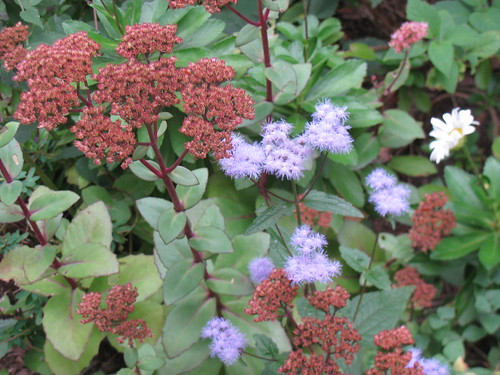
So there are these pretty little purple things blooming in the front garden -- I'm not sure what they are and am finding it difficult to get a good, in-focus photo of them -- but they are lovely! Especially nice against the red things which are blooming next to them, and of which I also do not know the name...
(Ellen tells me, the red flowers are sedum.) Update: Ellen is convinced the purple flowers are a weed/wildflower, not anything she planted -- there are similar white flowers growing in parts of the yard where we haven't planted anything.
posted morning of September 27th, 2009: Respond
➳ More posts about The garden
| |
Friday, September 25th, 2009
I hope a movie has been made of Unamuno's El marqués de LumbrÃa; this opening paragraph would be spectacular on the screen: La casona solariega de los marqueses de LumbrÃa, el palacio, que es como se le llama en la adusta ciudad de Lorenza, parecÃa un arca de silenciosos recuerdos del misterio. A pesar de hallarse habitada, casi siempre permanecÃa con las ventanas y los balcones que daban al mundo cerrados. Su fachada, en la que destacaba el gran escudo de armas del linaje de LumbrÃa, daba al MediodÃa, a la gran plaza de la Catedral, y frente a la ponderosa fábrica de ésta, pero como el sol bañaba casi todo el dÃa, y en Lorenza apenas hay dÃas nublados, todos sus huecos permanecÃan cerrados. Y ello porque el exelentÃsimo señor marqués de LumbrÃa, Don Rodrigo Suárez de Tejada, tenÃa horror a la luz del sol y al aire libre. "El polvo de la calle y la luz del sol-solÃa decir-no hacen más que deslustrar los muebles y hechar a perder las habitaciones, y luego, las moscas..." El marqués tenÃa verdadero horror a las moscas, que podÃan venir de un andrajoso mendigo, acaso de un tiñoso. El marqués temblaba ante posibles contagios de enfermedades plebeyas. Eran tan sucios los de Lorenza y su comarca...
The ancestral mansion of the Marquéses of LumbrÃa, the palace as it was called in the gloomy city of Lorenza, appeared as a chest of silent memories of the mysterious. In spite of its being in fact occupied, the windows and balconies which gave out onto the world were almost always closed. The façade, where the great coat of arms of the LumbrÃan lineage stood forth, looked south*, onto the great square of the Cathedral, whose ponderous construction it faced, but as the sun was shining all day long, and in Lorenza there are hardly any cloudy days, all of its openings remained closed. And this was because the excellent Señor Marqués of LumbrÃa, don Rodrigo Suáres de Tejada, abhorred the light of the sun and fresh air. "The dust of the street and the light of the sun -- he used to say -- do no more than dull the furniture's shine and spoil the rooms; not to mention the flies..." The Marqués was deathly afraid of flies, which might have come from a ragged, miserable beggar. The Marqués trembled at the thought of catching plebian diseases. And they were so filthy, the Lorenzans and the countryfolk...
 ...But it looks like no; several of his stories and books have been filmed but not this. *How great a dialect for "south" is "noon"? A lovely one.
posted evening of September 25th, 2009: Respond
➳ More posts about Cuentos Españoles/Spanish Stories
| Previous posts about Projects
Archives  | |
|
Drop me a line! or, sign my Guestbook.
•
Check out Ellen's writing at Patch.com.
| |