|
|
Monday, January 17th, 2011
 Further progress in improving the look of our dining room: Ellen found a great deal on reupholstering the chairs, from the McGowen Fabric Outlet in Elizabeth. Very reasonable price and excellent work, though perhaps lacking in customer service relations -- at about 5 this afternoon Ellen answers the ringing phone, listens for a minute, says "Jeremy, we have a situation" -- the chairs are finished and the fabric outlet manager wants them picked up right away so he does not have to hold them overnight. So me and John quit practicing and took a road trip to Elizabeth. Further progress in improving the look of our dining room: Ellen found a great deal on reupholstering the chairs, from the McGowen Fabric Outlet in Elizabeth. Very reasonable price and excellent work, though perhaps lacking in customer service relations -- at about 5 this afternoon Ellen answers the ringing phone, listens for a minute, says "Jeremy, we have a situation" -- the chairs are finished and the fabric outlet manager wants them picked up right away so he does not have to hold them overnight. So me and John quit practicing and took a road trip to Elizabeth.
I find the sheer extent of the urban area around here disconcerting. I often don't notice it because I will get on the highway to drive any significant distance; but the city, the neighborhoods, keep going beneath the highway in between the exits. There isn't much of any way to get to Elizabeth by highway -- it is just surface street after surface street, and you never lose the impression of being in the city. The chairs are probably nearly as old as I am -- they and the table are Ellen's parents' old dining-room set. The old leather upholstery on them was looking really bad; the new fabric is utterly transformative.
posted evening of January 17th, 2011: Respond
➳ More posts about Painting the House
|  |
Saturday, January 8th, 2011
 David Bonta (blogger at Via Negativa) has published a book of Odes to Tools with Phœnecia Publishing -- some beautiful thoughts about the things we use. David Bonta (blogger at Via Negativa) has published a book of Odes to Tools with Phœnecia Publishing -- some beautiful thoughts about the things we use.
Ode to a Socket WrenchBetter than all power tools
Is the socket wrench:
Its accomodating nature
Its chrome-plated steel
Its handling of torque.
Kristin Berkey-Abbott reviews the collection today.
posted morning of January 8th, 2011: Respond
➳ More posts about Readings
|  |
Sunday, January second, 2011
Here is the state of play â…“ of the way into Our Lady of the Dark Flowers, as the striking workers, having marched from Alto de San Antonio to Iquique,  settle into their quarters at the Escuela Santa MarÃa* to wait for the mining companies' response to their demands: settle into their quarters at the Escuela Santa MarÃa* to wait for the mining companies' response to their demands: The primary characters are four friends who work at San Lorenzo, the salitrera where the strike was initiated: Olegario Santana, a 56-year-old loner and a hard worker, a veteran of the War of the Pacific; Domingo DomÃnguez, a barretero, the most gregarious of the group; José Pintor, a widowed carretero who is virulently opposed to religion and religiosity; and Idilio Montañez, a young herramentero and a kite-builder. In Alto de San Antonio, these four meet up with Gregoria Becerra, an old neighbor of José Pintor's when he worked in San AgustÃn, and her two children, 12-year-old Juan de Dios and 16-year-old Liria MarÃa. Gregoria Becerra was recently widowed when her husband was killed in a mining blast, and there is some suggestion (as yet undeveloped) of a romantic connection between her and José Pintor. Idilio Montañez and Liria MarÃa fall deeply in love with one another during the march to Iquique (Chapter 4). Her mother initially disapproves** but by Chapter 6 she seems resigned to it and even warming to the young man.
The male characters' occupations are central to their identities; Dominguo DomÃnguez is often referenced as "the barretero" and likewise for Idilio Montañez and José Pintor. I think Olegario Santana has not yet been referred to by his occupation, except maybe as a calichero. Here are my understandings of some of these terms, I'm not sure how accurate they are:
- Barretero is a worker at the mine who digs trenches.
- Carretero is a mechanic who works on the carts used for hauling caliche, the nitrate ore.
- Herramentero is (at a guess) a blacksmith.
- Calichero is a mine-worker; I think it is a generic term covering anyone who works at the nitrate mines. There are several words derived from caliche that occur quite frequently in the text.
- Particular is one of the jobs in the nitrate fields; I think it might refer to someone who works with explosives.
- Derripiador is one of the jobs involved in processing nitrate ore.
- Patizorro is (I think) another term for particular.
- Perforista: another term for barretero.
Some of this stuff is pretty specific to nitrate mining in Chile, I'm not sure how it could be brought over cleanly into English. Album Desierto has a great glossary of salitrera terminology.
 *It is difficult reading (mostly in the present tense) about how excited the striking workers are, how happy and hopeful they are in the face of their hardships, when you know how the history is going to end up. **At one point Gregoria Becerra says her daughter "does not need any idilios"; Idilio Montañez' name means "love affair".
posted morning of January second, 2011: Respond
➳ More posts about Our Lady of the Dark Flowers
| |
Monday, December 27th, 2010
Teresa's Christmas post is very much worth checking out: Luke 2, 1-14 in a plethora of different translations. Read about Mary's revelation in Dutch, Portuguese, Lowland Scots, Greek, Slavonic, various Englishes...
posted afternoon of December 27th, 2010: 1 response
➳ More posts about The Bible
|  |
Tuesday, December 7th, 2010
 Many thanks to commenter Mariano on last year's Hypallage post for his valuable information about the image from Milton that Borges references in his dedication of El hacedor to Lugones. Mariano points out that beyond the fact that "las lámparas estudiosas" is clearly not quoting the "bright officious lamps" of Paradise Lost, book Ⅸ, there is not even any reference to this passage; rather, we have a quote from Milton's Areopagitica, a tract he wrote for Parliament in opposition to censorship. Many thanks to commenter Mariano on last year's Hypallage post for his valuable information about the image from Milton that Borges references in his dedication of El hacedor to Lugones. Mariano points out that beyond the fact that "las lámparas estudiosas" is clearly not quoting the "bright officious lamps" of Paradise Lost, book Ⅸ, there is not even any reference to this passage; rather, we have a quote from Milton's Areopagitica, a tract he wrote for Parliament in opposition to censorship.
Behold now this vast City: a City of refuge, the mansion house of liberty, encompast and surrounded with his protection; the shop of warre hath not there more anvils and hammers waking, to fashion out the plates and instruments of armed Justice in defence of beleaguer'd Truth, then there be pens and heads there, sitting by their studious lamps, musing, searching, revolving new notions and idea's wherewith to present, as with their homage and their fealty the approaching Reformation: others as fast reading, trying all things, assenting to the force of reason and convincement. So, well, this means that both Boyer's translation and Hurley's have problems. Boyer is correct in calling the phrase "the hypallage of Milton" (though I would like "Milton's hypallage" better) -- Hurley's "a Miltonian displacement of adjectives" is clumsy and does not communicate Borges' intent. And Hurley has "scholarly lamps", which undoes the quotation. But Boyer quotes the wrong passage of Milton! That spoils the image. The image from Areopagitica makes complete sense as a part Borges' dedication, while the image from Paradise Lost seemed pretty out of keeping with the context.
 ...Reinventing the wheel dept. -- I see Michael Gilleland of Laudator Temporis Acti wrote about this last November, saying "as others have noted" -- guess it's not a new piece of knowledge. Nice to have on hand though.
posted evening of December 7th, 2010: 1 response
➳ More posts about The Maker
|  |
Saturday, December 4th, 2010
I'm slightly surprised at (or surprised that I am surprised at) the reverent picture Rivera Letelier paints of the Christ of Elqui. I think my expectation going in was that he would be a Quixote figure; and there is that quality, a comedy of errors aspect to his mission in the desert.* But beyond that, his reverence is treated very respectfully, painted with a sincere, complex brush. Here is part of a sermon to the striking workers:
His arms open forming a crucifix, the intense dark of his eyes flaring up, he spoke to convince his congregation that the desert is
 «Atardecer en Atacama»
por Andrés RodrÃguez Morado
the place where one feels oneself most absolutely in the presence of the Eternal Father: the most perfect spot for speaking with Him.
— And it is not for nothing; as the Holy Bible tells us, even Christ himself spent forty days in the desert before he came out to preach his good news. And even so, O my brothers: not everything in this world is evil. You, sirs, have something which is worth more than gold and silver put together. The silence of the desert. The purest, finest silence anywhere on the planet; thus the most conducive for each one of you, to finding his own soul, the most suitable for listening to his God, for hearing the voice of the Eternal Father.
 * (This expectation may also have been shaped by the focus of my attention while I was reading and translating the first chapter, which does have a sort of broadly comic or slapstick tragic feel to it.)
↻...done
posted afternoon of December 4th, 2010: 2 responses
➳ More posts about The Art of Resurrection
| |
Sunday, November 28th, 2010
This is sort of an updated take on Borges' "Los teólogos" I think -- a man is reading and blogging about a book which he's reading in a language not his own (one not available in translation); he manages to create a controversy or at least a bit of publicity around blasphemy in the text which is, however, not actually present in the source material -- it is the product of a fundamental misreading on his part, but nevertheless the controversy necessarily involves the original author of the piece, a contemporary of the blogger's who is not seeking the spotlight. This publicity becomes the author's route to fame or celebrity -- a different fame than he would have had in mind, while the (mis-)translator is of course pretty much ignored in the press and ultimately forgotten by history.
posted afternoon of November 28th, 2010: 1 response
➳ More posts about The Theologians
|  |
|
I am falling into a pattern with reading/translating/revising The art of resurrection -- I think the best way to carry out these activities is in parallel, they strengthen and enhance one another. So far every chapter I read in full and translate a few pages of, the translation and revision process sends me off to read some more or to re-read and get a better grip on the story and on the author's voice, which in turn sends me back to revise and expand my translations of earlier chapters, and to forge outposts of translation in later chapters. (And of course blogging about is another activity in relation to the text, one which weaves in and out among and distracts from and contributes to these three.)
Chapter 8 introduces Magalena Mercado, the prostitute whom Christ has been searching for.
Dark, her hair was brown and her eyelids drooped over deep pupils. This was Magalena Mercado, her soft curves moved languidly and in the air behind her, fleeting, trailed the sensation of a wounded dove. And this sensation was strengthened by her gestures as it was by the falling cadence of her voice. ...
Like everything else about her, her age was a mystery. The men's guesses ranged from twenty-five, or a little more, to thirty-five, or a little less. Besides believing in God the Father, His Son Jesus Christ, and the Holy Spirit, she was a devoted follower of the Virgen del Carmen. In her house, in the room where she slept was an almost life-size icon, made from wood, always a candle was in front of it and little flowers made of paper hung from it.
The narrator goes on to discuss whether Magalena Mercado came to the north of Chile during a transfer of mental patients -- a "de-institutionalizing" I suppose it would be called. I need to get a better handle on the historical background here -- did that happen once in Chile during the twenties or thirties, or was it a common thing to have happen, or is it a fiction?*
What is certain is that her customers were generally surprised, disconcerted by the altar which was installed in a corner of the room where she plied her trade, so much so that some, the most devout among them, were inhibited, left without consummating the transaction. You see, the icon of the Virgin, about a meter 20 cm high, carved by hand, was of an overwhelming, breathtaking beauty. So Magalena Mercado took care: every evening before beginning to wait on her "parishioners," as she termed her regular customers, she would kneel before the Virgin, cross herself vigorously, and cover the icon's head with a square of blue velvet.
"See you soon, little lady," she would whisper.
 And look at how these paragraphs -- immediately following the above -- could be a short story in themselves --
Although many had heard her say that she could not stand priests, and even less the priest at La Piojo, whom she claimed to know from the village where they had grown up, Magalena Mercado was scrupulous in attending every mass. She would arrive a few moments after the beginning of the service; stealthily, ghostly, walking on tiptoes, she would take a seat in the final row of pews, on the left.
The priest, for his part, a fat, rubicund man, the shy expression on his face disturbed by nervous tics, he became so furious he had a coughing fit -- frothing at the corners of his mouth -- when they told him that the devout prostitute claimed to know him. Generally, when he saw her entering the church, he would make as if he did not notice, would continue to say his mass as if he had not noticed her presence. But on some occasions, particularly on Sundays, when the flock was larger, his Bible in hand, his stole flapping, he would imprecate against her from his pulpit, reading the sixteenth chapter of Ezekiel, picking out two or three of the most severe verses. On the days when his bile was blackest, filled with rage, he would read straight through all of the verses, like a brutal, biblical artillery attack: Wherefore, O harlot, hear the word of the Lord... I will judge thee, as women that break wedlock and shed blood are judged... therefore I will gather all thy lovers, with whom thou hast taken pleasure... And I will also give thee into their hand... and they shall break down thy high places: they shall strip thee also of thy clothes, and shall take thy fair jewels, and leave thee naked and bare. They shall also bring up a company against thee, and they shall stone thee with stones, and thrust thee through with their swords. And they shall burn thine houses with fire, and execute judgments upon thee in the sight of many women: and I will cause thee to cease from playing the harlot, and thou also shalt give no hire any more.
(There is a very mildly interesting question to be raised about translating a passage which is quoting a third work, e.g. the Bible, which has been translated elsewhere and in many versions, which English version to use: what I did here and what I think works best in this case is to use the KJV translation, which fits very closely with the Spanish lines quoted in the book.)
*This is discussed at greater length a few chapters later. I was misunderstanding the meaning of enganche, it means "recruitment" and has a special meaning in the context of nitrate mining. The mental patients in question here were brought north by an enganchador, a headhunter who recruits workers for the salitreras from the south.
↻...done
posted afternoon of November 28th, 2010: Respond
➳ More posts about Translation
| |
Friday, November 26th, 2010
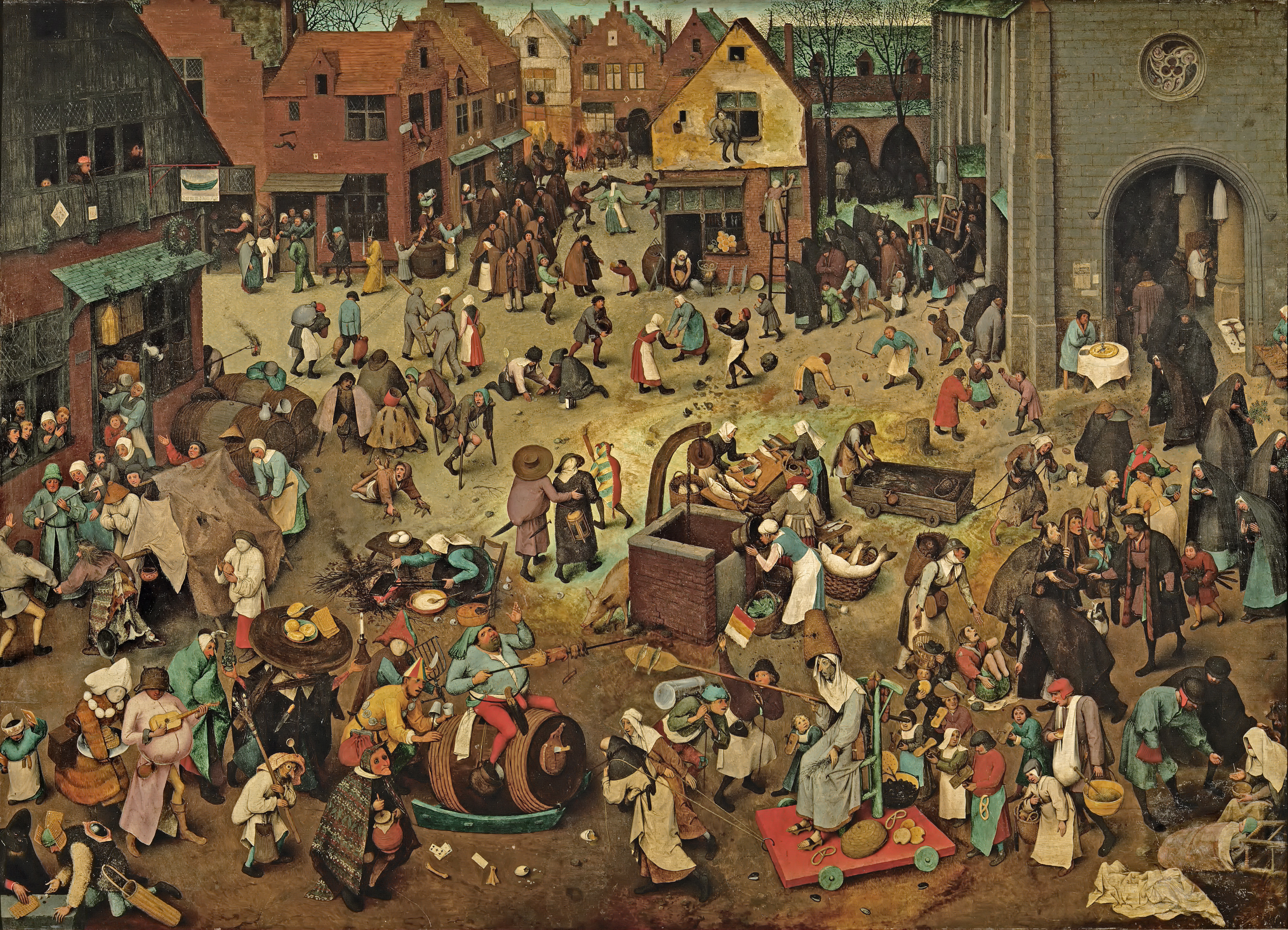
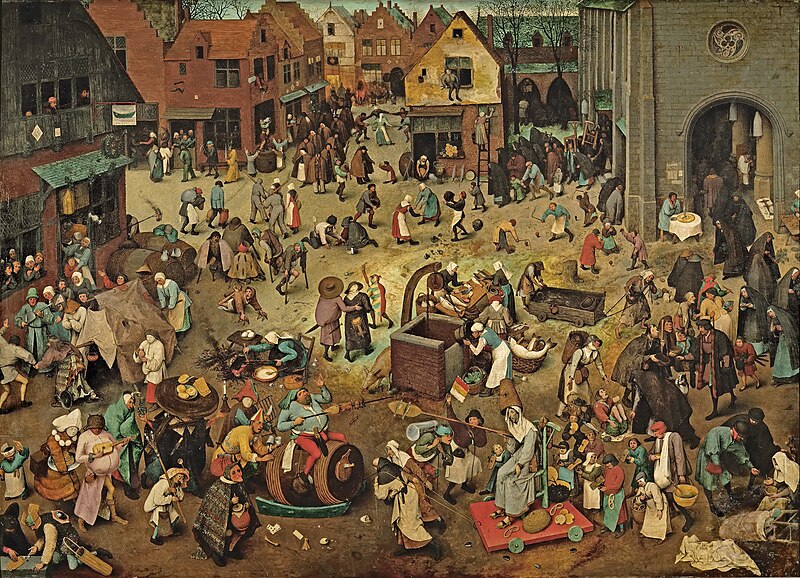
One key distinction to be made between El arte de la resurrección and a Bruegel painting, of course, is the direction, the cinematic quality of the former. If I stand looking at "The Battle between Carnival and Lent" it keeps me engaged, keeps my gaze shifting; but I am "directing" the movie by moving my gaze. Whereas here, there is clearly a cameraman showing us where to focus and what to move to the periphery. Check out this beautiful pan from the plaza to in front of the union hall, from chapter 7 -- reminds me a little of the opening shot from Heimat. The striking workers in La Piojo are waiting for their lunch, in front of the union hall:
Even from a distance one could see that chaos reigned, everything in a rambunctious disarray: a few kids, stick in hand, trying to keep at a distance the group of stray dogs that had assembled, attracted by the aroma of food, while a few well-built gaucho types were greasy with sweat, gathering and splitting wood for the fire; the group of women inside was sweating too, in their aprons cut from canvas flour sacks, their cheeks smudged with soot, they were ladling out dishes of the hot, steaming stew to the tight line of men, women, children who held out their chipped dishes, their faces long with hunger. The menu, like every day's, was a generous helping of chili beans -- one day with crushed maize, one day with peppers, which cooked on the other fire, smoking under a black skillet, seasoned with a colorful bloom of paprika.
The camera starts out away from the action, across the plaza; gradually it zooms in on the kids keeping away the stray dogs, then pans to men cutting wood (in my mental picture of this scene, the men are sort of behind the kids (vis-a-vis the pov) and a bit toward the union hall, the camera is moving across the plaza and a bit to the right) and then (continuing to the right, and swinging around) to the women cooking and to the people waiting; and the last word of the sentence is "hunger"! Then we linger lovingly on the food that's cooking, the centerpiece of this scene. (This and a passage a little later on when Christ is eating are beautiful food writing I must say -- this Rivera Letelier is extremely versatile.)
posted afternoon of November 26th, 2010: Respond
➳ More posts about Hernán Rivera Letelier
| |
Thursday, November 25th, 2010
An example of the kind of sentence I was mentioning loving in Arte de la resurrección is near the beginning of Chapter 6, a description the people of Providencia (not, as I initially thought, a village in Elqui Valley, but a mining company town, a "salitrera," in the Atacama -- and referred to throughout the story as La Piojo, which I am understanding as Lousy*) gathering to await the Christ of Elqui. Listen:
The women came, their heads covered in dark bandannas, rosaries in their hands, a prayerful, focused halo softening the faces of these strong women, dutiful, capable of any sacrifice for their families. The children were running with their wire hoops, their tin wagons, with the rambunctious happiness of seeing something novel in the endless tedium which was the pampa, all the world they knew of; while those few men who were idling, who were spending the siesta on the hot stones by their front doors -- for most of them were together in the union hall, or keeping watch on the factory gate for strike-breakers -- came following the women and the children to see this novelty, ganchito, a Chilean Christ preaching in the desert. Even the most skeptical, the least credulous of them -- and the mine-workers were the most skeptical, the least credulous of anyone in the pampa -- those who could not believe that this layabout, this beggar could be Christ the King, that he was divine, could perform miracles -- "This Christ of the slums has never even healed a sleepy little girl, paisita" -- even these came to look away from his footprints with the disdainful grimace of the suspicious macho tattooed on their oblong faces.
At this hallucinatory siesta hour on the pampa, the sun was a burning stone at the center of heaven.
In the original the whole first paragraph is a single sentence, I could not avoid dividing it into a couple. You can spend a lot of time in front of that sentence as if it were a Bruegel, it repays multiple readings with new layers of imagery.
* Or also, I see piojo is slang in the Andes for "gambling den" -- so maybe the nickname means something like "Dive".
I wonder a lot about how much weight I should give to cognates, to preferring English words which sound like the Spanish term they are translating, where it is feasible. This may end up statistically twisting the meaning of the text a bit as I read it. A similar caveat applies to the matter of using Spanish words in the translated text, this may need to change in a later draft... ("ganchito" in particular is a cheat; and I'm fairly sure the "look away from his footprints" passage is a mistranslation, that I don't understand the sentence as written.)
↻...done
posted evening of November 25th, 2010: Respond
➳ More posts about Writing Projects
| Previous posts about Projects
Archives  | |
|
Drop me a line! or, sign my Guestbook.
•
Check out Ellen's writing at Patch.com.
| |