This page renders best in Firefox (or Safari, or Chrome)
Projects
I like to work on things, with my hands and with my mind. Since 2000 I have been an amateur woodworker, and since we moved in to our house in 2002 I have been doing a good deal of carpentry as well. Also, I spend a fair amount of time thinking about computer programming, and occasionally do some human-directed writing and translation.
Here are a couple of poems I have written recently. Experimenting with story-telling and with prosody.
Horizon
The best-laid tracks converge, they meet
way out there by the setting sun
confounding engineering dreams perspective in the desert
where the train runs off the vanished rails and crashes, yes,
it's tragic, sad-sack Sam the goldrush pioneer will never see his lover
who was riding west to meet him, look how Jesse and his outlaws
are confused, the hold-up won't play out, they may just ride their horses over the edge behind the train or else perhaps they'll turn back just in time, they'll skirt impending doom and spend their days retelling stories of the one that got away.
Crystal Armies
Fit the image to the meter
We can print it when you're done
When the armies that you're dreaming
Wander sleepy off the page and
Wave their effervescent banners
To the rhythm of your drum.
Marching softly, scarcely there,
You have to strain to make them out
Their dusty footprints on the pages
Almost like a printer's error
When they finally encamp
Inside your thawed out cerebellum
They'll build ghostly fires and sing
About the journeys of their fathers
And you'll scratch your forehead wondering
(In your clarity of vision)
Where the simple, crystal image
Of your verbal armies went.
I'd like to thank Pelele of Muchacha Recostada, who has posted what I believe to be a great poem, Mutilaciones (from 2009) -- my working definition of a great poem is one the reading of which alters how you read and write poetry -- I believe that "Mutilaciones," with its frantic, driving meter and its clarity of vision, will have a permanent effect on my reading of poetry and on my poetic output. "Crystal Armies" is written strongly under the influence of Pelele's piece. I'm working on a translation of "Mutilaciones"* which will be my first time (even dreaming of) translating a metered poem -- I do not think I am going to be able to keep the rhyme, but the meter is coming through very naturally.
For I reckon that the sufferings of this present time [are] not worthy [to be compared] with the glory which shall be revealed in us. For the earnest expectation of the creature waiteth for the manifestation of the sons of God. For the creature was made subject to vanity, not willingly, but by reason of him who hath subjected [the same] in hope, Because the creature itself also shall be delivered from the bondage of corruption into the glorious liberty of the children of God. For we know that the whole creation groaneth and travaileth in pain together until now.
-- The letter of St. Paul to the Romans Chapter â…§: 18-22 King James version
For a long time I have been wondering how a translation of JoachÃn Pasos' Battle-song: The War of Things might best preserve the voice of the poet. Throughout the poem he is addressing vosotros, the explicitly familiar, explicitly plural second person which does not exist in English. Turns out the key is the epigraph to the poem.
For an epigraph, Pasos quotes from the Vulgate version of the above verses of Romans; but he prefaces the quotation with "Fratres:" -- "Brethren:", which is not part of these verses. Paul's letter is addressed to his brethren the Roman Christians, so this insertion makes good sense. And if you read Pasos' poem as a continuation of Paul's address to his brethren, then the familiar second-person plural is clear from context.
This morning I had what seems to me like a good idea for a non-literal translation of the poem's third stanza:
Give me a motor, a motor stronger than man's heart.
Give me a robot's brain, let me be murdered painlessly.
Give me a body, metal body without and within another metal body,
just like the leaden soldier's who never dies,
never begs oh Lord, your grace, let me not be disgraced among your works
like the soldier of mere flesh, our feeble pride,
who will offer, for your day, the light of his eyes,
who will take, for your metal, take a bullet in his chest,
who will give, for your water, give back his blood.
Who wants to be like a knife, like one no other knife can ever wound.
(With liberal borrowings from Steven F. White's more literal translation.) This poem reminds me strongly of León Ferrari's paintings of armaments. Remember that the poet is addressing his brethren: He is asking for these cybernetic enhancements not from his God but from his peers.
I got interested in this passage yesterday... I was trying to find out more about Œdipus and about Thebes, and one of the references was to Pindar's second Olympian ode. That particular reference* didn't turn up so much of interest; but I found the beginning of the first Olympian ode enchanting. Diane Svarlien translates it as "Water is best, and gold, like a blazing fire in the night, stands out supreme of all lordly wealth." I don't know Greek, but let's see how this works. The Perseus Digital Library makes it easy:
ἄÏιστον μὲν ὕδωÏ: Water is best. This seems clear enough, I know "arist-" from its use in English, and "udor" is close enough to "water" for my ear. What does Pindar mean? That water is the most virtuous/noblest of the elements? It looks sort of like he's setting up water in opposition to gold; the lexicon at Perseus says μὲν ... δὲ can be rendered as "on the one hand... on the other hand" -- this does not come through in Svarlien's translation.
χÏυσὸς αἰθόμενον Ï€á¿¦Ï á¼…Ï„Îµ... νυκτὶ: Gold blazing just like fire at night.
διαπÏÎπει: It catches the eye.
μεγάνοÏος ἔξοχα πλοÏτου: It looks to me like this phrase is meant to modify "gold" -- it's not too clear to me what "meganoros" is meant to do -- maybe in English this could be rendered as "but then again gold, the greatest wealth of great men, catches the eye; it blazes just like fire in the nighttime."
What does it all mean? ...Pindar is setting up some standards of greatness, it looks like, and then he is going to say that the greatest of all is the exploits of the Olympic contestants. Today in the NY Times magazine, Gary Wolf uses a different superlative in a similar construction when he calls gold "the most primitive form of wealth" -- seems like you could argue against that assertion, but anyways it caught my eye on the heels of reading Pindar.
Another sort of amusing detail, for me anyways: AOTW one of the top Google hits for this passage is Belle Waring's post a few years ago at Crooked Timber about the badness of comments sections at various moderate-left political blogs.
* "In such a way does Fate, who keeps their pleasant fortune to be handed from father to son, bring at another time some painful reversal together with god-sent prosperity, since the destined son met and killed Laius, and fulfilled the oracle of Pytho, spoken long before." -- Svarlien's translation
Update: I found my copy of Lattimore's translation of Pindar. (Which also is online at archive.org.) His rendering of the opening lines:
Best of all things is water; but gold, like a gleaming fire by night, outshines all pride of wealth beside.
rings most pleasantly in my ears.
posted morning of May 14th, 2011: Respond ➳ More posts about Readings
Below the fold, something that might become a first paragraph of a longer piece. I'm sort of wondering if it's worth pursuing; if you have any reaction to the piece I would be interested to know what it is. I'll post a comment a bit later concerning where I'm thinking about going with it; my hope is that its rhythm will grab the reader (or a particular few readers) and make him/her/them want to come along wherever I am going with it.
Sinking into the warm black pillow of night. I’m dreaming
Masks, new faces, costumes I will wear
Internally, so I won’t know myself,
My face, my clean white tablet lies
There on the pillow looking up at me.
So paint! Draw crazy patterns on your cheeks;
Sculpt horns and wild protuberances, scars
Where your clean virgin skin is lying smooth.
Add blemishes and warts around your mouth,
Sprout tufts of wiry hair beside your nose --
just let yourself go,
make a May Day parade
of masks:
We’ll set them up
For all to see
We’ll let you know
Which ones will work,
Which ones will trick you out obscenely sinister unrecognized and sneaking stealthy sliding past
the doorways of your ego lurking dark around the alleys of your childhood memories;
And when I've gone to sleep I’ll see
My costumed armies waiting
And the desolation staging
Where they play.
posted morning of May 11th, 2011: Respond ➳ More posts about Dreams
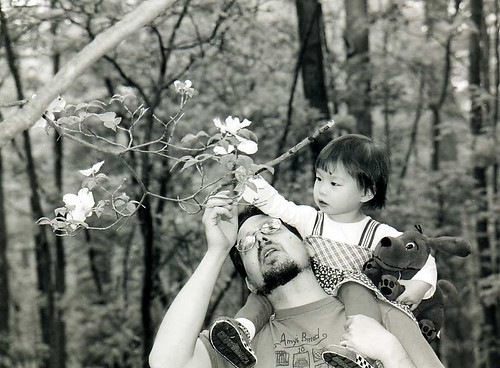
One of my very favorite-ever pictures of myself is this one, taken 8 years ago, when Sylvia was 3 and my parents were visiting -- I believe it was their first visit at our new house, the house we live in today. My dad took this picture of 3-year-old Sylvia on my shoulders, entranced by the dogwood blossom.
Every year since then, the dogwood has produced fewer blossoms, fewer leaves; and this year it is well and truly dead.
I spent some time this afternoon cutting off its limbs. For Sylvia's documentation of the process, look at our family album.
A story idea (or, well, a character idea -- nothing happening in the story, yet) that developed in China as I interacted with vendors at the Shanghai textile market. I was not really there to buy anything, just keeping Ellen and Sylvia company in their hunt for silk...
So the idea is, there's this character, a sexually/interpersonally-frustrated American businessman who spends time in China working for his company. Not really sure of the details of this, possibly I would model him on a British expatriate we met in Suzhou who had lived there for several years doing marketing for a British telecommunications firm. I think the character's name is Morris Babel, just because I was reading 100 Years of Solitude recently and thinking what a great character name that would be, and it seems to work for this character. Babel's business does not involve textiles but he develops the kink of hanging around the fabric and clothing markets having people sell to him -- the salespeople, who are generally attractive young women, make eye contact, greet him, ask him to look at their wares, and if he pauses to take a look, aggressively market the merchandise, pulling him in and connecting with him, or creating the appearance of a connection. Babel finds this addictive and returns daily to the markets, buying clothing and fabric and trinkets he does not have any use for in exchange for this experience of feeling wanted.
It seemed to me at the market like this form of direct personal marketing was the primitive form of the advertising industry I have been exposed to all my life in America, probably (almost certainly) more effective on a per-exposure basis than mass media advertising but of course much less efficient in terms of money, since labor is involved in each exposure.
10And Jacob went out from Beersheba, and went toward Haran. 11And he lighted upon a certain place, and tarried there all night, because the sun was set; and he took of the stones of that place, and put them for his pillows, and lay down in that place to sleep.
12And he dreamed, and behold a ladder set up on the earth, and the top of it reached to heaven: and behold the angels of God ascending and descending on it.
13And, behold, the lord stood above it, and said, I am the lord God of Abraham thy father, and the God of Isaac: the land whereon thou liest, to thee will I give it, and to thy seed;
14And thy seed shall be as the dust of the earth, and thou shalt spread abroad to the west, and to the east, and to the north, and to the south: and in thee and in thy seed shall all the families of the earth be blessed.
15And, behold, I am with thee, and will keep thee in all places whither thou goest, and will bring thee again into this land; for I will not leave thee, until I have done that which I have spoken to thee of.
16And Jacob awaked out of his sleep, and he said, Surely the lord is in this place; and I knew it not. 17And he was afraid, and said, How dreadful is this place! this is none other but the house of God, and this is the gate of heaven. 18And Jacob rose up early in the morning, and took the stone that he had put for his pillows, and set it up for a pillar, and poured oil upon the top of it. 19And he called the name of that place Bethel: but the name of that city was called Luz at the first.
-- Genesis 28 (kjv)
—Está bien, Prudencio —le dijo—. Nos iremos de este pueblo, lo más lejos que podamos, y no regresaremos jamás. Ahora vete tranquilo.
And a reward, for reading all that text: Here is Alison Kraus singing about (another) Jacob's Dream.
* I am not sure what this means. Gregory Rabassa renders it literally in his translation, "and they succeeded"; but it does not mean anything in English. I am leaving it out of my translation. My best guess is that it means some of the travellers *did* die of exhaustion; but no mention of this is made elsewhere, and it seems like it would be a strange thing to throw in with no specifics. ... Got it! (Maybe) -- I think I am misreading this. I wanted "todos estaban dispuestos a morirse de viejos" to mean, "they were ready to drop dead of exhaustion" so I ignored the meaning of the words; viejos is old age, not exhaustion. So estaban dispuestos means "they were ready/prepared" in the sense of what they were planning to do, not what they were about to do -- they meant to die of old age, not to die on the journey. "(and they succeeded)" -- i.e. they did die of old age, years later, not on the journey. I think Rabassa's translation is very unclear. I modified my translation above.
Update: Some further thinking about Jacob (and Macondo) here.
Si sólo fuese el grito
del agua,
o el rodar de una piedra
que no encuentro acomodo
a la orilla del llanto.
Si sólo fuese
la herida corrosiva
de los pasos sin nombre
en los dÃas que mueren,
o la processión lenta de las horas
(centinelas del miedo).
Si sólo fuese el puñado de hierba
lo que cubre a la sangre,
aventada al olvido,
para poder decir:
es el final.
Too Late
If only it were just the scream
the water's scream,
the restless turning of a stone
which finds no spot to nestle
by the banks of the storm.
If only it were just
the wound, corrosive wound,
that nameless passage,
flow of dead time;
the soft procession of the hours
(sentinels of fear).
If only that bundle of herbs,
the ones we use to bind our wounds,
could be scattered to oblivion,
that we might say:
it is over.
I'm torn here between the beauty of the language and imagery, and a fear that I'm not really understanding the poem, am misreading and mistranslating... A more literal translation of the title is "The Juvenile Offender" -- I could not make any sense of that so I seized on an alternate meaning of "delinquent" in English, but I really have no idea if that works in Spanish.
Cárdenas Peña seems like a good poet for Valentine's Day as he is just about as Romantic as they come. Wikipædia says that he was "infatuated with beauty, with masculine beauty; he passed his thankless days in Platonic admiration of young men's bodies. The contemplation of physical beauty, the slow and sensuous writing of his poetry, the dialogues which he carried out with himself in cheap hotels and in the beds of the poorhouse -- perhaps these were the three fundamental activities of his life."
Another animal that migrated across the Bering land bridge and east and south throughout the Americas and eventually down as far as Chile: the polyommatus butterfly. Dr. Naomi Pierce of Harvard et al. have vindicated Nabokov's hypothesis regarding the introduction of this genus of butterfly to the Americas, as Carl Zimmer reports today for the NY Times. The slideshow attached to the article has to be seen to be believed.
Below the fold, a piece from The Art of Resurrection that came to mind as I was reading this article. (I have that book on my brain now...)
At the opening of Chapter 4, the Christ of Elqui is walking along the rail line through the pampa, from Sierra Gorda to Providencia (or as the two he met in Sierra Gorda told him it is known locally, La Piojo -- they also warned him to stick to the tracks so as not to get lost in the desert) --
Across the pampa's wide expanse, the dry four o'clock wind was beginning to blow.
The Christ of Elqui, he had been hiking for a long hawl with no rest, his long hair blowing into his eyes, when he stopped; he lifted up his gaze, making a visor of his hands. All of a sudden it seemed as if he could make out the gravel lot of the plant over there where the hills began to rise -- in the pampa, such a sight gives one the illusion of seeing "a ship foundering on the desert plain," as some northern poet's verses call it. But the railroad line just followed its interminable southerly right-of-way.
Surely a little ways further, and it would turn off to that side.
Just at that moment, miraculous in the open pampa, under the brutally incandescent midday sun, a butterfly crossed over the iron rails. "An ephemeral butterflyâ€, he said in wonder, the Christ of Elqui; he could not imagine from how far off it had flown. It was an orange butterfly with black markings.*
As he watched it disappear, fluttering off to the east, that was when it occurred to him. Why not take the short cut, save some hiking, save some time? Clearly, more powerful than all the desert’s misdirections and illusions would be the Eternal Father, guiding his steps.
So he thought; and that is what he did.
(Is it clumsy, this having the two warn him to stay on the tracks, then having him take the short-cut and get lost? Possibly. But, very beautiful. Some of the subsequent portion of the chapter is quoted in this post from a few months back.)
I wonder who the northern poet being quoted in the second paragraph is. The closest thing to the quoted phrase I have been able to find with Google is from Elisabeth Nox' recently published first novel La ciudad de los hombres perdidos, "Pero en ningún momento llegó a preguntarse cómo habÃa llegado el barco a encallar en mitad del desierto." Interesting but probably not what I'm looking for...
* One of the butterflies that Nabokov named, the Pseudolucia aureliana, is native to the Atacama; however it is blue with yellow markings, oh well.




 Some text! Let's look at two longish quotes.
