Somehow, Cleveland has survived, with her gray banner unfurled -- the banner of Archangelsk and Detroit, of Kharkov and Liverpool -- the banner of men and women who would settle the most ignominious parts of the earth, and there, with the hubris born neither of faith nor ideology but biology and longing, bring into the world their whimpering replacements.
This page renders best in Firefox (or Safari, or Chrome)
Projects
I like to work on things, with my hands and with my mind. Since 2000 I have been an amateur woodworker, and since we moved in to our house in 2002 I have been doing a good deal of carpentry as well. Also, I spend a fair amount of time thinking about computer programming, and occasionally do some human-directed writing and translation.
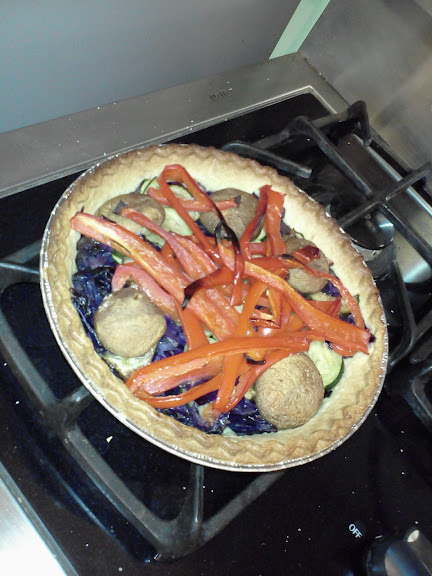
The roasted vegetables will be ready about now, so take them out of the oven. Leave the oven on to 450° so it will be hot for cooking the pie.
When the cabbage starts to soften, fill the pie crusts. Cabbage and onions, then zucchini slices and mushrooms, then red peppers. Cook at 450° until crust is nice and brown, approximately 20 min.
The inspiration is Robyn Hitchcock's Cooking with Rockstars post from a couple years ago. It seems like a nice dish to bring to the potluck supper which will follow this afternoon's concert.
posted morning of November 20th, 2011: Respond ➳ More posts about Recipes
De repente sentà que alguien me hablaba. DecÃan: señor Salvatierra, Amadeo, ¿se encuentra bien? Abrà los ojos y allà estaban los dos muchachos, uno de ellos con la botella de Sauza en la mano, y yo les dije que nada, muchachos, sólo me he traspuesto un poco...
— Amadeo Salvatierra January, 1976
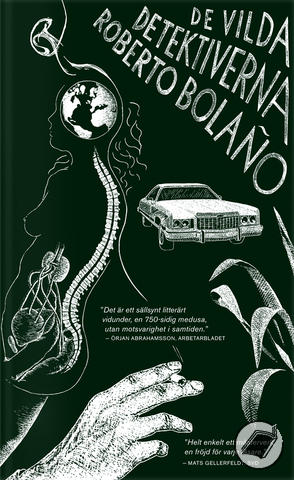
Amadeo Salvatierra's voice is one I could go on listening to for a long time without getting tired of it. His narratives seem to me to serve a special purpose in the vastness of part 2 of Savage Detectives, in that they keep the enclosing story of Belano et al. searching for Cesárea Tinajero front and center in the reader's mind. Below the fold, some lovely commentary from Salvatierra, in Natasha Wimmer's rendering, on the subject (near and dear to me) of mistranslation.
Salvatierra is showing Belano and Lima his treasured copy of the old Visceral Realist journal Caborca.
...Cosmopolites that they were, the first thing they turned to were the translations, the poems by Tzara, Breton, and Soupault, in translations by Pablito Lezcano, Cesárea Tinajero, and yours truly, respectively. If I remember correctly, the poems were "The White Swamp," "The White Night," and "Dawn and the City," which Cesárea wanted to translate as "The White City," but I refused to let her. Why did I refuse? Well, because it was wrong, gentlemen. Dawn and the city is one thing and a white city is another, and that's where I put my foot down, no matter how fond I was of Cesárea back then. Not as fond as I should have been, I grant you, but truly fond of her all the same. Our French certainly left much to be desired, except maybe Pablito's. Believe it or not, I've lost my French completely, but we still translated, Cesárea in a slapdash way, if you don't mind my saying so, reinventing the poem however she happened to see fit, while I stuck slavishly to the ineffable spirit as well as the letter of the original. Naturally, we made mistakes, the poems wound up battered like piñatas, and on top of it all, believe me, we had ideas of our own, opinions of our own. For example, Soupault's poem and me. To put it simply: as far as I was concerned, Soupault was the greatest French poet of the century, the one who would go farthest, you understand, and now it's been years and years since I've heard a word about him, even though as far as I know he's still alive.
I'm counting the hours going by until this weekend -- have tickets to see Robyn Hitchcock at The Bell House on Saturday night, and tickets to see Robyn Hitchcock at Mark and Elaine Costanzo's studio on Sunday! This is going to be a great weekend... Here is some classic Hitchcock to tide us over in the mean time.
I've been listening to "All I want to do is fall in love" a lot lately, it is on its way to replacing "Birds in Perspex" as my favorite love song. John and I covered it the other night and I think we did a really good job... The studio concert is being billed as "requests only" -- this is a strong candidate for my request.
Update with some further posts about the Sunday show -- the Food Pie I brought along for the potluck; my notes and set list (which he signed for me!)
posted evening of November 17th, 2011: 1 response ➳ More posts about Gig Notes
(Made up on the spur of the moment this evening and worth remembering. It takes about 15 minutes including prep time.) A vegetarian pasta dish (vegan even, if you omit the grated cheese at serving time); for those who prefer it with meat, lamb or veal would probably go nicely in place of the beans.
Rigatoni and yellow and red
Heat salted water for the pasta.
Prep: chop a small yellow onion, a yellow bell pepper, some carrots and a yellow summer squash into bite-size pieces. (The carrot pieces should be smaller.)
When the water is nearly at a boil, heat a skillet over a medium flame. Add about a Tbsp of olive oil. When hot enough that the onions will sizzle a bit, add the onions and some salt and stir around.
Add the pasta, preferably penne or rigatoni (or wagon wheels or shells would be good, too), and a little bit of olive oil to the boiling water. Return to a boil and lower heat.
As the onions start to cook, add the carrots and some turmeric and some oregano. Keep stirring occasionally. Add the bell pepper and the squash and a little more salt.
Heat a little bit of water in a saucepan over a low flame. Drain and rinse a can of canellini or kidney beans and add to the saucepan with a splash of soy sauce. (I used kidney beans, which were the "red" -- the dish would perhaps not be as visually interesting with cannellini but I expect it would taste very nice. Broccoli would also add some nice visual/textural diversity.)
Everything should basically be ready at about the same time, 10 minutes or so after you returned the noodles to a boil. I served the noodles and vegetables in one bowl and the beans on the side because of certain family members who are not partial to beans; or they could all be mixed together. Tasty with grated asiago cheese and red wine.
posted evening of November 5th, 2011: Respond ➳ More posts about Food
Man, am I glad we cut down that dogwood tree this summer! The storm last night brought down large (but ultimately insignificant to the giant tree) pieces of maple and most of the burning bush on the side of the house -- the power lines are rather miraculously none the worse for wear.
The story "Cartas para escribir una novela" is the central piece in Zupcic's book Dragi Sol -- all the stories are meditations on the narrator's relationship with his absent immigrant father, this story is likely the most successful. I think it is the heart of the work. Read the opening to get an idea of the voice he is developing and the complexity of narrative style he is achieving.
Postcards: towards a novel.
by Slavko Zupcic
The personal journal of Vojislav Didic (Notes on the life of my father, Zlatica Didic; his postcards and photos. His memory.)
for Leticia Z
"Huyo de mi semejante; en todo semejante hay un doble." -- Georges Braque
Yes -- I know what Anton said on his recent visit, I know all he said; but this will not be the day I regret having translated, having copied out fresh, written out on good white paper my father's old postcards. Quite the contrary: there is something to having saved these cards from oblivion, something enchanting, something heartening -- the marvel of seeing a new world, a new universe, just an ocean away from my own. Some -- the majority -- were written in Serbo-Croatian; others in a mix of English and French, a jargon my father picked up as he made his way through Europe during the Second World War; and a few letters, two or three, written in Spanish, a Spanish peppered liberally with Serbian idiom. Almost all were sent from my father to his brother Vinko Didic (Hrastovica, zp: Petrinja), and to his best friend in Yugoslavia, Stevo Valec (L.R. 168, Karlovac); also to Ankika Car in the United States (R.R.I. Box 118A, Hobart, Ind.), who was his first girlfriend, and Van Hecke Zimmerman (JunÃn 1689D, 1233 Buenos Aires), a German engineer my father had met on board the Fontainbleau -- not the legendary ship, one built in imitation of it which sailed the Atlantic Ocean for many years under an Argentine flag. The others are replies to his letters, from Vinko, Stevo, Ankiko and others my father wrote to occasionally.
Of his siblings, my uncles and aunt, Vinko was the only one he wrote to very frequently, and the only one he received letters from. He wrote a few times to Marko and to Nikolas. Never to Anna, or if he did those letters were among those that we destroyed, my sister and I, ten years ago. We know her name and where she lived (Leigh Creek, S.A., Australia), because these points are mentioned frequently in the letters, as are the corresponding data for Zlatko -- how he sings, how he pisses. And Zlatko, he never could have written to my father: dead men*, as dead as he has been for the past 40 years, do not write.
*Information in my father's letters suggests that Zlatko Didic died in 1944, fighting with partisan troops against a German convoy, drilled through by a bullet from the Nazi front.
Anton B., an old Yugoslavian diplomat in the service of the Italian government and lately a friend of our family, had no trouble confirming the date and locale of my uncle Zlatko Didic's demise. Where his skepticism lay was with the circumstances under which it took place. Indeed he appears to be taken with a complex theory which suggests that not even the address we have for my aunt Anna is accurate.
(I think "Correspondence" would actually be a better word to use in the title and header.)
From the four points of the compass they came, the strikers on their way to Alto de San Antonio in their long, dusty caravans. The village was boiling over with excitement. As you looked into the chaos of the crowds streaming through the village's streets, you could see signs bearing the names of salitreras, La Gloria, San Pedro, Palmira, Argentina, San Pablo, Cataluña, Santa Clara, La Perla, Santa Ana, Esmeralda, San AgustÃn, Santa LucÃa, Hanssa, San Lorenzo, others that we hadn't even heard of. And that's not all -- covered with dirt from their heads to their feet,the strikers came singing, shouting, not only the oficinas in San Antonio's district, but from every district in the Pampa del Tamarugal. The influx of people showed no signs of letting up. The strike had spread across the pampa like a duststorm -- "Good dust, the dust of righteousness, my brothers" crowed Domingo Dominguez, walking among the crowd. To the bird's eye, there were more than five thousand of us, pushing together into the streets of the village, bringing our power to the strike. Men of every race and nationality, groups which had clashed in bitter fratricidal wars, were coming together now under the sun, under a single standard -- that of the proletariate.
Laura's wishing Peter would just
Give up this pretension, would just
Break this patterned silence
Where he builds his lonesome castle. Now she
Cries out in the morning when she
Wakes and finds him missing. Wishes
He'd reach out and touch her, wants
To hold him in his grief -- she wants to
Have back these long years that
she's been waiting for his voice. Peter's
Walking in the garden, where he
Knows the paths are laid,
Planted crocus in the springtime, planted
Hostas in the shade, wanders
Down the road to town, but nothing's
Open Sunday morning, now he
Rubs his eyes and wonders if he'll
ever find his home.
Expectation conquers knowledge and the
Evidence of senses; what I
see and hear and feel
I'll never grasp if I decline;
For all I wish and want and hope I'll never
Stand beside my grave, I'm seeing
Gauzy patterns traced out
On the page of wounded time.
She gets up, groggy, runs the water,
Steaming up the mirror, she hears
Peter downstairs in the kitchen,
hopes he's making coffee,
Laura's tired out, she didn't sleep well,
Combs her hair and squints and in the
Mirror she can see the look of
anguish on her face.
She's downstairs with a cup of coffee,
Looking quizzically at Peter,
Peter's solemn face that just
can't seem to meet her gaze.
A question's in the air and they both know it, but the
heavy silence keeps their lips held tight; keeps
Heavy thoughts drawn back to yesterday.
Jorge López reviews Peter Gabriel's "New Blood" orchestral tour -- the performance he saw at Santiago's Movistar Arena on Wednesday has left him with a smile that is not going away.





 reviews
