This page renders best in Firefox (or Safari, or Chrome)
Projects
I like to work on things, with my hands and with my mind. Since 2000 I have been an amateur woodworker, and since we moved in to our house in 2002 I have been doing a good deal of carpentry as well. Also, I spend a fair amount of time thinking about computer programming, and occasionally do some human-directed writing and translation.
I rode my bike down Muntaner to Diagonal. Parked it in front of the Dau al set gallery and rang Valerie's doorbell.
—When you come to the door, so you won't have to tell me who it is, ring three times in a row: ta, ta, ta. That way I'll know it's you. —that's what she had told me, the first day.
The door opened and I went upstairs. Valerie went over to the sofa with me as soon as I came in, she was moving her hands slowly in front of me, telling me her mother had been in the hospital since that afternoon, she feared the worst, that she had only come away from there to meet me, so that I would not come to an empty apartment and be scared.
She gave me a kiss on the cheek, paid me, and we left the apartment. Of course I didn't tell her any of what I'd been thinking about. I wasn't going to be seeing her anymore, surely; but I had left the mobile -- the lizards, the Gaudi mobile, on her sofa.
I have made a couple of revisions and have submitted the story to Words Without Borders. The biographical note I submitted:
Jeremy Osner is a computer programmer living in New Jersey. He came to Spanish translation late in life and has been learning the language as he learns the voices of the authors he has translated. Notable among these is Venezuelan Slavko Zupcic, a psychiatrist now living in Valencia, Spain, whose stories examine the gaps in understanding at the borders between people.
I was translating (just starting to translate, I was on the first page) into English a translation into Croatian of Stephen Crane's Red Badge of Courage. It seemed like it was going to be a magnum opus...
posted morning of January 10th, 2012: Respond ➳ More posts about Dreams
Although I’ve been doing it non-stop for thirty years, in spite of living my life surrounded by other people who are always doing it, I still think there are few activities so intriguing as the reading of novels.
I keep wondering why we do it: why would an adult devote his time, his mental energies, his moral intelligence to reading about things that never happened to people who never existed; how could this activity be so important, so vital, that this person would voluntarily withdraw from real life to carry it out. I've come across a few answers over the years, some of them in conversations with other addicted readers, but mostly in books here and there along the way. And indeed, the most recent of these books is truly marvelous: The Naïve and Sentimental Novelist consists of six essays in which Orhan Pamuk seeks to answer one crucial question: What happens to us when we read (and write) novels? This book is the most illuminating, most stimulating, most abundant examination of this difficult topic that I've read in years. I can do no less than to offer this urgent call to readers.
"I have learned by experience that there are many ways to read a novel," says Pamuk. "We read sometimes logically, sometimes with our eyes, sometimes with our imagination, sometimes with a small part of our mind, sometimes the way we want to, sometimes the way the book wants us to, and sometimes with every fiber of our being." In other words: there are no two identical readers of the same novel; not even two identical readings. And this fact, which seems so obvious, is what can explain the effects, the intimate, unpredictable effects the novel can have on us. What are these effects? Pamuk says we read the way we drive a car, pressing the pedals and shifting gears while watching the signals and traffic and the landscape around us: our intellect moves in a thousand and one directions in every instant. With part of our mind we do the simplest thing: follow the story. But readers of "serious" novels are doing something more: are looking constantly for the secret center of the novel, for that revelation the novel seeks to bring to light, which cannot be summarized, which can only be expressed just as the novel expresses it. Sábato was once asked what he meant to say in On Heroes and Tombs. Sábato replied, "If I could have said it any other way, I would never have written the book."
To read a novel is to leave behind a Cartesian understanding of the world. We know these things never happened, but we believe in them as if they had happened; we know they are the product of someone else's imagination, but we live through them as if they were a part of our own experience. "Our ability to believe simultaneously in contradictory states," according to Pamuk, is an essential characteristic of the reader of novels; another one is the urge to understand, not to judge, the characters. "At the heart of the novelist's craft lies an optimism," says Pamuk, "which thinks that the knowledge we gather from our everyday experience, if given proper form, can become valuable knowledge about reality." As readers, we share in this belief: that a good novel is a means of bringing a little bit of order to the chaos which reigns around us, of beginning to understand it. And that’s no small thing.
Vásquez (who I think is my favorite new author that I found out about this year) writes a weekly column for Bogotá-based newspaper El espectador. Many thanks to Mr. Vásquez for allowing me to post this translation here, and especially to Anne McLean for helping me to contact him and for passing an editorial eye over my effort. It reads much more smoothly with her suggestions incorporated.
In this autumn of 2011, the peak concert experiences are coming fast and furious. Last night John and I went out to Union Hall in Brooklyn, the basement of which contains about the nicest performance space of its size that I can remember being in, to see Jeffrey Foucault and Mark Erelli touring their new album, Seven Curses. We showed up about a half hour early and got a chance to mingle with the other concert-goers, a lovely crowd of folkies, chat about the music, the weather, the neighborhood... talked up Mountain Station to a couple of people who seemed receptive...
Jeff came on stage looking like Ulysses S. Grant with a Gibson J-45 and Mark picked up his mandolin; sat down about ten feet away from us. After a little loose strumming and tuning up they broke into a clear, insistent rhythm, chords ringing out, sweeping us away. The two sets were a mix of covers and originals from both artists, tracks from the new record and from their back catalogs, murder ballads and love songs -- one particularly charming moment in the second set came when a man from the audience called out a request for Dylan's "Shooting Star" -- Erelli knew it, Foucault said he could figure it out, and (after a brief debate over whether they should play Bad Company's "Shooting Star" instead) the two of them improvised a rocking cover version on the spot.
posted morning of December third, 2011: Respond ➳ More posts about Gig Notes
Brandon Holmquest's analysis of the practice of translating poetry is well worth reading. Holmquest translates Borges' poem "El general Quiroga va en coche al muere" and examines closely the decisions he is making at each juncture.
The concept of
Impermanence manifests itself frequently enough in Buddhist philosophy. It asserts that life "is like a dream, just like a dream. Completely hallucinatory -- like lightning -- of a transitory nature. Lightning brings with it an explosion of light and disappears immediately. That's how things are, that's life."*
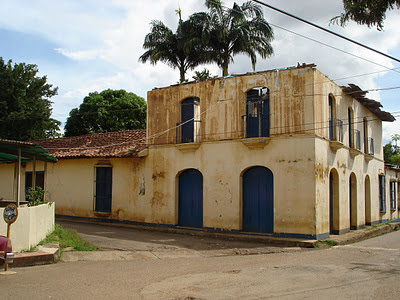
Since I laid eyes on this house I have not been able to stop thinking about it. Its beauty is incredible, in spite of its state of deterioration.
Passing by, the years have softened the memories: the laughter of children in its hallways, the extraordinary aromas that would come from the kitchen when grandma was cooking, grandpa's old Victrola, which played before the lovely parties they threw in their spacious main hall; the southern songbirds which filled the house and its grounds with such beautiful tones, which cheered them up.
None of this exists any longer. It's just the memories and ghosts that remain to live there. The house is a mute testament to those parties, which once filled those old walls of brick and adobe.
If anyone is interested in knowing -- it's in San Francisco Javier de Lezama, in Guárico, Venezuela. A bit closer down to where the wind comes from.
*The words enclosed in quotation marks above, concerning life and "impermanence", are by the Lama Kyabje Zopa Rinpoche, who spoke them in Kuala Lumpur, Malasia, in February, 2002.
Knight from Presto MusiCo in Point Pleasant was at the show in Freehold and made some lovely, ghostly videos of a couple of songs. Look at his YouTube channel for "Crystal Ship" and more. The impressionistic quality of the video -- its pixellations, its lacks of focus -- is really key to capturing the weary feeling of "River Man". Watch it full screen.
This afternoon's show was fantastic. I have really been anticipating it for a month or more now, and it was worth the waiting for. The whole concert was acoustic, no amplification at all, just Robyn and his guitar, about 50 people in the audience -- his amazing voice and his guitar. (There was a pleasant cognitive dissonance between that and the much larger, packed Bell House show last night. Both shows were in best-ever territory but the two could not have been more different.)
He comes in to Mark's garage where we are sitting and starts talking about the show, says Thank you so let's see what it sounds like... I'm going to play as many of your requests as I have time to play. First a little context, I'd like to play a couple of cover songs. "In the unlikely event of a water landing, please locate the exits nearest you..." and starts strumming, blocking out chords, "Mark and Elaine will equip you with flotation devices should you not feel sufficiently buoyant.But remember... God wants you just the way you are..." His Dylan cover takes you away, seizes hold of you -- the music and the voice will have complete control over the events of the coming hour.
Thank you he says, and without a beat lost continues laying out his context -- "Dear Prudence" he dedicates to Michele and Montague, he plays a Barrett tune -- Thank you he says Thank you, that's what I'm all about. That's what I've been aiming for and missing all these years. What you're hearing today is what I've come up with over the years, how I've fallen short of my aspirations. But this is a collection of Robyn Hitchcock songs. And here starts playing his own music. He tells us that a song is always, properly considered, a form of invocation or of exorcism, a summoning up or a getting rid of. Plays for us devotional songs. (Last night's songs had been more of the exhortative genre.) After the set we went out to Mark's back yard and he played a few more cover tunes in the unseasonably pleasant outdoors. (It felt as my friend Jeanne remarked, "like being extras in Rachel Getting Married.")
The whole afternoon had a pleasant patina of starstruckness to it. It was weird and enjoyable to be chatting with and eating dinner with one's musical idol, to be able to listen to his music in such an intimate setting. Many thanks to hosts Mark and Elaine Costanzo. Set list below the fold.


 I was translating (just starting to translate, I was on the first page) into English a translation into Croatian of Stephen Crane's Red Badge of Courage. It seemed like it was going to be a magnum opus...