|
|
Sunday, November 28th, 2010
I am falling into a pattern with reading/translating/revising The art of resurrection -- I think the best way to carry out these activities is in parallel, they strengthen and enhance one another. So far every chapter I read in full and translate a few pages of, the translation and revision process sends me off to read some more or to re-read and get a better grip on the story and on the author's voice, which in turn sends me back to revise and expand my translations of earlier chapters, and to forge outposts of translation in later chapters. (And of course blogging about is another activity in relation to the text, one which weaves in and out among and distracts from and contributes to these three.)
Chapter 8 introduces Magalena Mercado, the prostitute whom Christ has been searching for.
Dark, her hair was brown and her eyelids drooped over deep pupils. This was Magalena Mercado, her soft curves moved languidly and in the air behind her, fleeting, trailed the sensation of a wounded dove. And this sensation was strengthened by her gestures as it was by the falling cadence of her voice. ...
Like everything else about her, her age was a mystery. The men's guesses ranged from twenty-five, or a little more, to thirty-five, or a little less. Besides believing in God the Father, His Son Jesus Christ, and the Holy Spirit, she was a devoted follower of the Virgen del Carmen. In her house, in the room where she slept was an almost life-size icon, made from wood, always a candle was in front of it and little flowers made of paper hung from it.
The narrator goes on to discuss whether Magalena Mercado came to the north of Chile during a transfer of mental patients -- a "de-institutionalizing" I suppose it would be called. I need to get a better handle on the historical background here -- did that happen once in Chile during the twenties or thirties, or was it a common thing to have happen, or is it a fiction?*
What is certain is that her customers were generally surprised, disconcerted by the altar which was installed in a corner of the room where she plied her trade, so much so that some, the most devout among them, were inhibited, left without consummating the transaction. You see, the icon of the Virgin, about a meter 20 cm high, carved by hand, was of an overwhelming, breathtaking beauty. So Magalena Mercado took care: every evening before beginning to wait on her "parishioners," as she termed her regular customers, she would kneel before the Virgin, cross herself vigorously, and cover the icon's head with a square of blue velvet.
"See you soon, little lady," she would whisper.
 And look at how these paragraphs -- immediately following the above -- could be a short story in themselves --
Although many had heard her say that she could not stand priests, and even less the priest at La Piojo, whom she claimed to know from the village where they had grown up, Magalena Mercado was scrupulous in attending every mass. She would arrive a few moments after the beginning of the service; stealthily, ghostly, walking on tiptoes, she would take a seat in the final row of pews, on the left.
The priest, for his part, a fat, rubicund man, the shy expression on his face disturbed by nervous tics, he became so furious he had a coughing fit -- frothing at the corners of his mouth -- when they told him that the devout prostitute claimed to know him. Generally, when he saw her entering the church, he would make as if he did not notice, would continue to say his mass as if he had not noticed her presence. But on some occasions, particularly on Sundays, when the flock was larger, his Bible in hand, his stole flapping, he would imprecate against her from his pulpit, reading the sixteenth chapter of Ezekiel, picking out two or three of the most severe verses. On the days when his bile was blackest, filled with rage, he would read straight through all of the verses, like a brutal, biblical artillery attack: Wherefore, O harlot, hear the word of the Lord... I will judge thee, as women that break wedlock and shed blood are judged... therefore I will gather all thy lovers, with whom thou hast taken pleasure... And I will also give thee into their hand... and they shall break down thy high places: they shall strip thee also of thy clothes, and shall take thy fair jewels, and leave thee naked and bare. They shall also bring up a company against thee, and they shall stone thee with stones, and thrust thee through with their swords. And they shall burn thine houses with fire, and execute judgments upon thee in the sight of many women: and I will cause thee to cease from playing the harlot, and thou also shalt give no hire any more.
(There is a very mildly interesting question to be raised about translating a passage which is quoting a third work, e.g. the Bible, which has been translated elsewhere and in many versions, which English version to use: what I did here and what I think works best in this case is to use the KJV translation, which fits very closely with the Spanish lines quoted in the book.)
*This is discussed at greater length a few chapters later. I was misunderstanding the meaning of enganche, it means "recruitment" and has a special meaning in the context of nitrate mining. The mental patients in question here were brought north by an enganchador, a headhunter who recruits workers for the salitreras from the south.
↻...done
posted afternoon of November 28th, 2010: Respond
➳ More posts about Translation
|  |
Friday, November 26th, 2010
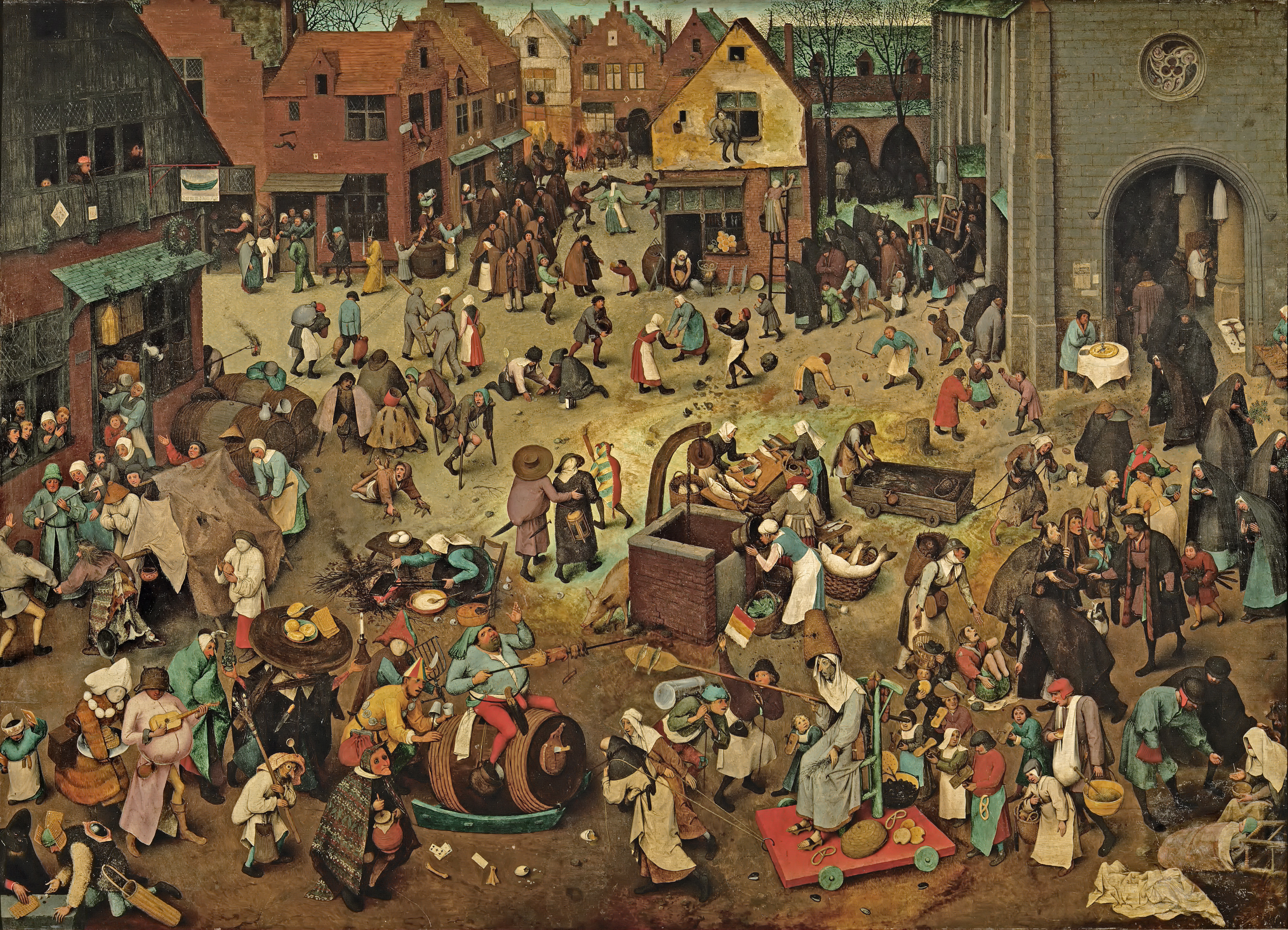
One key distinction to be made between El arte de la resurrección and a Bruegel painting, of course, is the direction, the cinematic quality of the former. If I stand looking at "The Battle between Carnival and Lent" it keeps me engaged, keeps my gaze shifting; but I am "directing" the movie by moving my gaze. Whereas here, there is clearly a cameraman showing us where to focus and what to move to the periphery. Check out this beautiful pan from the plaza to in front of the union hall, from chapter 7 -- reminds me a little of the opening shot from Heimat. The striking workers in La Piojo are waiting for their lunch, in front of the union hall:
Even from a distance one could see that chaos reigned, everything in a rambunctious disarray: a few kids, stick in hand, trying to keep at a distance the group of stray dogs that had assembled, attracted by the aroma of food, while a few well-built gaucho types were greasy with sweat, gathering and splitting wood for the fire; the group of women inside was sweating too, in their aprons cut from canvas flour sacks, their cheeks smudged with soot, they were ladling out dishes of the hot, steaming stew to the tight line of men, women, children who held out their chipped dishes, their faces long with hunger. The menu, like every day's, was a generous helping of chili beans -- one day with crushed maize, one day with peppers, which cooked on the other fire, smoking under a black skillet, seasoned with a colorful bloom of paprika.
The camera starts out away from the action, across the plaza; gradually it zooms in on the kids keeping away the stray dogs, then pans to men cutting wood (in my mental picture of this scene, the men are sort of behind the kids (vis-a-vis the pov) and a bit toward the union hall, the camera is moving across the plaza and a bit to the right) and then (continuing to the right, and swinging around) to the women cooking and to the people waiting; and the last word of the sentence is "hunger"! Then we linger lovingly on the food that's cooking, the centerpiece of this scene. (This and a passage a little later on when Christ is eating are beautiful food writing I must say -- this Rivera Letelier is extremely versatile.)
posted afternoon of November 26th, 2010: Respond
➳ More posts about The Art of Resurrection
|  |
Thursday, November 25th, 2010
An example of the kind of sentence I was mentioning loving in Arte de la resurrección is near the beginning of Chapter 6, a description the people of Providencia (not, as I initially thought, a village in Elqui Valley, but a mining company town, a "salitrera," in the Atacama -- and referred to throughout the story as La Piojo, which I am understanding as Lousy*) gathering to await the Christ of Elqui. Listen:
The women came, their heads covered in dark bandannas, rosaries in their hands, a prayerful, focused halo softening the faces of these strong women, dutiful, capable of any sacrifice for their families. The children were running with their wire hoops, their tin wagons, with the rambunctious happiness of seeing something novel in the endless tedium which was the pampa, all the world they knew of; while those few men who were idling, who were spending the siesta on the hot stones by their front doors -- for most of them were together in the union hall, or keeping watch on the factory gate for strike-breakers -- came following the women and the children to see this novelty, ganchito, a Chilean Christ preaching in the desert. Even the most skeptical, the least credulous of them -- and the mine-workers were the most skeptical, the least credulous of anyone in the pampa -- those who could not believe that this layabout, this beggar could be Christ the King, that he was divine, could perform miracles -- "This Christ of the slums has never even healed a sleepy little girl, paisita" -- even these came to look away from his footprints with the disdainful grimace of the suspicious macho tattooed on their oblong faces.
At this hallucinatory siesta hour on the pampa, the sun was a burning stone at the center of heaven.
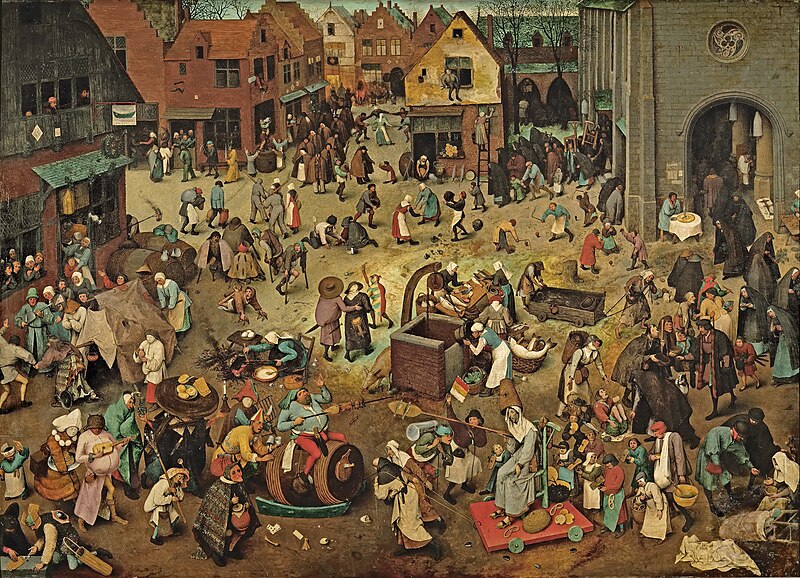
In the original the whole first paragraph is a single sentence, I could not avoid dividing it into a couple. You can spend a lot of time in front of that sentence as if it were a Bruegel, it repays multiple readings with new layers of imagery.
* Or also, I see piojo is slang in the Andes for "gambling den" -- so maybe the nickname means something like "Dive".
 I wonder a lot about how much weight I should give to cognates, to preferring English words which sound like the Spanish term they are translating, where it is feasible. This may end up statistically twisting the meaning of the text a bit as I read it. A similar caveat applies to the matter of using Spanish words in the translated text, this may need to change in a later draft... ("ganchito" in particular is a cheat; and I'm fairly sure the "look away from his footprints" passage is a mistranslation, that I don't understand the sentence as written.)
↻...done
posted evening of November 25th, 2010: Respond
➳ More posts about Hernán Rivera Letelier
| |
Monday, November 22nd, 2010
1Jesus, full of the Holy Spirit, left the Jordan and was led by the Spirit into the wilderness, 2 where for forty days he was tempted by the devil. He ate nothing during those days, and at the end of them he was hungry.
3 The devil said to him, "If you are the Son of God, tell this stone to become bread."
4 Jesus answered, "It is written: 'Man shall not live on bread alone.'"
-- Luke 4 (NIV, 2010)
After he had walked he knew not how many hours, thirst and weariness were defeating him. He thought to himself that his destination could not be so far away now. He felt he was lost. The only thing that he could do was to let himself fall onto the sand. He sat in a lotus position, his little paper sack between his legs. As always in such difficult emotional times he commenced to pick his nose. He looked about himself: it was as if he were in the dead center of a circle composed of the horizon on all sides, a circle as if it had been traced by some celestial hand, perfect, round, endless. The silence, the solitude were of such divine purity, they moved him, they were tangible. He removed his sandals. He wanted to take communion with the land.
He sat there, listening, for a long time.
Evening's flame lit the horizon. Red. Impressive. Overwhelming. It made him think of dusk, of Golgotha. His surroundings swam before his eyes into a great ring of fire. "The fiery ring of a lion-tamer," he said. He sensed suddenly, and with divine clarity, that the lion-tamer was God; he, the lion, tamed. That his master was ordering him to jump. Yes; to jump. Highest glory to the Eternal Father!
He jumped.
He closed his eyes and jumped.
-- The art of resurrection ch. 4
The art of resurrection is reminding me a bit of reading The Gospel according to Jesus Christ (and I ought to track down Saramago's take on the temptation in the desert passage...) in the degree of sympathy each author expresses for his imperfect messiah.
 Update: ...And also SFAM is getting in on the Messianic action.
posted evening of November 22nd, 2010: Respond
➳ More posts about Readings
|  |
Sunday, November 21st, 2010
In the midst of that curious crowd, the Christ of Elqui was not silent. On the contrary: with the purple taffeta of his cape broiling under the sun he stood, he turned toward the dead man. An absent, almost translucent look was on his face, like someone who is looking at a mirage in the desert. He seemed to be struggling with a deep-seated psychic dilemma. After an instant which seemed an eternity, with a histrionic wave, he looked away from the dead man; he raised both arms above his head and opened his mouth to speak, bearing infinite pain in the inflections of his voice:
— I am sorry, my brothers, but I can do nothing; the sublime art of resurrection belongs exclusively to God the Father.
But the miners had not come to hear rejection, rejection wrapped up in the celophane of pretty phrases. Surrounding him, their wiry beards almost touching him, they pleaded, they demanded, they begged him in the name of God Most Holy, o Lord Christ, at least try it. That it will cost him nothing to try. That all he need do is to place his blessed hands over the body of their friend — as they have seen him do for the infirm among them, all these days — and to recite a few ave marias or a pater noster. Or whatever he might find to say. He must know better than them which things one must say to the ancient one on high, to convince him. And who knows, perhaps God in his moment will understand, and take pity on their comrade, the best among strong working men, who has left in this vale of tears a widow, still young, and a crowd of seven little kids, imagine it, o Lord, seven children, evenly spaced, all still quite young.
— This poor kid Lazarus, his body here with us — cried one of them, turning to the deceased, laying his arms in a cross over his chest — you could say he is a countryman of yours, sir, for just like you, as we have read of you, he was born in a village of Coquimbo province.
The Christ of Elqui lifted his gaze to the eastern sky. For a moment he appeared fascinated by a far-off flock of birds, flying in slow circles above the gravel plain, flying over the dusty cement of the salitrera. Pulling at his bushy beard, thinking and rethinking what he was going to say, he spoke in an apologetic tone:
— We all know where we were born, o my brothers, but not where our bones will lie buried.
El arte de la resurrección is seeming like one of the best novels I've ever read. Do I overstate? Perhaps -- translating is a different lens through which to view the reading process, it adds a certain meta-narrative tension that is not always present (or present to varying degrees) when reading my own English. But these fantastic paragraphs are chosen practically at random from the cornucopia of the first couple of chapters that I've read so far.
The gentle, brutal good humor of the narrator's relationship with his characters and his scenes-- the switch for instance to second person when the miners address the Christ of Elqui and then quickly back to third, so there is some confusion about where the focus should lie, turns the reader's head, makes him wipe his forehead in disbelief.
posted evening of November 21st, 2010: Respond
➳ More posts about Projects
| |
Wednesday, November 17th, 2010
In all the years he had been carrying his lessons through the land, preaching his axioms, counsels and wise thoughts regarding the good of Humanity -- and declaring in passing that the Day of Judgement is at hand, repent, sinners, before it is too late -- this was the first he had ever experienced a success of such sublime profundity. And it had taken place in the dry desert of Atacama, more precisely in the wasteland of a saltpetre mining camp, the least likely setting for a miracle. And to top it off the dead man had been named Lazarus.
-- The art of resurrection
Hernán Rivera Letelier
posted evening of November 17th, 2010: Respond
| |
Sunday, November 14th, 2010
 A new story from Jorge López, a walk through his neighborhood in Santiago. A new story from Jorge López, a walk through his neighborhood in Santiago.
It all happened in Providencia
by Jorge López
On the metro, at Manuel Montt station. An old woman is having trouble trying to get off, unable to find a handhold anywhere. The train brakes and the woman steadies herself against me. I hold her up, I give her my hand. Hold on, I say. She grips my hand firmly and smiles at me. Thank you, you’re very kind. I hold her up and help her move up until she’s able to get to the exit. She again thanks me. Have a good day, I say. You too, young man.
That’s all it would have been, one event in the course of the day, if it weren’t for a voice -- grave, reproachful -- inside the train car as the doors closed.
-- That lady’s too old to be fooling anybody.
The light at the corner of Guardia Vieja and 11 de Septiembre is red; a few pedestrians are waiting to cross. I’m watching, my earphones on, a bit cut off from the world. In the few seconds of silence between the end of one song and the beginning of the next, I overhear a bit of conversation between two of them, perhaps a mother and her daughter.
-- Well, it was just that poor-person smell!
The way poverty smells. It hurts me, it moves me to hear that; what moves me the most is that I recognize it, I see its reflection in myself. I too have spoken of the odor “of poor people,†always doing an embarrassed double-take, I who work with poor people, it has nothing to do with poverty.
I’m walking along Providencia, GalerÃa Drugstore is one of those over-designed, over-priced shops. One of the customers is saying to the woman at the counter:
-- You know, I have to make so many adjustments when I come by here, I live up in La Dehesa, I never come down here...
I leave the store quickly, almost automatically.
Night is falling on a rainy day. A man on the sidewalk, a drunkard, a homeless man I’m sure, sheltered by the eaves of the Portal Lyon. It’s not unusual to see homeless around here. Today it is cold, and he is not even covered by the customary cardboard boxes. I move a bit closer and notice the smell of spilt wine. So drunk he cannot stand up, I guess. But it’s not the ordinary box wine. Shards of glass are glittering on the sidewalk, I step carefully trying to avoid them. Did he throw the bottle down after he drank the last drops? Did somebody smash the bottle against him? I don’t see any blood, he appears to be conscious, sitting, doesn’t seem to be hurt. I don’t ask him what happened, just go on my way, don’t get involved.
I’m as much to blame as anyone, only thinking of how to get home without getting wet, the few more blocks remaining, perhaps the McDonald’s on my street will still be open.
At what point did we lose our solidarity, our understanding? We shut ourselves off so coarsely from the world. When did this moment come?
posted afternoon of November 14th, 2010: 3 responses
|  |
Tuesday, November 9th, 2010
Another Saramago epigraph from El libro de los consejos -- at the front of his Small Memories is the line, "Déjate llevar por el niño que fuiste/(roughly) Allow the child you were to carry you." The first time I've been able to find a lead suggesting affirmatively that these quotations are actual quotations from somewhere else, not invented by Saramago -- this line takes me to Juan Pedro Villa-Isaza's blog
Casi un objeto, which gives some context for it:
Mientras no alcances la verdad, no podrás corregirla. Pero si no la corriges, no la alcanzarás. Mientras tanto, no te resignes.*
Déjate llevar por el niño que fuiste.
As long as you do not know the truth, you will not be able to alter it. But if you do not alter it, you will never be able to reach it. Still, do not resign yourself. Allow the child you were to carry you.
 (Also, Googling for the original Portuguese rendering of this quote "Deixa-te levar pela criança que foste" leads me to a 2006 interview with Saramago, where he talks about his life and his writing process.) ..."llevar/levar" can also mean "to lead" -- indeed that appears to be the primary meaning in Portuguese; a better rendering of this line might be "Let yourself be led by the child you were." *... and now I am remembering that this line is the epigraph for The History of the Siege of Lisbon... and am back to thinking the whole thing is Saramago's invention.
posted evening of November 9th, 2010: 2 responses
➳ More posts about Blindness
| |
Thursday, October 28th, 2010
Versos sin sentido por Jeremy Osner
Esas palabras se dicen a mà mismo
Como los ecos que vibranse entre las nubes
Pero también debéis escuchar, escuchad
al voz de vuestra Diosa propia.
Cuando vos sentÃs familiar me decid.
Vamos mañana tal vez al paisaje de nuestras ilusiones
o a una ruina postapocalÃptica similar, nos
desaparezcase la iglesia, la iglesia de los padres, la iglesia de ayer.
from Criminalby José Cárdenas Peña
If only it were just the scream
the water's scream,
the rolling stone
abandoned, with no place to lay its head
against the storm.
If only it were just
the wound, corrosive wound,
the nameless passage,
flow of dead time:
the soft procession of the hours,
sentinels of fear.
If only it were the handful of herb
the herb which mates with blood
winnowed through memory
now it can say:
it is over,
the statue, the labyrinth,
angel's shadow, world which never is.
But behind this silent
anguished nostalgia,
behind you yourself
o wounded shadow who calls me,
swells the violence
the destruction over cliffs
over conquered ragged armies, ashes, dust.
And still I know the damage,
in this moment of my hapless lineage;
this ghost or god who from my birthplace
from my rubble rises up
this dove of the final flood,
and around me your words
your tongues of fire
baptismal conch
pouring out on your mirror of drunkenness
handful of naked salt
of biblical questions:
the mud, the signal, seed of man
your voice, your name, your sorrow;
the shape of just one tear
wept out for the dead
for fallen moorish idols
blood which teaches me to feel,
who cannot catch it, fend it off
as the sky fends off his luminous abyss,
the sea her piscene stigmata.
...
posted evening of October 28th, 2010: Respond
➳ More posts about Poetry
|
Friday, October 22nd, 2010
Here is a poem by a Mexican poet named José Cárdenas Peña, "Los contados días".
This wandering groping
like I'm walking into ruins:
this turning my face to the wind
without expecting a response from the wind;
instinctive phrasing, to live and to hope
without contact:
this clamour to God,
this doubt and this love, this blasphemy;
this dread of being lonely,
of the death that is not death;
it hurts me, hurts like a wound,
like my own native land,
like an angel's wing --
like my crime, like her bleak silence...
And when at last I scream Here! Here I am!,
so cleaves in two my naked, naked heart.
I really like the rhythm of the poem in Spanish and am trying to get a similar rhythmic thing going in the translation.
 (I posted the original of this poem in the comments to a LanguageHat entry about free verse and memorization.)
posted evening of October 22nd, 2010: Respond
➳ More posts about Los contados dÃas
| Previous posts about Writing Projects
Archives  | | |
|
Drop me a line! or, sign my Guestbook.
•
Check out Ellen's writing at Patch.com.
| |