|
|
Monday, January 19th, 2009
I had my first-ever His Dark Materials-based dream last night! Can't remember it other than that it was extremely involved and plotted out in detail. I did not have a dæmon, most of the people I interacted with did, so I'm guessing I was a person from this world who had passed through into Lyra's world. (Note: Is Will's world "this world," the world of the reader? It certainly seems to be -- nothing about it seems unfamiliar, in the limited view of it we have gotten.) Many characters from the books were in the dream but interestingly they were all adult characters, where the main characters of the books are children. That reminded me of something I had been meaning to write about The Subtle Knife -- I don't remember this being the case as much in The Golden Compass* -- which is that there's just a ton of exposition. I haven't been keeping track exactly, but so far there have been at least three occasions of a character speaking for multiple pages, narrating the story-so-far to another character and, obviously, to the reader. Not sure what to make of this -- some of the narration is filling in needed plot points, some of it is confirming stuff I had already figured out from reading the book-so-far... I had a thought that maybe this was "because HDM is children's lit" -- that the intended audience won't have made all the connections, so Pullman is bringing them out explicitly. Maybe that's right, I don't know -- I'm finding it a bit of a distraction.
 * (Just remembered one instance of this in The Golden Compass -- it was integrated really nicely into the story there, where these feel a bit more patched-on.)
posted morning of January 19th, 2009: Respond
➳ More posts about His Dark Materials
|  |
Saturday, January 17th, 2009
Coincident with my interest in learning to read and understand Spanish, I find that I'm reading a little differently these past few weeks, more sensually and in a less plot-directed way. (This may also have a lot to do with What Can I Do When Everything's on Fire?, which in its strangeness has sort of knocked me for a loop...) This is nice because it makes me able to listen to recordings of spoken and sung Spanish which I understand only in a very limited sense, and get the cadences and flow without knocking myself out about the meaning. And I'm finding that I can get a similar thing going with English, of course I understand the meaning of it much better, but I can focus on the sound of the text and the visual/sensual qualities of the scene, rather than on characters and plot, which have been my main focus over the last few years. Today I started rereading Garcia Marquez' Of Love and Other Demons (tr. Edith Grossman), and this is a fantastic book for sensual reading. I'm taking it slow, reading it like poetry -- glad I picked it up. Take a look at the first paragraph for a sense of the story's lushness:
An ash-gray dog with a white blaze on its forehead burst onto the rough terrain of the market on the first Sunday in December, knocked down tables of fried food, overturned Indians' stalls and lottery kiosks, and bit four people who happened to cross its path. Three of them were black slaves. The fourth, Sierva María de Todos los Ángeles, the only child of the Marquis de Casalduero, had come there with a mulatta servant to buy a string of bells for the celebration of her twelfth birthday.
A few notes about it: The epigraph is from the supplement to Part III of Aquinas' Summa Theologica, Question 80: Article 2, which addresses whether hair and fingernails will be resurrected along with the rest of the human body. Huh, I thought as I read this, that's a strange subject -- Garcia Marquez explains in a note at the front of the text, how this book got started. In 1949, as a reporter for El Universal in Cartagena, he covered the destruction of the historic Convent of Santa Clara and the disinterment of the bodies in its graveyard. One of the bodies was a young girl's, and yards of red hair were growing from its skull -- the grave marker said "Sierva María de Todos los Ángeles," and he associated this name with a folk tale he had heard from his grandmother about a girl who died of rabies and was credited with miracles. So 45 years later, in 1994, Garcia Marquez wrote a novel about a red-haired girl of that name dying of rabies. This is an interesting take on historical fiction -- mixing history and myth/folklore freely and without apology.
 (Note that the author's note is part of the fiction, like the dedication of The White Castle -- I wonder though what part of it is true. I'm assuming with no proof that it is true except for the detail about the red hair.)
posted afternoon of January 17th, 2009: 2 responses
➳ More posts about Of Love and Other Demons
|  |
Wednesday, January 14th, 2009
Argentine author Sergio Chejfec, whose Mis dos Mundos was recommended by Enrique Vila-Matas as one of the best books he read in 2008, will be reading from the translation My Two Worlds in NYC Thursday the 29th, two weeks from tomorrow. His translator Liz Werner will also be there; this is Chejfec's first book to appear in English. The event is a party for the 10th anniversary of BOMB Magazine. If you're coming, drop me a line. (via 3%.)
 Update: A misreading -- Chejfec's translator is Margaret Carson.
posted morning of January 14th, 2009: Respond
➳ More posts about My Two Worlds
| |
Monday, January 12th, 2009
Listening to the Colombian band Musicalizando sing Neruda's poem "Plenos Poderes" is, well, fun. I'm not quite connecting with the music -- it doesn't really move me -- but the poem is just lovely and I'm glad to be able to hear it recited rather than just reading it on the page and trying to figure out the cadences for myself. And also, it's just a nice feeling to see pop musicians rooted in the literary tradition like that. I wonder (with reference to El Laberinto de la Soledad) if this is more common in Latin America than it is here. The lines Y no me canso de ir y de volver;
no me para la muerte con su piedra,
no me canso de ser y de no ser.
seem like a disavowal of his earlier Sucede que me canso de ser hombre. (from "Walking Around"). I suppose without knowing, this might be connected to the political situations of the times when he wrote these two poems. The lines from "Plenos Poderes" work nicely as a response to Hamlet's question.More Neruda-based pop music below the fold.
posted evening of January 12th, 2009: 5 responses
➳ More posts about Pablo Neruda
|  |
|
The bolano-l mailing list is hosting a group read of 2666, starting today. I'm sitting this one out, but if you're meaning to read the book I'm guessing this will be a very useful resource. (via The Howling Fantods.)
posted afternoon of January 12th, 2009: Respond
➳ More posts about Roberto Bolaño
|  |
Sunday, January 11th, 2009
There seems to be a lot written about translating Neruda's poetry. Here are a couple of things I've found this morning.
posted morning of January 11th, 2009: Respond
| |
Saturday, January 10th, 2009
So on the one hand I feel like who am I to criticize Reid's translations -- he surely knew Spanish better than I and was more familiar than I with the literature he was translating. Still I'm seeing a lot of lines in Neruda's poems that look poorly translated to my eye. But one in particular is kind of knocking me for a loop, because it just seems wrong, in a very basic and easy way. From "El desnudo": Esta raya es el Sur que corre,
este círculo es el Oeste is translated asThis ray is the running sun,
this circle is the East when obviously the ray is "the South which runs" and the circle is "the West" -- why would you change "the South" to "the sun" and lose the parallelism between these two lines? Why would you make the West into the East? I'm missing something, or else this is just a botched job.
posted afternoon of January 10th, 2009: 3 responses
➳ More posts about Translation
|  |
|
The poems in Fully Empowered are kind of perfect for me to read in Spanish -- short stanzas, short lines, so I can hold them in my head while I go over Reid's translation and back over the original. And lots of repetition of words, so I can maybe get some of them into my vocabulary -- building vocabulary has always been the most difficult part of language study for me. The repetitions seem meaningful -- certain words occur in almost every poem, like "línea" (in various senses), "caer" (in various forms), words relating to the water like "mar," "océan," "ola," "espuma,"... There are also frequent references to geography and geometry, to birds, 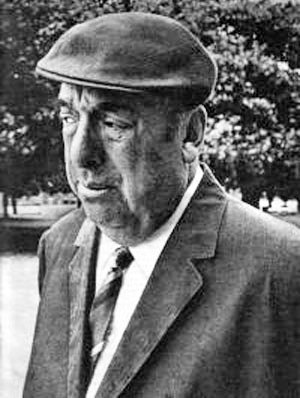 to movement, to towers... I haven't quite put all this together yet -- the references to water make me think about Neruda being Chilean, seems like the ocean must be a pretty important part of life in Chile. (Jorge, can you speak to this?) The many repetitions of "línea" are making me think about geometry and language and again, the sea, and tying them together. to movement, to towers... I haven't quite put all this together yet -- the references to water make me think about Neruda being Chilean, seems like the ocean must be a pretty important part of life in Chile. (Jorge, can you speak to this?) The many repetitions of "línea" are making me think about geometry and language and again, the sea, and tying them together. I just love the rhythm of this passage, which totally does not come through in the translation; I haven't been able to make a lot of sense of the passage, with or without the translation, but the sound of it is wonderful. From the second stanza of "Pájaro":
Cuando volví de tantos viajes
me quedó suspendido y verde
entre el sol y la geografía:
vi cómo trabajan las alas,
cómo se transmite el perfume
por un telégrafo emplumado
y desde arriba vi el camino,
los manantiales, las tejas,
los pescadores a pescar,
los pantalones de la espuma,
todo desde mi cielo verde.
posted afternoon of January 10th, 2009: 2 responses
➳ More posts about Writing Projects
| |
|
Looking through Ellen's old poetry books I am glad to find a bilingual edition of Pablo Neruda's poetry, Fully Empowered. (Translations are by Alastair Reid, and I'm making a note to myself to look up this guy whose name is on much of the mid-century Latin American literature that interests me.) Take a look at the first stanza of the first poem in the book.
Deber del poeta
A quien no escucha el mar en este viernes
por la mañana, a quien adentro de algo,
casa, oficina, fábrica o mujer,
o calle o mina o seco calabozo:
a éste yo acudo y sin hablar ni ver
llego y abro la puerta del encierro
y un sin fin se oye vago en la insistencia
un largo trueno roto se encadena
al peso del planeta y de la espuma,
surgen los rÃos roncos del océano,
vibra veloz en su rosal la estrella
y el mar palpita, muere y continúa.
| |
The Poet's Obligation
To whoever is not listening to the sea
this Friday morning, to whoever is cooped up
in house or office, factory or woman
or street or mine or dry prison cell,
to him I come, and without speaking or looking
I arrive and open the door of his prison,
and a vibration starts up, vague and insistent,
a long rumble of thunder adds itself
to the weight of the planet and the foam,
the groaning rivers of the ocean rise,
the star vibrates quickly in its corona
and the sea beats, dies, and goes on beating.
|
 A couple things -- why does Neruda say "casa, oficina, fábrica o mujer" -- is he meaning a woman is something to keep you cooped up like a house or a factory? This sounds sexist in a pretty retrograde tone which is not something I'd expect from Neruda; but then I don't really know that much about him -- think of him vaguely as progressive, which I take to imply egalitarian. "Adentro de... mujer" leads me to think of a fetus but I'm pretty sure that is not who the poem is addressed to... In the phrase "un sin fin se oye" is "un" a pronoun -- is this literally "something hears itself endlessly" -- I had thought "un" could only be an article, is this a poetic usage? This is beautiful imagery; but I don't think I can read it closely enough in the translation to realy appreciate it -- I expect this is a failing more of my own reading than of the translation. I'm really happy to have read the observation (I think I read it first from Daniel Hahn; I've seen it referenced several places since then, most recently by Katherine Silver, so maybe it is a commonplace) that translation is a form of reading closely -- this is opening up a new understanding of how to read closely for me.
posted afternoon of January 10th, 2009: Respond
➳ More posts about Ellen
| |
Tuesday, January 6th, 2009
So she flew on, never losing sight of the angels, and gradually as she came closer they took on a clearer shape.They shone not as if they were burning but as if, wherever they were and however dark the night, sunlight was shining on them. They were like humans, but winged, and much taller; and, as they were naked, the witch could see that three of them were male, two female. ...  Ruta Skadi was four hundred and sixteen years old, with all the pride and knowledge of an adult witch queen. She was wiser by far than any short-lived human, but she had not the slightest idea of how like a child she seemed beside these ancient beings. Nor did she know... that she saw them as human-formed only because her eyes expected to. If she were to perceive their true form, they would seem more like architecture than organism, like huge structures composed of intelligence and feeling.
For some reason I am finding this description of the angels very satisfying. I can picture them very clearly in my mind. (And as I was writing this, I realized the image I am picturing is the stone faces of Igor Mitoraj.)Here is a minor thing that has been bugging me about the setup of the worlds in His Dark Materials. Clearly various languages exist, and a similar set of languages exists across the parallel universes, at least those few we have seen. But Lyra doesn't seem to have encountered anybody yet she could not speak to in English. So okay: let's say (a) witches and (b) bears are both non-human, so maybe they are communicating with Lyra via some kind of extra-linguistic mechanism that just seems to be speech; or more simply and implausibly, that witches and bears speak English. And I guess it's reasonable that all the humans Lyra interacted with in the first book could have known English. But the place where Lyra and Will meet is clearly parallel-world Italy, with Italian place names and everything. So at this point you have to just say ok, well the structure of the book demands that everybody speaks English; that's fine, I'll go along with that. But! Joachim Lorenz threw a huge monkey wrench into that psychic construct on p. 135, when he referred to a building as "the Torre degli Angeli, the Tower of the Angels" and to a city as "Cittàgazze. The city of magpies." -- I found this extremely annoying because it indicates that Joachim knows the place names are in a different language than he's speaking in. Well anyway, not a huge deal or anything. End rant.
posted evening of January 6th, 2009: Respond
| Previous posts about Readings
Archives  | |
|
Drop me a line! or, sign my Guestbook.
•
Check out Ellen's writing at Patch.com.
| |